Tire pressure parameters

Disclaimer: Links on this page pointing to Amazon, eBay and other sites may include affiliate code. If you click them and make a purchase, we may earn a small commission.

Landryland83

Member
Joined
Nov 27, 2024
Posts
7
Reaction score
3
Location
Lafayette
I recently brought my 2022 expedition into ford for the 40k mile service. When I picked the it up I noticed it was alot more stiff of a ride. They took the liberty to air up all the tires(BFG KO3s) to 45psi. When I got home I let the air out to 34psi which is what I normally run. Now all my sensors are lit on dash saying low tire pressure.

I run 32 psi in my toyos on my f150 and dont get any low pressure indicator.

Is there a way to set this parameter? Or is there a way to reset the low tire pressure indicator on the 2022 expedition so that my service light will go off??

Thanks!
 

Mack444

Well-Known Member
Joined
Mar 5, 2023
Posts
72
Reaction score
63
Location
CA
I run my KO3s at ~34 with no issues. Maybe driving it awhile will reset it? Strange…
 

DieselMonk

Full Access Members
Joined
Dec 29, 2024
Posts
592
Reaction score
339
Location
Atlantic Canada
The TPMS should not light up if a tire is a bit under inflated. I am thinking you let the air too fast out and this triggers the TPMS. So inflate your tires to 38 or 40 PSI and drive around make sure the TPMS is happy. Then air down slowly and drive around again and you should be golden.
 

SyndicateZ

Full Access Members
Joined
Nov 11, 2022
Posts
1,022
Reaction score
708
Location
Mass
I recently brought my 2022 expedition into ford for the 40k mile service. When I picked the it up I noticed it was alot more stiff of a ride. They took the liberty to air up all the tires(BFG KO3s) to 45psi. When I got home I let the air out to 34psi which is what I normally run. Now all my sensors are lit on dash saying low tire pressure.

I run 32 psi in my toyos on my f150 and dont get any low pressure indicator.

Is there a way to set this parameter? Or is there a way to reset the low tire pressure indicator on the 2022 expedition so that my service light will go off??

Thanks!
Forscan I believe can set the low range
 

Mr Big

Full Access Members
Joined
May 29, 2023
Posts
1,003
Reaction score
586
Location
Tampa Bay, Florida USA
You should run the air pressure at the specs of the tires. I run my Michelins on my Expedition at 45 to 50psi. I don't have any roughness because the defenders give such a great ride.
 

tominwi

Full Access Members
Joined
Dec 26, 2024
Posts
138
Reaction score
60
Location
Up North
You should run the air pressure at the specs of the tires. I run my Michelins on my Expedition at 45 to 50psi. I don't have any roughness because the defenders give such a great ride.
Say what? My door sticker says "35 PSI" all the way around for my Goodyear Wrangler 265/70R18 116T. I would normally run them a couple PSI more but... to tire specs?
 

cptbligh

Active Member
Joined
Dec 27, 2021
Posts
25
Reaction score
24
Location
GA
You should run the air pressure at the specs of the tires. I run my Michelins on my Expedition at 45 to 50psi. I don't have any roughness because the defenders give such a great ride.
The spec on the tire sidewall is the maximum cold pressure they are rated for. It's not what you're supposed to run them at normally. o_O

ETA According to the Toyo chart an LT tire needs around 5 psi more than a stock P metric tire for the same load rating
 
Last edited:

Eddie Hudson

Member
Joined
Jun 21, 2014
Posts
16
Reaction score
8
Location
NYC
I recently brought my 2022 expedition into ford for the 40k mile service. When I picked the it up I noticed it was alot more stiff of a ride. They took the liberty to air up all the tires(BFG KO3s) to 45psi. When I got home I let the air out to 34psi which is what I normally run. Now all my sensors are lit on dash saying low tire pressure.
Check your tire pressures cold, I bet they're lower than 34psi.
 

Fizzy

Full Access Members
Joined
Dec 18, 2020
Posts
443
Reaction score
321
Location
Alberta, Canada
You should run the air pressure at the specs of the tires. I run my Michelins on my Expedition at 45 to 50psi. I don't have any roughness because the defenders give such a great ride.

As mentioned already... the max PSI on the tire sidewall is exactly that... the safe MAX PSI, not the recommended... You are absolutely driving around with drastically overinflated tires.
 

tominwi

Full Access Members
Joined
Dec 26, 2024
Posts
138
Reaction score
60
Location
Up North
It has always been my understanding that the door sticker PSI is what the manufacturer of the vehicle recommends for optimal handling safety and ride quality. I have typically run most of our vehicles a PSI or two above "recommended" because we are not aggressive drivers and I always want the least rolling resistance thus best fuel economy.

I guess I should ask here: Does anyone know for a 4th gen 2024 vehicle as mine, at what lower PSI will the TPMS system activate and warn me a tire is low?
 

Fizzy

Full Access Members
Joined
Dec 18, 2020
Posts
443
Reaction score
321
Location
Alberta, Canada
It has always been my understanding that the door sticker PSI is what the manufacturer of the vehicle recommends for optimal handling safety and ride quality. I have typically run most of our vehicles a PSI or two above "recommended" because we are not aggressive drivers and I always want the least rolling resistance thus best fuel economy.

I guess I should ask here: Does anyone know for a 4th gen 2024 vehicle as mine, at what lower PSI will the TPMS system activate and warn me a tire is low?

That's only true if you are running the same dimension tires and rims the truck came with. If you sized up or down, changed to a non-standard rolling diameter etc, that sticker is meaningless and you need to find out what the new correct PSI is.

If you went with another standard size (same rolling diameter) such as I did for my winters (22" down to 20"), I got the correct new tire sizes for the 20" to maintain the rolling diameter. Then I looked up the 20" PSI on the Ford website.

If you put on some crazy 33" mud tires, it's anyone's guess.
 

jar0023

Member
Joined
Jun 18, 2021
Posts
24
Reaction score
19
Location
MS
There is a procedure for resetting each sensor to its location after tire rotation. Given I own multiple other vehicles that let you reset the base “correct “ psi I’d assume Ford may do this as well. IIRC with my 18 you turn hazards off/on in a specific pattern.

I run 35 psi with 275/65r18. If I had 20” or 22” wheels it may be different.
 

Meeker

Full Access Members
Joined
Apr 3, 2016
Posts
296
Reaction score
180
Location
Calgary, AB, Canada
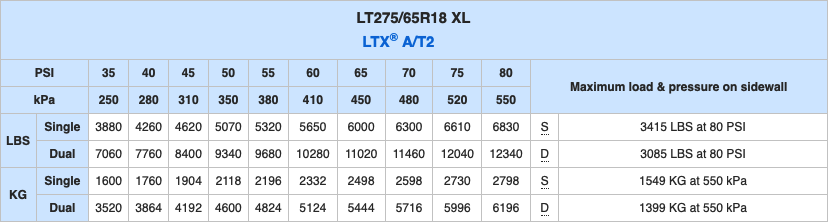
When I switched from P to LT tires, I found this chart (Michelin LTX A/T2 - same size as the original P tires):
1738696227984.png

This shows what the minimum pressure needs to be for a given load (and vice versa). So to carry my GVWR/payload, I have to bump up the pressure to 44 psi (being a bit conservative - front actually a bit lower). With my trailer I run 55 rear/50 front to limit sway. It does ride rougher with no trailer so I drop them again when not towing.

Also refer to this: https://tirepressure.com/tire-pressure-calculator

As usual, things aren't as simple as we want them to be...
 

tominwi

Full Access Members
Joined
Dec 26, 2024
Posts
138
Reaction score
60
Location
Up North
As usual, things aren't as simple as we want them to be...
Yeah you said a mouthful there. Presumably my door sticker has the recommended PSI for my truck and tires, but I have yet to find any easy answers in re: whether to alter these once I've connected my new travel trailer. I would assume that I might want/need to up my Timberline's tire PSIs when I have my truck loaded with passengers and etc. and then also the tongue weight of my loaded trailer.

If it's not as simple as "if you're within the weight guidelines for yr truck then leave the PSIs alone" then it might be nice to have some sort of calculator to allow one to input all the numbers and have it recommend a PSI for the tires.

I did BTW find this for my trailer tires...

1738770533043.png

FWIW I am not an inexperienced driver having also owned a Class C RV in the past, but apart from pulling a couple of utility trailers i.e. eight-foot and sixteen-foot a few times (and with a different tow vehicle), I am new to this Travel Trailer RV thing (24-foot long, 10' 7" high, seven feet wide) and find the prospect somewhat intimidating to be honest. Have never forgotten seeing a jackknifed truck-with-travel-trailer on a highway in TX years ago.
 

Fizzy

Full Access Members
Joined
Dec 18, 2020
Posts
443
Reaction score
321
Location
Alberta, Canada
FWIW I am not an inexperienced driver having also owned a Class C RV in the past, but apart from pulling a couple of utility trailers i.e. eight-foot and sixteen-foot a few times (and with a different tow vehicle), I am new to this Travel Trailer RV thing (24-foot long, 10' 7" high, seven feet wide) and find the prospect somewhat intimidating to be honest. Have never forgotten seeing a jackknifed truck-with-travel-trailer on a highway in TX years ago.

I pull a 33ft / 11ft / 8 ft travel trailer with our 2020 HD Tow up and down the Rocky mountains all summer, and I've never adjusted the tire PSI when towing. Never had problems either. The rear tires do not look squished or flat. We do have a weight distributing hitch though, that transfers that weight forward in the vehicle. Maybe that helps.

What matters far more, for your jacknifed truck scenario, is how you've loaded the weight throughout the trailer. You need the trailer to be noseweight heavy - not tailweight. It's the reason travel trailer manufacturers put the storage passthroughs, 12v battery, propane tanks etc at the front.

This video demonstrates far better than I can describe in words:
 

GlennSullivan

Full Access Members
Joined
Jul 3, 2021
Posts
1,095
Reaction score
705
Location
NY & FL
Yeah you said a mouthful there. Presumably my door sticker has the recommended PSI for my truck and tires, but I have yet to find any easy answers in re: whether to alter these once I've connected my new travel trailer. I would assume that I might want/need to up my Timberline's tire PSIs when I have my truck loaded with passengers and etc. and then also the tongue weight of my loaded trailer.

If it's not as simple as "if you're within the weight guidelines for yr truck then leave the PSIs alone" then it might be nice to have some sort of calculator to allow one to input all the numbers and have it recommend a PSI for the tires.

I did BTW find this for my trailer tires...

View attachment 83598

FWIW I am not an inexperienced driver having also owned a Class C RV in the past, but apart from pulling a couple of utility trailers i.e. eight-foot and sixteen-foot a few times (and with a different tow vehicle), I am new to this Travel Trailer RV thing (24-foot long, 10' 7" high, seven feet wide) and find the prospect somewhat intimidating to be honest. Have never forgotten seeing a jackknifed truck-with-travel-trailer on a highway in TX years ago.
Trailer tires are a different animal than vehicle tires. My dual axle Featherlite car trailer (7000lb GVW) came with / has the same tires as you have highlighted above and the trailer manufacturer's sticker on the trailer lists the recommended (not max) tire pressure at 65psi, which is where I run them.

I have the Michelin Defender 275/55/R20 on both of my Expeditions. I set tire pressure at 38PSI unless towing or heavily loaded, then I increase the rears to 40PSI. Max pressure for this tire per the sidewall is 44PSI

To Answer the OP: Dropping tire pressure by 10lbs as you did could trigger a TPMS alarm. Drive the car a few miles and see if it resets. To my understanding the low pressure alarm should not trigger unless tire pressure drops below 28psi. Not sure if the dealer might have reset the low pressure alarm setpoint - they should not deviate from the factory settings. The other possible explanation is you have a faulty TPMS sensor that isn't reading the correct pressure, it may be seeing 28 when the tire is actually 34. When you had the tires at 45, it could have been reading 39 and not throwing an alarm.
 

Ugh_J

Full Access Members
Joined
Jul 24, 2023
Posts
146
Reaction score
104
Location
Texas, USA
I'll chime in here to hopefully provide some clarity.

My uncle was a design mechanical engineer at Michelin for a few decades. His statement when I asked about pressures was this: pressure for a given load is linear between 0psi/0load and the sidewall's max PSI at max load. Plot a line between 0/0 and max/max and then go weigh your vehicle per axle. The correct pressure will be whatever the weight point on that axle divided by 2 correlates to. You will have to weigh it under multiple conditions to get it perfect. Towing a trailer, loading up the family for Christmas vacation, and all that will obviously change the axle loads, which changes the pressure requirements.

That's it. That's the formula.
 

ROBERT BONNER

Full Access Members
Joined
Apr 2, 2021
Posts
296
Reaction score
334
Location
Denver, NC
I'll chime in here to hopefully provide some clarity.

My uncle was a design mechanical engineer at Michelin for a few decades. His statement when I asked about pressures was this: pressure for a given load is linear between 0psi/0load and the sidewall's max PSI at max load. Plot a line between 0/0 and max/max and then go weigh your vehicle per axle. The correct pressure will be whatever the weight point on that axle divided by 2 correlates to. You will have to weigh it under multiple conditions to get it perfect. Towing a trailer, loading up the family for Christmas vacation, and all that will obviously change the axle loads, which changes the pressure requirements.

That's it. That's the formula.
And the most important thing Ugh stated is "...go weigh your vehicle per axle". And I'll add that if you are exceeding your GAWR (most likely rear), regardless of what the tires will or will not support, you are off the reservation from a brake and handling standpoint. These are light vehicles made for light towing. There are a lot of trailers out there that might advertise that they are within the tow capacity of your Expedition; but, once you load your vehicle with gas, luggage, people, dogs, cats, surf boards, etc., then hook up your two axle travel trailer full of gear, batteries, propane, etc.....you will be surprised how far over your rear GAWR you are. Personally, I've been right on the line with Boy Scouts and gear and NOTHING on the receiver. I hate to be a buzz kill....but, if you're doing a lot of towing of things other than small boats, and utility trailers...you need to step up to a Super Duty.
 

tominwi

Full Access Members
Joined
Dec 26, 2024
Posts
138
Reaction score
60
Location
Up North
Great info. I've been thinking to get a scale to measure my trailer's tongue weight, but how do you "weigh your vehicle per axle"???
 

tominwi

Full Access Members
Joined
Dec 26, 2024
Posts
138
Reaction score
60
Location
Up North
I pull a 33ft / 11ft / 8 ft travel trailer with our 2020 HD Tow up and down the Rocky mountains all summer, and I've never adjusted the tire PSI when towing. Never had problems either. The rear tires do not look squished or flat. We do have a weight distributing hitch though, that transfers that weight forward in the vehicle. Maybe that helps.

What matters far more, for your jacknifed truck scenario, is how you've loaded the weight throughout the trailer. You need the trailer to be noseweight heavy - not tailweight. It's the reason travel trailer manufacturers put the storage passthroughs, 12v battery, propane tanks etc at the front.

This video demonstrates far better than I can describe in words:
My trailer purchase includes a weight-distributing anti-sway hitch from Blue Ox, and the trailer itself appears to be forward-loaded not only with LP tanks and batteries, but also the head is up there and so I expect the fresh/gray/black water tanks are up there too. My trailer has it's spare tire clamped to the rear bumper, and when we take delivery I am gonna look to see if it might be possible to move it to the trailer yoke up-front somehow.

Otherwise astern of the trailer is the queen bed and a full side-to-side storage compartment. Should be relatively light in weight when we're moving I would think.
 
Top