

Fuel Economy Decreasing

Disclaimer: Links on this page pointing to Amazon, eBay and other sites may include affiliate code. If you click them and make a purchase, we may earn a small commission.

FordandPolaris

Full Access Members
Joined
Feb 7, 2012
Posts
2,246
Reaction score
265
Location
Saint Cloud, MN
So I have noticed recently that my fuel efficiency is going the wrong way. Used to get around 11 mpg's through the city, but the last few months it has been more in the high 8 low 9's. I am slowly changing out spark plugs and COP's as they go bad, but otherwise the truck runs just fine. I am wondering if bad O2 sensors could cause this? They have been throwing a code for like a year now, but they have been low on the priority list of things to repair. Also the codes came up long before my fuel efficiency issue. If anyone else has ideas on what could cause a decrease in mpg's I would appreciate the advice, thank in advance!

 

toms89

technical advisor
Joined
Mar 13, 2011
Posts
5,173
Reaction score
442
Location
MD
Yes bad O2 sensor(s) can cause a loss in fuel economy. If the pcm has determined they have failed or reading incorrectly it will stay in open loop and its programmed to run rich to be on the safe side.

As O2 sensors go bad they become less responsive and I believe they generally read lean which will cause the pcm to compensate by adding fuel.
 
Last edited:

1997SCEBFEX

Full Access Members
Joined
Nov 5, 2011
Posts
1,262
Reaction score
114
Location
Northwest Panhandle
Yes bad O2 sensor(s) can cause a loss in fuel economy. If the pcm has determined they have failed or reading incorrectly it will stay in open loop and its programmed to run rich to be on the safe side.

As O2 sensors go bad they become less responsive and I believe they generally read lean which will cause the pcm to compensate by adding fuel.

+1 on this. would also inquire as to where you purchase fuel, same or varied locations/dealers, and if you use any additives etc due to the E10 issues. these could contribute too, but as Tom said, the 02 sensors will def contribute to decreased mpg.
 

Whack

Full Access Members
Joined
Jul 6, 2012
Posts
123
Reaction score
9
Location
St Louis
+1 on the O2 sensor stuff...


Saint Cloud, MN?

How cold is it getting there? Are they using a crazy winter mix gas?

Sometimes the winter mix can lower MPG, and the colder it gets the weirder it seems to be.
 

whowey

Full Access Members
Joined
Nov 3, 2012
Posts
106
Reaction score
9
Location
Illinois
Winter fuel. I've lost almost 6/10ths off my last MPG check due to the winter fuel blends.
 
OP
OP
FordandPolaris

FordandPolaris

Full Access Members
Joined
Feb 7, 2012
Posts
2,246
Reaction score
265
Location
Saint Cloud, MN
Yeah I have lost 2 mpg's since the summer. Seems a lot to blame on winter blend alone. Also I buy gas a varying locations. Its been cold though haha. Woke up on tuesday to go to work and it was -17. The truck surprisingly started, but the gear shift was all stiff cause of the cold. I will start with the O2's.
 

flyin

Full Access Members
Joined
Jun 27, 2011
Posts
92
Reaction score
1
Location
WI
When it is very cold nothing wants to move or turn. Gear oil and grease resist movement. Try pushing a cold vehicle. They don't want to move. Not to mention warm up time.
 

toms89

technical advisor
Joined
Mar 13, 2011
Posts
5,173
Reaction score
442
Location
MD
When it is very cold nothing wants to move or turn. Gear oil and grease resist movement. Try pushing a cold vehicle. They don't want to move. Not to mention warm up time.

Mine does. Seems like the motor wants to jump out of the engine bay soon as I tip into the throttle. Loves the cold dry air!!! (high air density)

:))
 
Last edited:

DF5.4

Full Access Members
Joined
Mar 18, 2011
Posts
455
Reaction score
83
Location
Hilton, NY
Mine does. Seems like the motor wants to jump out of the engine bay soon as I tip into the throttle. Loves the cold dry air!!! (high air density)

:))

Cold, dry air = more O2. More O2 needs more fuel to be mixed properly. It would be interesting to see if there is any study that shows how much of a change air temp/quality makes in fuel consumption.
 

toms89

technical advisor
Joined
Mar 13, 2011
Posts
5,173
Reaction score
442
Location
MD
Cold, dry air = more O2. More O2 needs more fuel to be mixed properly. It would be interesting to see if there is any study that shows how much of a change air temp/quality makes in fuel consumption.

Yes more O2 molecules per volume of air but this does not equal more fuel consumption. You control the throttle and it makes more power thus requires less throttle input. The pcm uses mass of the air to determine fuel demand, load, idle , etc.. not volume. Now if you like to drive w.o.t. regardless, the potential to burn more fuel is obviously there. :)

I would even venture to say the motor is more efficient when cold out if all other conditions are equal. I say this because the intake runners, plenum, etc... can flow a given volume of air at a specific pressure. So as the air density goes up it is actually getting more burnable O2 per volume of flow thus the system flows more efficiently. I doubt it would be significant enough to measure.
 
Last edited:

rburch

Full Access Members
Joined
Jun 10, 2010
Posts
1,432
Reaction score
10
Location
Independence, Mo
With MAF it basically uses a table to come up with fuel calculations.

There are 2 parts to the equation, the first is the MAF its self which just measures the volume of air being sucked in by the engine. The second part is air intake temp, which measures the temp of the air the engine is getting. So @ 70 deg and 400 cfm the engine would need x amount of fuel, which would be x amount of duty cycle on each injector (Duty cycle is what time and how long the injector is working)

Technically the cooler the air coming in the more fuel the engine would need to complete the combustion cycle because cooler air is denser there for has more O2 which there for makes more power. But it usually isnt enough to calculate/change the mpg since because it is canceled out by the efficiency of the engine and powertrain.

This is why our trucks run so sluggish when its hot and humid! Less 02 and more water in the air which causes a richer mixture and less power because of less 02 and more water that in turn causes a decrease in mpg.
 

toms89

technical advisor
Joined
Mar 13, 2011
Posts
5,173
Reaction score
442
Location
MD
With MAF it basically uses a table to come up with fuel calculations.

There are 2 parts to the equation, the first is the MAF its self which just measures the volume of air being sucked in by the engine. The second part is air intake temp, which measures the temp of the air the engine is getting. So @ 70 deg and 400 cfm the engine would need x amount of fuel, which would be x amount of duty cycle on each injector (Duty cycle is what time and how long the injector is working)

Technically the cooler the air coming in the more fuel the engine would need to complete the combustion cycle because cooler air is denser there for has more O2 which there for makes more power. But it usually isnt enough to calculate/change the mpg since because it is canceled out by the efficiency of the engine and powertrain.

This is why our trucks run so sluggish when its hot and humid! Less 02 and more water in the air which causes a richer mixture and less power because of less 02 and more water that in turn causes a decrease in mpg.

This is not the case. For a brief period of time they used vane air sensor which measured volume. They now use mass air sensor. It heats an element up to a specific temperature and the voltage required to maintain that temperature is used to determine the air mass in pounds per second (weight). The IAT sensor is primarily used to adjust the timing. Hotter air is much more likely to detonate and it pulls timing the hotter the intake air gets. This is also why those that do a lighting conversion need to mount there IAT into the intake manifold. The blower outlet temps are much more critical for ignition timing.

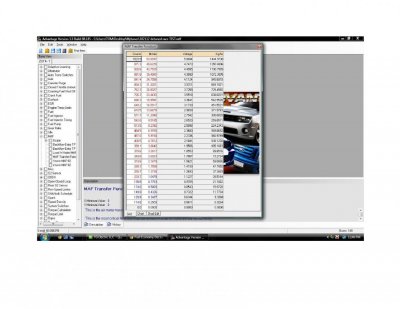
I will attempt to copy and post some items from my tune.
 
Last edited:

toms89

technical advisor
Joined
Mar 13, 2011
Posts
5,173
Reaction score
442
Location
MD
Edited: Finally figured a way to get it here.
 

Attachments

  • SCT tunepage-page-001.jpg
    SCT tunepage-page-001.jpg
    91.3 KB · Views: 38
Last edited:

rburch

Full Access Members
Joined
Jun 10, 2010
Posts
1,432
Reaction score
10
Location
Independence, Mo
I wasnt sure exactly how it works, it was just for example for the laymen. I figured it was a close enough example. So its by weight in grams, thats a big number lol! But the AIT is still a key part in the fuel trim!
 

rburch

Full Access Members
Joined
Jun 10, 2010
Posts
1,432
Reaction score
10
Location
Independence, Mo
I was wrong about the hot air it would actually pull fuel to prevent detonation and timing also.
 

toms89

technical advisor
Joined
Mar 13, 2011
Posts
5,173
Reaction score
442
Location
MD
I wasnt sure exactly how it works, it was just for example for the laymen. I figured it was a close enough example. So its by weight in grams, thats a big number lol! But the AIT is still a key part in the fuel trim!
Its primarily timing with IAT!! The air density alone will have big impact on power because it effects the "breathing" of the motor. It really has nothing to do with changing air/fuel ratios. The pcm really does not change the air/fuel ratio based on air temps. If you install a wideband O2 sensor on your expy you would quickly find this out. Reads the same in the summer heat as it does in artic air. This is the biggest advantage of efi vs old school carbs. Hot, cold, high altitude, low altitude, rainy, dry, it runs consistent air fuel ratios. Try that with a carb.


I was wrong about the hot air it would actually pull fuel to prevent detonation and timing also.

Never heard this. Supercharged vehicles are tuned richer than N.A. to help ward off detonation. If you pull all fuel you would be ok but there would also be no power.
 
Last edited:

rburch

Full Access Members
Joined
Jun 10, 2010
Posts
1,432
Reaction score
10
Location
Independence, Mo
I was talking about na not in your case but as related to fordandpolaris post.

Not trying to argue with you or discredit you in anyway i know you know what your talking about. Ive been out of the seen for a while so dont know a whole lot about the new stuff.

So do our trucks look at a table when in open loop and a ratio (14.7:1) when in close loop? Im a former DSMer and this is how the ecu works on them.

Also with Eclipses, AIT is a BIG factor in A/F! The timing on these is adjusted by the ecm according to the rpm & MAF reading! More air means more timing!
 
Last edited:
Top