Supercharged Expedition needs help!

Disclaimer: Links on this page pointing to Amazon, eBay and other sites may include affiliate code. If you click them and make a purchase, we may earn a small commission.

signdoctor

Member
Joined
Feb 20, 2012
Posts
22
Reaction score
0
Location
Robbinsville, NC
Okay, I'm back with all new problems! A brief history: I have installed a 2003 F150 Lightning motor into a 1997 Expedition 4X4. Upon start up the first time many months ago it ran like it had cams in it and would not build any vacuum unless revved. I have since taken it back apart from the intake up. Compression test on motor says 165 across the board and the needle on the gauge looked good. Pulled valve cover and verified that it does not have after market cams. Reassembled the top end with all new gaskets and some Indian head gasket shellac. Tested all vacuum lines with air compressor and have verified the vacuum line on the back of the intake is in place. Installed new O2 sensors just in case. Used computer and wire harness from Expedition and had a tune written by Mike at More Power Tuning. Stock pulley's. At this point I am running out of ideas about why, after all that, it runs the exact same way. No change at all. Any thoughts to add to my own would be greatly appreciated, again.
 

toms89

technical advisor
Joined
Mar 13, 2011
Posts
5,173
Reaction score
442
Location
MD
Okay, I'm back with all new problems! A brief history: I have installed a 2003 F150 Lightning motor into a 1997 Expedition 4X4. Upon start up the first time many months ago it ran like it had cams in it and would not build any vacuum unless revved. I have since taken it back apart from the intake up. Compression test on motor says 165 across the board and the needle on the gauge looked good. Pulled valve cover and verified that it does not have after market cams. Reassembled the top end with all new gaskets and some Indian head gasket shellac. Tested all vacuum lines with air compressor and have verified the vacuum line on the back of the intake is in place. Installed new O2 sensors just in case. Used computer and wire harness from Expedition and had a tune written by Mike at More Power Tuning. Stock pulley's. At this point I am running out of ideas about why, after all that, it runs the exact same way. No change at all. Any thoughts to add to my own would be greatly appreciated, again.

I know we had discussed this some back initially when you completed your build. Just don't know what exactly what was said now.

What are your vacuum readings at idle?? Does it idle rich, lean or unknown?
Ignition timing at idle?? Is it possible your cats are shot building up back pressure?

On to the vacuum lines.....

What do you mean you verified the vacuum on the back of the intake is in place? Are you talking about the lower intake or "turkey pan" 90?

Theoritically this line has a restricter in it and "T"'s off with the pcv valve in the valve cover and upper plenum (rear). This line is strictly for use with the pvc system. I really believe the sole purpose of the turkey pan line is to "purge" oil from the lower intake when boost is present but I am just speculating. I can explain why I believe so if your the least bit interested.

If you happen to be using the pcv lines in addition to breathers you will have a major vacuum leak.

The vacuum lines on the drivers side are also boost reference as they are below the blower. These should be used for the fuel pressure regulator and boost gauge.

I have all other vacuum lines to the vacuum port on the upper plenum (front) This includes the boost bypass valve. The line running to the boost bypass valve runs to the top half of it. I left the bottom line on the boost bypass valve open but it can run to the intake just behind the mass air.

The boost bypass valve should be fully opened with vacuum (throttle closed) and you should be able to confirm if the solenoid is pulling the bypass lever to the full up position. This is critical otherwise the blower will be attempting to make boost while your at closed throttle.

One line from the elbow between the throttle body and mass air sensor runs to the IAC valve. The other to the drivers side valve cover and used for fresh air supply for the pcv system. If you have a breather installed in addition to this line you will have a source of unmetered air entering motor which would make for a tuning nightmare that would be impossible to get correct.

Just a few items you can go through..

Edit: I sent you a PM if you wish to discuss.

 
Last edited:

Goats

Full Access Members
Joined
Jul 3, 2013
Posts
101
Reaction score
10
Location
Wpb,fl
By chance did you installed new timing chains and ten. Cause it seems like the timing is off and retarted. Which would cause lope idle and poor vac.
 
OP
OP
S

signdoctor

Member
Joined
Feb 20, 2012
Posts
22
Reaction score
0
Location
Robbinsville, NC
Sorry for the delay guys. I'm Just gonna run down the list and answer as I go.
No vacuum at idle
Runs rich (Most likely b/c its not burning it all)
Not running well enough to get timing
Cats are new high flow
Yes, I was talking about the turkey pan; I just got a oil separator kit that I will install
The last time we talked you helped me with figuring out all the vacuum lines. I also just had a smoke test done. It shows no vac leaks.
Timing was set by another shop in PA and I have never gone over there work. (Feeling stupid for not) I'm going to remove the cover today and check it out.
I will get back as soon as I can after playing Mr mom for a day or two.
 

Copper93

Full Access Members
Joined
Jul 27, 2013
Posts
175
Reaction score
34
Location
Charlotte, NC
What work was done on the engine proir to you getting it. Did anyone work on the valves? It the cams were rotated out time they would open and close the valves at the wrong time, not allowing a full burn or any vacuum pressure to build.
 
OP
OP
S

signdoctor

Member
Joined
Feb 20, 2012
Posts
22
Reaction score
0
Location
Robbinsville, NC
The work that was suppose to be done when I bought the motor is as follows:
Polished Crank
Manley Rods (Not sure if "H" or "I")
J&E Pistons (Not sure which of the two offered)
Bored .030
Light Port and Polish on Heads

I just got the timing cover off and set #1 to TDC and at first glance for me it looks like my timing marks on the cams are off. Would the timing be set the same as a non-supercharged motor? There was no different colored links like some other info I read said there should be, I just did it old school. Any useful info on timing would be greatly appreciated so I can be more sure of where I'm sitting. Sure would be nice to have found a smoking gun.
 

toms89

technical advisor
Joined
Mar 13, 2011
Posts
5,173
Reaction score
442
Location
MD
The work that was suppose to be done when I bought the motor is as follows:
Polished Crank
Manley Rods (Not sure if "H" or "I")
J&E Pistons (Not sure which of the two offered)
Bored .030
Light Port and Polish on Heads

I just got the timing cover off and set #1 to TDC and at first glance for me it looks like my timing marks on the cams are off. Would the timing be set the same as a non-supercharged motor? There was no different colored links like some other info I read said there should be, I just did it old school. Any useful info on timing would be greatly appreciated so I can be more sure of where I'm sitting. Sure would be nice to have found a smoking gun.

They should be installed "straight up" as any motor unless you go though the trouble to check and degree the cams. Then you need adjustable cam gears to be able to adjust.

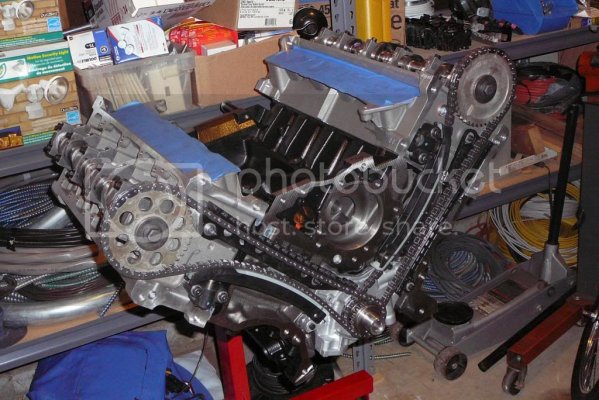
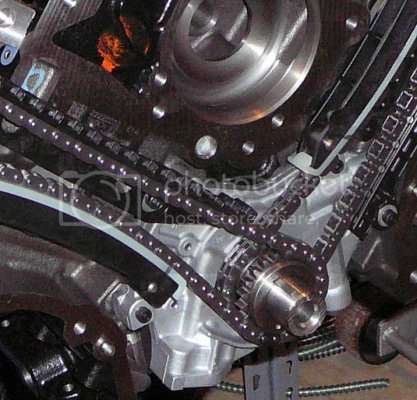
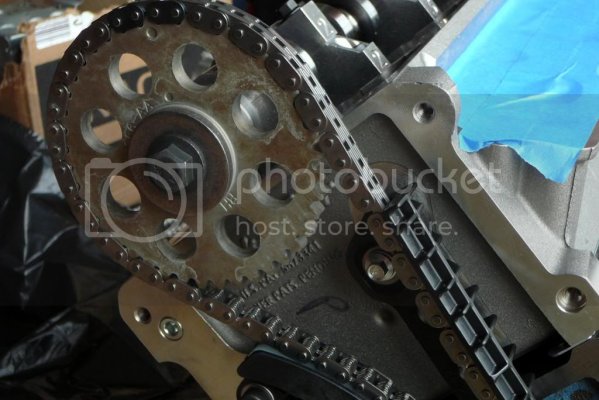
I added photos of my motor before it was installed. Notice the relative position of the cams and crank timing marks. The timing marks on the chains line up with marks on the cams and crank.


54builtblock012_zps901e5391.jpg


54builtblock012B_zps3e3867e2.jpg

54builtblock005_zpsd3f9466a.jpg

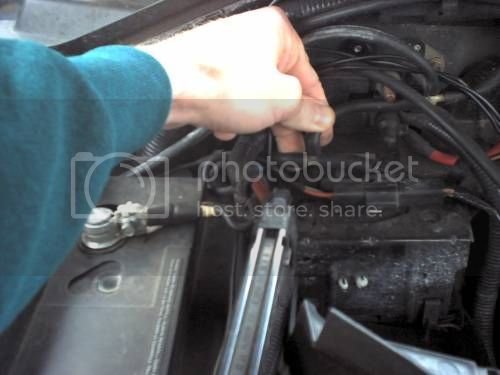
54builtblock003_zps0c0ed151.jpg
 
Last edited:

toms89

technical advisor
Joined
Mar 13, 2011
Posts
5,173
Reaction score
442
Location
MD
Even without the marks if you look at the photos the cam gear timing marks should be in the same relative position.

Whats not clear is the precise location of the crank mark but it looks very close to the 6:00 position. Each cam mark appears to be 5 links exactly from the inside edge of the head where the cam covers sit. Maybe this can help?

If the cam timing marks appear to be 180 degrees out rotate crank another 360 degrees and check again.. :)


If you were to remove or are installing new timing chains you can mark them by folding them exactly in half. On one end you mark single link the other two links. It follows that if you count links there should be an equal number of links from the crank gear timing mark to the cam gear timing mark counting either direction on the chain.

Timingchainmarks_zps25181567.gif


These are interference fit motors so do not attempt to rotate either the cams or crank with the timing chains removed. You can have piston to valve contact!!
 
Last edited:
OP
OP
S

signdoctor

Member
Joined
Feb 20, 2012
Posts
22
Reaction score
0
Location
Robbinsville, NC
Thanks Tom! I am going back to the shop today to see if the links count out the same way. If they are off; Did you use the special tools for setting up the timing or did you do it manually?
 
OP
OP
S

signdoctor

Member
Joined
Feb 20, 2012
Posts
22
Reaction score
0
Location
Robbinsville, NC
I counted out the links and made my own marks on the chains while they were still on the motor and it looks like my timing is dead on. So now I KNOW I have good timing, I have solid compression, I have no vacuum leaks, I have good injectors, I have new plugs, I have new O2 sensors and I tested all coils and they passed too. I guess I am going to put in a new crank and cam sensor while I am there.
 

toms89

technical advisor
Joined
Mar 13, 2011
Posts
5,173
Reaction score
442
Location
MD
Remove the blower belt and try and run it. It will run fine with blower belt removed though it will obviously be down on power as it is breathing through the smallish bypass valve at that point.

Report back your vacuum readings.

If the engine is mechanically sound that leaves vacuum line routing or tune issues. Either may not allow the engine to produce enough vacuum to open the bypass valve which will have the blower attempting to produce boost at idle. With the blower belt removed it will eliminate any potential "boost".
 
Last edited:

Crash!

Full Access Members
Joined
Jul 20, 2013
Posts
68
Reaction score
7
Location
Tulsa
A few things I want to throw in here. Please stop throwing parts at it and go back to basics.

One- If the engine is running, no matter how poorly, you will have a vacuum reading. Ensure you have the gauge connected to a manifold source (Behind the throttle body).

Here is a chart you can use to correlate the vacuum readings you have to the symptoms it will indicate.

VacuumGaugereadingchart.jpg

Two- 165 PSI is a LOW compression rating, indicating a tired engine. You should see 180-220 PSIG.

Three- ANY vacuum leak will cause problems. Breathers on a draw through MAF system is a bad thing. Air is to be metered ONCE, and the mass of air measured must be used without leaks or your calibration will be off.

Four- The bypass is to be connected to a MANIFOLD source. Here is an image of a "T" that you can connect the bypass and boost gauge to without tapping or using and engine control vacuum harness. This vacuum "T" is in series with the A/C controls, and is located behind the starter solenoid. There is a cap already on it, as if it was made for this purpose. Take the cap off, stick it on the stud, and put your bypass hose there.

vactee0001-1.jpg

PM me if you need further assistance.
 

toms89

technical advisor
Joined
Mar 13, 2011
Posts
5,173
Reaction score
442
Location
MD
A few things I want to throw in here. Please stop throwing parts at it and go back to basics.

One- If the engine is running, no matter how poorly, you will have a vacuum reading. Ensure you have the gauge connected to a manifold source (Behind the throttle body).

Here is a chart you can use to correlate the vacuum readings you have to the symptoms it will indicate.


Two- 165 PSI is a LOW compression rating, indicating a tired engine. You should see 180-220 PSIG.

Three- ANY vacuum leak will cause problems. Breathers on a draw through MAF system is a bad thing. Air is to be metered ONCE, and the mass of air measured must be used without leaks or your calibration will be off.

Four- The bypass is to be connected to a MANIFOLD source. Here is an image of a "T" that you can connect the bypass and boost gauge to without tapping or using and engine control vacuum harness. This vacuum "T" is in series with the A/C controls, and is located behind the starter solenoid. There is a cap already on it, as if it was made for this purpose. Take the cap off, stick it on the stud, and put your bypass hose there.


PM me if you need further assistance.

I prefer compression leakdown test to test overall condition of motor. It will also indicate where the compression is leaking if so. Intake, exhaust valve, rings, etc.... The important thing is the cylinders should be balanced to each other.

Compression readings will depend on cam and compression ratio. The numbers you quoted sound high to me but maybe they are correct for a 9 to 1 stock expy motor ?!

Note that the op has a lightning block. (lower compression)

I have 8.7 to 1 compression and aftermarket cams so no idea where mine would be.

The vacuum lines on a lightning setup are significantly different than stock expedition. A difference between a roots blower set up and centi is there are two distinct possible sources of vacuum. In the plenum ahead of the blower, but still after the throttle body which will never see boost and intake manifold post blower which is vacuum and boost referenced.

With my setup the only items using boost reference vacuum source are the fuel pressure regulator and vacuum/boost gauge. My bypass valve uses plenum referenced vacuum source.

I would be curious what my vacuum readings would be if I allowed the bypass valve to shut at idle. Theoritically there would still be vacuum because the throttle body is shut but that depends on how much air the IAC valve is letting through. The supercharger will attempt to compress what little air is available.
 
Last edited:
Top