Tire pressure

Disclaimer: Links on this page pointing to Amazon, eBay and other sites may include affiliate code. If you click them and make a purchase, we may earn a small commission.

CertusExpo

Customizing trucks since I was 7 with my Legos
Joined
Jul 3, 2014
Posts
342
Reaction score
66
Location
Fort Worth, TX
I was curious and decided to search on the topic and here I am.

Running 75# currently at all four corners. Almost at wear indicators.
 

TobyU

Full Access Members
Joined
Apr 5, 2013
Posts
2,479
Reaction score
873
Location
Ohio
I don't care what any door sticker or owners manual says. I put 35 in a 35 psi max tire and 40-41 in a 44 psi max tire and at least 70 in a 10 ply 80 psi max tire.
Manufacturers are not as smart (or give best info)as some people claim them to be.
Now I have been doing this since way before....but remember fords recommended pressures and the Explorers. Had I of had a explorer with firestone tires, I would have had no issues with the air I would have run in them
 

08T1

Full Access Members
Joined
May 22, 2016
Posts
267
Reaction score
46
Location
sierravista, az
I don’t care what Ford says. I’m not running their tires. I’m running 65# cause it’s what my tires are rated for. I am very happy with there wear and performance.

If you change from stock tires the door sticker is useless.

JMHO.
CJ
 

TobyU

Full Access Members
Joined
Apr 5, 2013
Posts
2,479
Reaction score
873
Location
Ohio
I don’t care what Ford says. I’m not running their tires. I’m running 65# cause it’s what my tires are rated for. I am very happy with there wear and performance.

If you change from stock tires the door sticker is useless.

JMHO.
CJ

Correct.
Always check the tires though because you would never want to put that much pressure in a tire rated for 35 maximum.
I often don't fill the tires up all the way to the maximum inflation except for the ones that are 35. I always put 35 and 35 max PSI Tire.

People must remember that the manufacturers often do not have the same goals in mind as the end-user or the owner of the vehicle.
 

Plati

Well-Known Member
Joined
May 4, 2016
Posts
2,781
Reaction score
1,367
Location
.
There was a thread on this last year (or so). I seem to recall that if you're running Light Truck tires (10 ply, rated up to 80 psi) like I am, you need to calculate or measure the appropriate pressure to use? Somebody had a chart from the Tire & Rim Association to calculate. There is also the chalk method, which displays tread contact with the pavement.

You dont want to just fill to max pressure I thought. Tire pressure should match the weight carried, more weight = more pressure? Thats the idea with those tires, as weight carried increases ... the tire pressure is increased to compensate. The tires have beefy sidewalls to be able to handle that. If you have a "normal" load on the tire and crank it up to max psi that isnt good?

 

1955moose

Full Access Members
Joined
Nov 23, 2014
Posts
6,004
Reaction score
1,351
Heat is the biggest enemy on an under inflated tire. More tire catastrophes happen with a tire or tires that are run too long without sufficient air pressure. Over inflating is also bad, due to side walls being stressed. A good rule of thumb, that I've always followed was inflate car tires at about 70 percent of maximum side wall total. My kumho street tires give a Max of 49, I run about 41-42 psi. When hauling a heavy load such as a camper or such, that pressure would increase to 80-85 percent. This is my personal situation, I'm sure tire manufactures recommend different.

Sent from my N9131 using Tapatalk
 

TobyU

Full Access Members
Joined
Apr 5, 2013
Posts
2,479
Reaction score
873
Location
Ohio
There was a thread on this last year (or so). I seem to recall that if you're running Light Truck tires (10 ply, rated up to 80 psi) like I am, you need to calculate or measure the appropriate pressure to use? Somebody had a chart from the Tire & Rim Association to calculate. There is also the chalk method, which displays tread contact with the pavement.

You dont want to just fill to max pressure I thought. Tire pressure should match the weight carried, more weight = more pressure? Thats the idea with those tires, as weight carried increases ... the tire pressure is increased to compensate. The tires have beefy sidewalls to be able to handle that. If you have a "normal" load on the tire and crank it up to max psi that isnt good?

You are correct but this is more of an issue on 10 ply 80 psi tires that sometimes people will put on a normal vehicle that doesn't really carry any weight. On some of my larger vehicles that do carry some weight I've only gone to 70 or 72 as I've never been at the limit of what the tires can handle according to what stamp on the sidewal weight wise.
It seems that most tires either say 35, 44, 51, or 80.
I always put 34 to 35 in a 35 tire and they have always worn nicely. I find the if you put 44 or 51 in those marked tires they can often be a little over inflated and you can get increase center wear. This is where the chalk method mentioned can come in handy.
I would much rather have my tires at 35 PSI on a 35 max marked Tire than to risk them being down at 26 or 28 and starting to get low and being severely under-inflated.
 

Motorcity muscle

Full Access Members
Joined
May 6, 2018
Posts
612
Reaction score
221
Location
Motorcity
Mine has 35 on door sticker, couple questions, if you run say 40 does it effect TPMS? How do use the chalk method to check for proper inflation/wear?
 

TobyU

Full Access Members
Joined
Apr 5, 2013
Posts
2,479
Reaction score
873
Location
Ohio
Google chalk tire wear testing...should get you a lot.

Basically you draw a heavy even chalk line across the tire tread and then drive in a straight line to see if the center or edges are wearing the chalk faster. If the sides are wearing more you air up the tire more. If the center is getting worn first you reduce air.
 

TobyU

Full Access Members
Joined
Apr 5, 2013
Posts
2,479
Reaction score
873
Location
Ohio
The standard stems will fail at 60#


My grandpa popped a 35 psi tire at about 60 one time..Was airing it up and not paying attention and scared the heck out of him but luckily not hurt.
You explode a 80 psi 10 ply or truck or bus and you will not be ok.

Speaking of zipper failures...what's anyone's experience on this.
I had a 10 ply Michelin LTC MS or MS2 265/70-16 I think that was getting low often. It would get down to like 42 but no lower.
I ran it at 70-72.
When airing it up I heard a creaking sound. Crackling like. There was some checkering on sidewall but tread was awesome.
Comments????
 

CertusExpo

Customizing trucks since I was 7 with my Legos
Joined
Jul 3, 2014
Posts
342
Reaction score
66
Location
Fort Worth, TX
Speaking of zipper failures...what's anyone's experience on this.
I had a 10 ply Michelin LTC MS or MS2 265/70-16 I think that was getting low often. It would get down to like 42 but no lower.
I ran it at 70-72.
When airing it up I heard a creaking sound. Crackling like. There was some checkering on sidewall but tread was awesome.
Comments????

I'm thinking there was a minimum wheel width that the tire in question may have been exceeding? Otherwise I have no idea.
 

1955moose

Full Access Members
Joined
Nov 23, 2014
Posts
6,004
Reaction score
1,351
I don't know if this is any help, but our 14 passenger Ford Transit vans that we haul people in, have 49 up front and 72 psi rears. That's with duallys or regular 2 tire rears. And yes, I'm always seeing a van with the tire light on. Apparently the high pressure is killing the sensors. You'd think they'd put in ones, especially the rears to handle that 72 pounds pressure.

Sent from my N9131 using Tapatalk
 

Plati

Well-Known Member
Joined
May 4, 2016
Posts
2,781
Reaction score
1,367
Location
.
There was a thread on this last year (or so). I seem to recall that if you're running Light Truck tires (10 ply, rated up to 80 psi) like I am, you need to calculate or measure the appropriate pressure to use? Somebody had a chart from the Tire & Rim Association to calculate. There is also the chalk method, which displays tread contact with the pavement.

You dont want to just fill to max pressure I thought. Tire pressure should match the weight carried, more weight = more pressure? Thats the idea with those tires, as weight carried increases ... the tire pressure is increased to compensate. The tires have beefy sidewalls to be able to handle that. If you have a "normal" load on the tire and crank it up to max psi that isnt good?
Also ... since I just this morning installed my winter tires (which are Light Truck tires) and I had to think about this. I run 44 psi in those EVEN though I'm running a normal load. Even less than normal, since I took all the seats out of the rear cabin. So in other words, LT tires need "some amount" of higher pressure even at normal load ... is my understanding.

I told Goodyear about this and they wouldnt pump them up to 44 psi. Said the sticker is 35 so thats what they do. Legal mumbo jumbo I guess. Fine, I'll do it myself. Then I took it to Valvoline for an oil change and told them "dont even look at the tires, I run 44 psi". If I didnt say that they would probably lower them to 35psi.
 
Last edited:

CertusExpo

Customizing trucks since I was 7 with my Legos
Joined
Jul 3, 2014
Posts
342
Reaction score
66
Location
Fort Worth, TX
FOUND A CHART!!
 

Attachments

  • Discount-Tire-inflation.pdf
    114.1 KB · Views: 12

RustyOval

Full Access Members
Joined
Sep 4, 2017
Posts
148
Reaction score
47
Location
Illinois
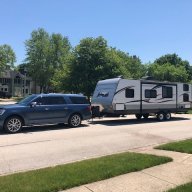
I run 34 -36# unless I am pulling the camper, then I max out front and back at 50#.
 
Top