Rear Air Suspension Bags Fully Inflated - Help!

Disclaimer: Links on this page pointing to Amazon, eBay and other sites may include affiliate code. If you click them and make a purchase, we may earn a small commission.

AutoKerl

Member
Joined
Feb 2, 2019
Posts
14
Reaction score
0
Location
Bay Area, CA
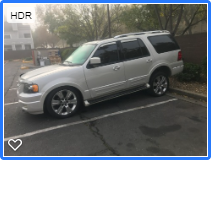
A couple of days ago I noticed the rear end of my 06 Expo Limited seemed rather high. Turns out the air suspension bags are fully inflated and will not deflate.

I can hear the compressor run to lift the front (new bags but for some reason they don't hold air when the vehicle is shut off - as seen in the pic) when Expo is running.

How do I vent the rear bags? Do I need to reset the system? If yes, how do I reset the system? The ride is borderline dangerous with the back end bouncing like a p_ssed off mule on a bad day over even small pavement imperfections.

Hoping there is a simple short-term temporary solution. Clearly, the entire system needs to be reviewed but I just don't have the time at the moment.

Thx Guys.
 

Attachments

  • Rear High.png
    Rear High.png
    56.3 KB · Views: 10

whtbronco

Full Access Members
Joined
Nov 13, 2021
Posts
1,153
Reaction score
687
Location
Winchester, VA
So my first thought is to check the switch for the rear suspension. On my 2004 there was only 1 for the rear. To me it sounds like it's stuck.

For the front let the air bags pump up an then hit the switch to turn off the air suspension. Maybe the 2006 switch is located in the left rear of the vehicle. Then shut off the engine and listen for the leak. Could just be a cracked air line, loose connection or failed solenoid.
 

jamoses

Member
Joined
May 5, 2025
Posts
7
Reaction score
6
Location
Ventura CA
Hello. I have the same problem with my 2003 Lincoln Navigator. What was the problem and resolution to (1) get the rear (L+R) back down, and (2) fix the problem. The rear was so jacked up that one of the air bags exploded. I'm wondering is a leak up front caused the rear to get too much air.
 

whtbronco

Full Access Members
Joined
Nov 13, 2021
Posts
1,153
Reaction score
687
Location
Winchester, VA
I would think you have a failed rear height level switch. It could be the solenoids for the rear bags, but both failing at the same time is rather unlikely. Each air bag has it's own solenoid so the compressor can run all day and none of the bags should over inflate.

The best place to start is with a code scan, but you'll need a scanner that can read the air suspension module. FORScan is a low cost option if you want to do this and other troubleshooting in the future.

I grew tired of listening the air compressor run for like 5 minutes at every start. When I looked at cost, complexity and reliability I removed the air suspension in favor of Rancho Quicklift loaded struts. The new struts cost much less than maintaining the air suspension Basically no lift compared to the air suspension, but I prefer the improved handling, no compressor noise, and no suspension issues. The loss of load leveling you'll have to decide on yourself, I don't need it often anymore.
 

Ixlr8nAk

Member
Joined
Jun 21, 2025
Posts
17
Reaction score
6
Location
Alaska
Best place to start In my Humble opinion is behind the passenger rear wheel is the only height sensor for the rear. In a both wheel over height, its most likely the connecting rod to the sensor has popped off. The system thinks the rears are low because the arm of the sensor is stuck in the up position. They can fail at that position internally as well, even if the connecting rod is still attached. Amazon has all 3 sensors for the rig or individually, for a very affordable price. Rock A toe would be a great source as well.
Keep spares.
The system (air ride) offers so many great things, and once the function of each part individually is understood, ours is worth keeping.
Though shock options are becoming rarer.
 
Last edited:

jamoses

Member
Joined
May 5, 2025
Posts
7
Reaction score
6
Location
Ventura CA
Follow-up: Problem solved. My local repair shop replaced both rear air bags (one blown and the other was old w/250K on it). This was caused because the rear linkage popped off, setting a too-low condition; causing it to raise the rear until one air bag exploded and a fault code was set. The local repair shop also said they replaced the rear sensor. After two weeks (seriously!) of not being able to figure out why the rear would not go up, I took the car back from them. I disconnected the rear linkage, started the car, which sets "Ride Height" opposed to "Knee Height", and manually, slowly, raised the rear sensor linkage and then slowly lowered the linkage. The system worked opposite to what was supposed to happen. (When the car raises, the linkage extends higher between the lower A-arm and the chassis. When the car lowers, it collapses, so the sensor arm goes up. Manually operating it in the opposite direction worked.) Repair shop installed the *wrong sensor* in the rear. As soon as I installed to correct sensor, it all worked. For the rear height sensor there is a sensor with a black steel bracket and new linkage available on amazon for $45. Works perfectly.

Additional stuff I learned:
#1: After replacing the two airbags, shop said they were troubleshooting for blown fuses, bad compressor, etc. Claimed they could not get the compressor to come on at all. I told them they either had to clear the existing stored fault codes (since the compressor times out when the original bag failure occurred, or they had to pull the battery cable). They pulled the batt cable. Lesson: Don't expect the system to work after a repair w/o clearing codes.

#2: Troubleshooting a bad airbag. If you manually raising an airbag by moving the rear linkage, you're proving out a bunch of things: Ensuring that the compressor works because it will come one and both rear air solenoids since they will open and close per the linkage movement. If you disconnect the rear solenoid cables after manually moving the linkage, the rears will stay inflated so you can make sure there are no leaks in the bags overnight. The solenoids isolate the air in each bag from the distributed air line.

#3: How it works: I wondered how each bag was actually deflated. There is only one air dump valve and it's located at the compressor, so to lower any one or more airbag, the system must command one or more solenoids to open AND open the air dump valve to vent the air lines.

#4: Repair shop had a Snap-on code reader with NO ability to read, or reset the suspension system code, let alone read, test or set ride height functions (actuate solenoids, read sensor, turn on/off compressor). My Autel MX808 did the job. Best $500 I've spend for our cars!

 

jamoses

Member
Joined
May 5, 2025
Posts
7
Reaction score
6
Location
Ventura CA
Sensor testing: I forget the pin-out and color coding, but if you want to test the ride height sensors: (1) Apply +5V to the power pin (Red/???; Pin1) and Gnd (BLK/???) to the return. (2) Read DC voltage from center pin on the sensor (TAN; Pin 2). It ranges from 4.5VDC to 0.5VDC when the arm is moved. (3) Arm should move smoothly.
 

Ixlr8nAk

Member
Joined
Jun 21, 2025
Posts
17
Reaction score
6
Location
Alaska
Thanks for the heads up on a reader with such functions. Need that for sure! Sensor testing and solenoid voltage was another wonder. Thanks Jamoses.

Sound like one of you might have seen the inside (shock side ) of an air spring? Do they use the shock and the 2 O-rings at top and bottom to seal the spring? About to pull mine and replace shocks and springs ( pre-assembled ).
 

jamoses

Member
Joined
May 5, 2025
Posts
7
Reaction score
6
Location
Ventura CA
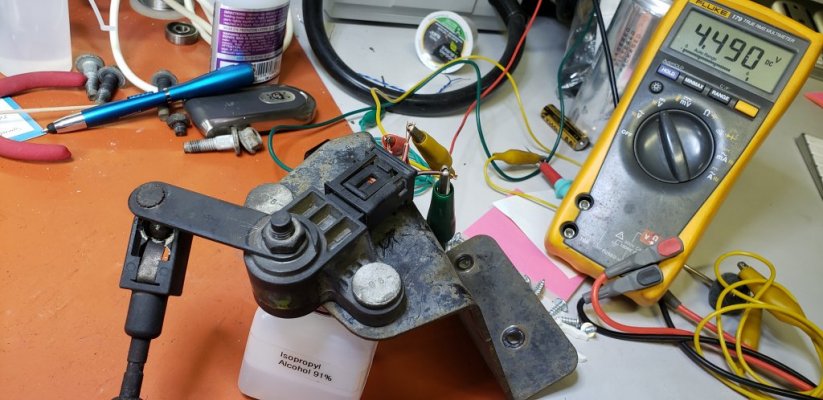
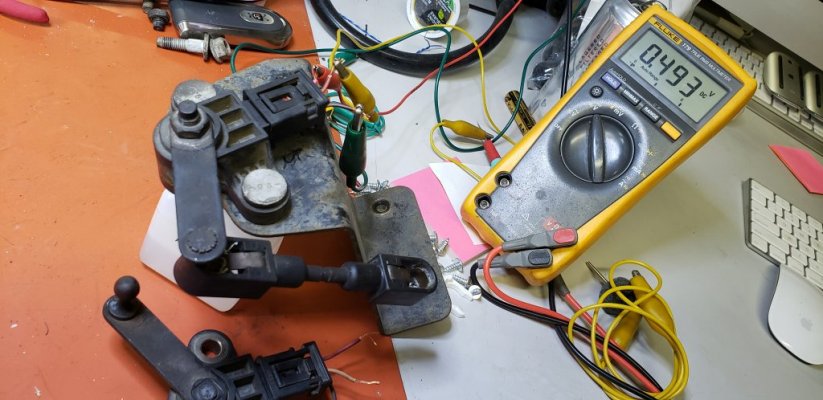
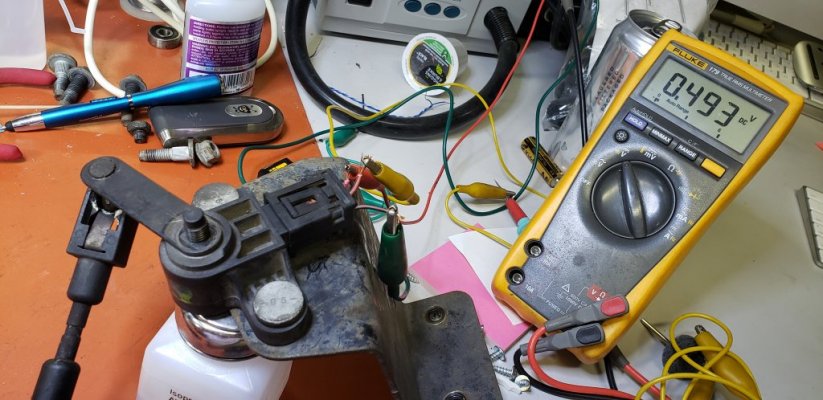
Another follow-up on the Ford height sensors: I did some testing on the front and rear height sensors (03-06 Exy/Navi) and powered them up with +5VDC to make sure the two ranged through +4.5V to +0.5VDC but with opposite motion. Which was confirmed. However, I was puzzled with why the OEM would make two different $300 left hand and right hand sensors. So I pulled the lever arm nut, turned the shaft 180deg and confirmed that the voltage range flips. So if you have ANY working, smooth travel sensor, you can change the sensor behavior simple by re-clocking the lever arm.

The pics below show the sensor range from 4.5 to .5 volts then opposite after re-clocking (note the missing lever arm nut).
 

Attachments

  • Lowered4.5.jpg
    Lowered4.5.jpg
    123.3 KB · Views: 4
  • Raised0.5.jpg
    Raised0.5.jpg
    117.8 KB · Views: 4
  • Lowered0.5Reclock.jpg
    Lowered0.5Reclock.jpg
    130.2 KB · Views: 4

jamoses

Member
Joined
May 5, 2025
Posts
7
Reaction score
6
Location
Ventura CA
Thanks for the heads up on a reader with such functions. Need that for sure! Sensor testing and solenoid voltage was another wonder. Thanks Jamoses.

Sound like one of you might have seen the inside (shock side ) of an air spring? Do they use the shock and the 2 O-rings at top and bottom to seal the spring? About to pull mine and replace shocks and springs ( pre-assembled ).
Sorry; Not sure what you're asking here, but the 2003 Navigator rear end uses an air bag over the top of the shock/springs. The front uses a complete combined strut/bag unit. I had the shop replace both rear airbags (one blown, and one cracked and old) so Im not sure what the o-ring stack looks like.
 

Ixlr8nAk

Member
Joined
Jun 21, 2025
Posts
17
Reaction score
6
Location
Alaska
Was wondering, since I have not seen the air springs/ bags off yet. If they use the shock and the O-rings to seal the air. Seems very convoluted to have 4-5, O-rings on parts that are painted or plated being used to seal the air in a spring.
was wondering is all. Have been espoused to, or seen the air ride on semi's and large equipment that are totally enclosed air cells. Even some aftermarket load leveling kits use dual doughnut air cells, so I am shocked ( pun noticed ) that ford used so many dry-rot-able O-rings. If they indeed have no inner wall to the air springs?
 

jamoses

Member
Joined
May 5, 2025
Posts
7
Reaction score
6
Location
Ventura CA
Was wondering, since I have not seen the air springs/ bags off yet. If they use the shock and the O-rings to seal the air. Seems very convoluted to have 4-5, O-rings on parts that are painted or plated being used to seal the air in a spring.
was wondering is all. Have been espoused to, or seen the air ride on semi's and large equipment that are totally enclosed air cells. Even some aftermarket load leveling kits use dual doughnut air cells, so I am shocked ( pun noticed ) that ford used so many dry-rot-able O-rings. If they indeed have no inner wall to the air springs?
I believe the rear air bags are completely separate from the rear shocks (i.e. you can blow them up even with the shock not installed since the shock is not a sealing surface.). The front bags are totally integrated, but I doubt there is any oring separation between the shock and air bag.
 
Top