

texasscot
Well-Known Member
My 2003 developed a persistent P1132 code indicating an overfuelling condition in Bank 1. There are various potential causes for this that I checked off one by one. I’m now left with the last thing which - a stuck open fuel pressure regulator in the fuel pump. I have 61psi at the rail at idle, which is way too high causing the injectors to push too much fuel at each pulse.
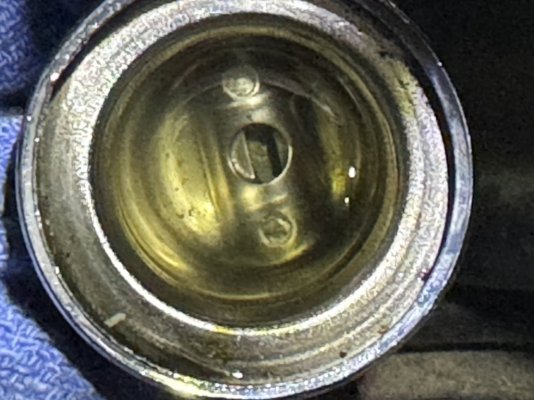
Apparently, 2003 vehicles started out with a single fuel line going to the rails, with a fuel rail damper located on the LHS fuel rail, with the pressure being mechanically controlled by the pump in the tank. This is what i have. Attached is a pic of the inside of the housing from the LHS fuel rail. It has no function in controlling fuel pressure, other than as a pulsation dampener (despite it having a vac line on it).
During the model year, there was a switch to locating a pressure regulator on the rail along with a pressure sensor. Doing AI searches causes results to flip flop between these two versions, as it tries to rationalize the situation, giving spurious information.
I've replaced the fuel pump twice in its 295,000 miles. I'd never had i thought about the fact that there must be two different fuel pump designs in 2003; one for the single fuel line, i think it's termed "returnless", with an internal fuel pressure mechanical valve, and one for the newer version. Have i used the wrong pump previously?
Based on some real AI digging, i find only Motorcraft, Delphi and Bosch came up recommended for my system. Previously, i just bought whatever "2003" generic pump was available (i'm generally cheap). Anyway, Delphi pump coming from Rockauto tomorrow.
TLDR; despite all my interactions with this fuel system, i've only just found out about the two different designs in 2003.
Am i the last to know?!
Edit to add this info from 12 years ago on another forum, and for Rangers. It's disturbing because it mentions 60+ psi.
"1998+ Rangers utilize what is called a "mechanical returnless" fuel system. These returnless fuel systems have the following characteristics:
(1) there is no return line running back to the fuel tank from the fuel rail;
(2) designed to operate at higher fuel pressure - 64psi (+/-8psi);
(3) the fuel pressure regulator and check valve are now located in the fuel tank with the pump assembly, not on the fuel rail.
So then, 65psi fuel pressure is spot-on for your '98. It shouldn't deviate from that number all that much, even at different RPMS.
Did Autozone test for fuel pressure leakdown? You should verify that fuel pressure remains within 5 psi of the operating fuel pressure for 1 minute after the fuel pump is turned off.
The fuel rail "pulse damper", located on the fuel rail, reduces fuel system noise caused by the pulsing of the fuel injectors. It has nothing to do with controlling fuel pressure. The vacuum port located on the damper is connected to manifold vacuum to avoid fuel spillage in the event the pulse damper diaphragm were to rupture. As such, vacuum does not control the damper in the sense that you infer. I don't know of a test for the damper itself, or whether a bad damper can cause a "no start" condition."
Apparently, 2003 vehicles started out with a single fuel line going to the rails, with a fuel rail damper located on the LHS fuel rail, with the pressure being mechanically controlled by the pump in the tank. This is what i have. Attached is a pic of the inside of the housing from the LHS fuel rail. It has no function in controlling fuel pressure, other than as a pulsation dampener (despite it having a vac line on it).
During the model year, there was a switch to locating a pressure regulator on the rail along with a pressure sensor. Doing AI searches causes results to flip flop between these two versions, as it tries to rationalize the situation, giving spurious information.
I've replaced the fuel pump twice in its 295,000 miles. I'd never had i thought about the fact that there must be two different fuel pump designs in 2003; one for the single fuel line, i think it's termed "returnless", with an internal fuel pressure mechanical valve, and one for the newer version. Have i used the wrong pump previously?
Based on some real AI digging, i find only Motorcraft, Delphi and Bosch came up recommended for my system. Previously, i just bought whatever "2003" generic pump was available (i'm generally cheap). Anyway, Delphi pump coming from Rockauto tomorrow.
TLDR; despite all my interactions with this fuel system, i've only just found out about the two different designs in 2003.
Am i the last to know?!
Edit to add this info from 12 years ago on another forum, and for Rangers. It's disturbing because it mentions 60+ psi.
"1998+ Rangers utilize what is called a "mechanical returnless" fuel system. These returnless fuel systems have the following characteristics:
(1) there is no return line running back to the fuel tank from the fuel rail;
(2) designed to operate at higher fuel pressure - 64psi (+/-8psi);
(3) the fuel pressure regulator and check valve are now located in the fuel tank with the pump assembly, not on the fuel rail.
So then, 65psi fuel pressure is spot-on for your '98. It shouldn't deviate from that number all that much, even at different RPMS.
Did Autozone test for fuel pressure leakdown? You should verify that fuel pressure remains within 5 psi of the operating fuel pressure for 1 minute after the fuel pump is turned off.
The fuel rail "pulse damper", located on the fuel rail, reduces fuel system noise caused by the pulsing of the fuel injectors. It has nothing to do with controlling fuel pressure. The vacuum port located on the damper is connected to manifold vacuum to avoid fuel spillage in the event the pulse damper diaphragm were to rupture. As such, vacuum does not control the damper in the sense that you infer. I don't know of a test for the damper itself, or whether a bad damper can cause a "no start" condition."
Attachments
Last edited:


