

hooraah
Member
When I picked up our project Exp the previous owner said the car had cold AC, but when we tested it, it did not. Turns out a plastic shield had rubbed a hole in the double AC line with a small accumulator. Not sure the name of it, but its the big assembly right in front on the passenger side. I thought about tig welding the pin-hole, but decided instead to pick up a spare in the junkyard. I got one out of the newest car I could find.
This is the line:

A smart person would have taken this opportunity to buy an AC o-ring kit and replace all the orings while the system is taken apart. I am not that person.
I installed the new line and made sure all of the mounting faces, especially that funky double line connection on the compressor, were clean. Setup my gauges and vac'd the system down to -30. This was done using a borrowed set of manifold gauges and an electric vacuum pump, both from harbor freight. I can't tell you how much they cost.
I like to let the system set overnight if possible to make sure the vacuum holds and that there are no leaks, but unfortunately didn't have that opportunity this time. It held -30psi for over an hour, and I called it good.
Filling:
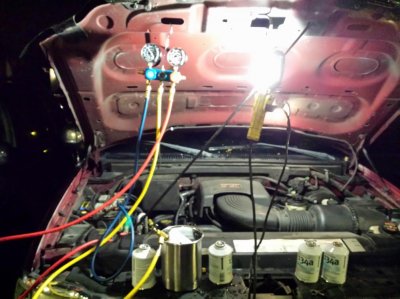
With the system empty, I setup the first can. I won't go over every step, but you're going to fill from the center, yellow line and be sure to purge the line with R134a before you open the can into the system. It helps to put the cans of refrigerant into a bucket of warm water, otherwise the pressure drop causes the cans to get cold, which drops the pressure, which drops the flow.
The first can filled the system to around a static 75psi at 70F. It won't take anymore after that, now you need to start running the system.
Start the engine and set the AC to max cold. The compressor will be short cycling now, when the compressor kicks on and drops the low side pressure, you open the valve on the can to let the new refrigerant in. You should see it flowing through the sight glass in your manifold gauges. It helps if you only open the valve when the compressor is running and like I said earlier, keep the can of R134a in a bucket of warm water.
I have the system with rear AC, so from empty, the system takes around 62 oz of refrigerant, which is just over 5 lbs.
After around 3 cans, the system will start running more normally and the compressor will cycle slower and slower (which is good). This will make it easier to fill with the remaining cans.
Be sure to watch your pressures as you're filling. Low side should be around 20-30 (filling) depending on outside temperature. High side in my case climbed from 80 psi (first can) to around 150 psi by the 5th can. The high side pressure seems low from memory, but I'm not an AC tech nor have I ever done an expedition before. Check book values if you want to do this right, I was just winging it.
When you're done, the low side pressure should be around 30 psi or so with the system running.
Here's the part where I wanted a cool picture of my IR thermometer showing the vent temp but the thing was dead and I was out of AA batteries for it. Fortunately, the system is blowing nice and cold.
This is a beater project truck, so I took some shortcuts while doing this job and got lucky.
If you want to do it right, I'd suggest:
- replacing the o-rings on any AC lines you replace, any connection you open.
- replacing the accumulator, which holds the system drier.
- replace the orifice tube.
This is a job that CAN be done at home if you know what you're doing and you have the right tools. Don't use this guide as perfect - I winged some of this and glossed over a few steps. If this is your first time, use this guide in conjuction with a detailed A/C guide that describes each step in detail. If you don't have the rear AC, you won't need anywhere near 5 cans, so don't overfill.
Good luck!
This is the line:
A smart person would have taken this opportunity to buy an AC o-ring kit and replace all the orings while the system is taken apart. I am not that person.
I installed the new line and made sure all of the mounting faces, especially that funky double line connection on the compressor, were clean. Setup my gauges and vac'd the system down to -30. This was done using a borrowed set of manifold gauges and an electric vacuum pump, both from harbor freight. I can't tell you how much they cost.
I like to let the system set overnight if possible to make sure the vacuum holds and that there are no leaks, but unfortunately didn't have that opportunity this time. It held -30psi for over an hour, and I called it good.
Filling:
With the system empty, I setup the first can. I won't go over every step, but you're going to fill from the center, yellow line and be sure to purge the line with R134a before you open the can into the system. It helps to put the cans of refrigerant into a bucket of warm water, otherwise the pressure drop causes the cans to get cold, which drops the pressure, which drops the flow.
The first can filled the system to around a static 75psi at 70F. It won't take anymore after that, now you need to start running the system.
Start the engine and set the AC to max cold. The compressor will be short cycling now, when the compressor kicks on and drops the low side pressure, you open the valve on the can to let the new refrigerant in. You should see it flowing through the sight glass in your manifold gauges. It helps if you only open the valve when the compressor is running and like I said earlier, keep the can of R134a in a bucket of warm water.
I have the system with rear AC, so from empty, the system takes around 62 oz of refrigerant, which is just over 5 lbs.
After around 3 cans, the system will start running more normally and the compressor will cycle slower and slower (which is good). This will make it easier to fill with the remaining cans.
Be sure to watch your pressures as you're filling. Low side should be around 20-30 (filling) depending on outside temperature. High side in my case climbed from 80 psi (first can) to around 150 psi by the 5th can. The high side pressure seems low from memory, but I'm not an AC tech nor have I ever done an expedition before. Check book values if you want to do this right, I was just winging it.
When you're done, the low side pressure should be around 30 psi or so with the system running.
Here's the part where I wanted a cool picture of my IR thermometer showing the vent temp but the thing was dead and I was out of AA batteries for it. Fortunately, the system is blowing nice and cold.
This is a beater project truck, so I took some shortcuts while doing this job and got lucky.
If you want to do it right, I'd suggest:
- replacing the o-rings on any AC lines you replace, any connection you open.
- replacing the accumulator, which holds the system drier.
- replace the orifice tube.
This is a job that CAN be done at home if you know what you're doing and you have the right tools. Don't use this guide as perfect - I winged some of this and glossed over a few steps. If this is your first time, use this guide in conjuction with a detailed A/C guide that describes each step in detail. If you don't have the rear AC, you won't need anywhere near 5 cans, so don't overfill.
Good luck!
Attachments
Last edited:


