Great video on direct injection from Road & Track magazine

Disclaimer: Links on this page pointing to Amazon, eBay and other sites may include affiliate code. If you click them and make a purchase, we may earn a small commission.

Boose

2017 Platinum EL
Joined
Mar 18, 2014
Posts
319
Reaction score
101
Location
NJ
Just more reasoning on avoiding 0 wt oil and get a catch can on the Gen 3 Eco Boosted Expys. Great video, thanks for sharing! Glad to know that Ford took steps with the 2018 EcoBoost to add the port injection back in.
 

J Ski

3.5plati
Joined
Apr 4, 2017
Posts
1,019
Reaction score
485
Location
VA
Just more reasoning on avoiding 0 wt oil and get a catch can on the Gen 3 Eco Boosted Expys. Great video, thanks for sharing! Glad to know that Ford took steps with the 2018 EcoBoost to add the port injection back in.
See how long these will last now before ppl start throwing cans on them too
 
OP
OP
NASCAR Mike

NASCAR Mike

Full Access Members
Joined
Sep 30, 2008
Posts
267
Reaction score
106
Location
Syracuse NY
See how long these will last now before ppl start throwing cans on them too

I have a JLT oil catch can on my 2013 Mustang GT with 5.0 Coyote engine. No turbo, no supercharger and I get about 2-3 ounces of oil per oil change @ 5,000 miles. I think oil catch cans make sense in any engine.

I just wish JLT would make one for my 2008 Expy with 5.4 engine.
 

Boose

2017 Platinum EL
Joined
Mar 18, 2014
Posts
319
Reaction score
101
Location
NJ
I have a JLT oil catch can on my 2013 Mustang GT with 5.0 Coyote engine. No turbo, no supercharger and I get about 2-3 ounces of oil per oil change @ 5,000 miles. I think oil catch cans make sense in any engine.

I just wish JLT would make one for my 2008 Expy with 5.4 engine.


I was considering their 3 port dual side can for my 3.5... in your opinion, and based on my interpretation of the problem, does the 3 port likely offer a significant benefit over the standard passenger side catch can? I am thinking the addition of the other vacuum port allows the signal to be present to the can under boost as well as off boost conditions. However, regarding the dual side T fitting, I am struggling with the added benefit. As the vapors are ingested in the intake at 1 location why not just install the can in between the PCV & the intake port?
 
OP
OP
NASCAR Mike

NASCAR Mike

Full Access Members
Joined
Sep 30, 2008
Posts
267
Reaction score
106
Location
Syracuse NY
A friend of mine has a 2014 Mustang GT500 - 5.8L supercharged V8. He has a JLT catch can on the passenger and driver side. The passenger side typically catches 2-3 ounces of oil while the passenger side has barely anything - just a light oily film covering.

I only have the passenger side one on my Expy and Mustang and they both collect the oil fine.
 

Flexpedition

Full Access Members
Joined
May 26, 2015
Posts
1,339
Reaction score
665
Location
midwest
Glad to know that Ford took steps with the 2018 EcoBoost to add the port injection back in.

I know Ford is adding port injection in addition to direct injection on high output EcoBoost variants. Like Ford GT and Raptor. Is this what you are referring to?
 

J Ski

3.5plati
Joined
Apr 4, 2017
Posts
1,019
Reaction score
485
Location
VA
I was considering their 3 port dual side can for my 3.5... in your opinion, and based on my interpretation of the problem, does the 3 port likely offer a significant benefit over the standard passenger side catch can? I am thinking the addition of the other vacuum port allows the signal to be present to the can under boost as well as off boost conditions. However, regarding the dual side T fitting, I am struggling with the added benefit. As the vapors are ingested in the intake at 1 location why not just install the can in between the PCV & the intake port?
Jlt does not have a 3 port. All of there’s are 2
 

Boose

2017 Platinum EL
Joined
Mar 18, 2014
Posts
319
Reaction score
101
Location
NJ
I know Ford is adding port injection in addition to direct injection on high output EcoBoost variants. Like Ford GT and Raptor. Is this what you are referring to?


Not just in the Raptor, all 2nd Gen 3.5's are getting it:

2018 Expeditions as well as F 150's get the same 375 HP Gen 2 3.5

3.5L ECOBOOST®

Not satisfied with the high power ratings of their 3.5L EcoBoost® , Ford engineers designed the second generation of this potent EcoBoost with even higher ratings of 375 horsepower and best-in-class* 470 lb.-ft. of torque, beating out all gas and diesel competitors. This engine delivers the F-150 max best-in-class* tow rating too. Big improvements: Fordfirst port fuel and direct injection (PFDI) with two injectors per cylinder—one in the air intake port and another inside the cylinder—to improve power and efficiency. All-new twin turbos for greater on-demand power. A more responsible plus high-end-efficient 10-speed transmission.
*When properly equipped. Class is Full-Size Pickups under 8,500 lbs. GVWR based on Ford segmentation.

https://www.ford.com/trucks/f150/features/Power/?intcmp=vhp-featcta-power
 

Boose

2017 Platinum EL
Joined
Mar 18, 2014
Posts
319
Reaction score
101
Location
NJ
Yeah be careful with that one. Drilling into intake may void warranty. Not 100% sure

VERY concerned about that... I Was considering getting a 2nd pipe to use for the installation. I could easily enough swap it out if it ever needed to go in for warranty work.
 

theoldwizard1

Full Access Members
Joined
Jul 29, 2013
Posts
320
Reaction score
81
Location
SE MI
I am a retired engineer from one of the Detroit Three. While not infinitely knowledgeable, I do now quite a bit about the spark ignited internal combustion engine, port fuel inject and and direct fuel injection. There are major errors in video !

At about 3:09 he states that there is fuel "constantly being sprayed on the back side of the (intake) valve". It is NOT constant. It is pulse whose length varies with the amount of air flowing into the engine. The timing of the pulse can be adjusted so that it can be sprayed on an open or closed valve.

GDI injectors do NOT have a higher "flow rate". They do have a "finer" spray pattern caused by smaller holes.

GDI, by itself, does not significantly "create more power" or "burn fuel more completely", given the same operating conditions as a port fuel injected engine. Check this "snipet". Higher temps actually mean more HC production.
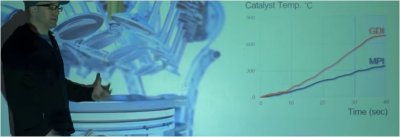
Capture.JPG

Variable valve cam timimg does NOT require DI. (6:35 )

The sample PCV system (7:50) is very poorly drawn. The inlet air for the PCV system is totally separated from the extracted air.

NO, NO, NO ! Toyota and Ford are going to DI and PFI, because GDI creates "particulates". Tiney particles of carbon from unburned fuel. While these particulates are not currently regulated (for gasoline engines) in either the US or EU, they WILL BE SOON ! Most of the fuel in a dual injected system greatly reduces these particulates.

GDI can run quite lean, much leaner than a "traditional" PFI engine. DI engines in EU DO run leaner because their (current) emission standards allow them to emit more pollutants under certain driving conditions compared to the US standards.

Ford knows all of this. Ford also knows that marketing sells cars. EcoBoost is all about marketing. Ford could achieve very similar fuel economy and performance results by just turbo charging a naturally aspirated engine, but the loss of the EcoBoost market term would be devastating.

Are PCV fuel/air separators a good idea ? Sure. A requirement. NO ! Probably a waste of money of a PFI only engine.

 
Top