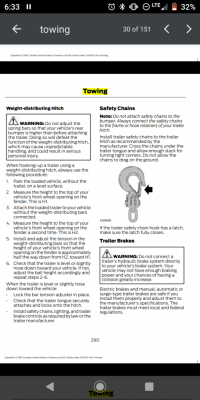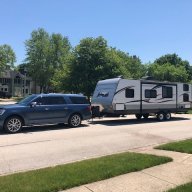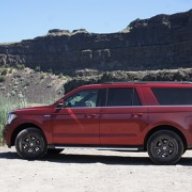

Tuning Andersen WDH + 2019 Expy Max XLT

Disclaimer: Links on this page pointing to Amazon, eBay and other sites may include affiliate code. If you click them and make a purchase, we may earn a small commission.

Joey Smith

Well-Known Member
Joined
Sep 9, 2019
Posts
80
Reaction score
15
Location
Sunnyvale, CA
Hi-

I recently purchased a used Airstream FC 23D (2017).
I was concerned about tongue weight so opted for an Andersen WDH (~60lbs).

I loaded up the family and camping equipment to get readings at the CAT scales and based on the numbers, I am trying to make adjustments.

Would appreciate any tips. One option is to buy another WDH but would like to see what is the best I can do with what I have at present given the $$$.


Generally, I am trying to:
1. Keep everything safe for me and the family (but don't know all of the rules of thumb around this).
2. Keep the trailer balanced (front vs back)
3. Shift weight to the front axle and keep rear axle weight as low as possible (reduce sag)


INFO ABOUT TOW VEHICLE (TV)
(2019 Exp XLT Max, 4x4, w/Heavy Tow)
GVWR: 7720 lbs
Payload: 1767 lbs
Front GAWR: 3550 lbs
Rear GAWR: 4380 lbs
Towing Capacity: 9000 lbs
Tongue Weight Capacity: 900 lbs
Combined TT+TV Weight: 15500 lbs
Curb Weight (not sure about this as found somewhere online): 5794 lbs
Maybe this one is actually 7720 - 1767 = 5953 lbs

Details about the CAT weighings are at the bottom...

CHECKING TONGUE WEIGHT:
I used the CAT scale weighings (#1 and #2) to determine the tongue weight as being 680 lbs and was happy to see that it was sufficiently under the 900 lbs.

REAR GAWR AND REAR SAG:
Next I looked to confirm that I was under the Rear GAWR and wanted to check how much rear sag there was.
With a WDH tuning of 7 threads on the Andersen hitch, I am at 4260 lbs on the Drive Axle which gives me 40 lbs of margin for additional TV cargo (assuming the additional 1/2 tank of gas consumes ~80 lbs).
TV Front: 36 1/2"
TV: Rear: 35"
TT Front: 16"
TT Rear: 16"

With a WDH tuning of 8 threads on the Andersen hitch, I am at 4180 lbs on the Drive Axle which gives me ~120 lbs of margin for additional TV cargo (again assuming the addl 1/2 tank gas gas consumes ~80 lbs). The problem with this setup is that the trailer is a little less level now (16" in front and 16 3/4" in the back).
TV Front: 36 3/4"
TV: Rear: 35 1/8"
TT Front: 16"
TT Rear: 16 3/4"

QUESTIONS:
1. Between the following, what is most important:
A. Balancing Front and Rear of the Tow Vehicle (TV)
B. Balancing Front and Rear of the Travel Trailer (TT)

2. Is there a goal in terms of what the front and rear weight should look like on the Tow Vehicle? Ratio between the two? Difference between the two?

3. Would like to know people's opinions regarding the safety of the #'s for either scenario of 7 threads and 8 threads dialed into the Andersen WDH for those with experience with the Andersen WDH.

Thanks!


Details of CAT Scale Weights:
===================
1. TV Only (family+cargo+1/2tank of gas)
Steer Axle: 3120 lbs
Drive Axle: 3360 lbs
TV front: 36"
TV rear: 36 1/4"
TOTAL: 6480 lbs

2. TV+TT (WDH disabled or chains loosened)
Steer Axle: 2820 lbs
Drive Axle: 4340 lbs
Trailer Axle: 4900 lbs
TOTAL: 12060

--> Tongue weight = (2820+4340) - 6480 = 680 lbs

3. TV+TT (WDH enabled with 7 threads)
Steer Axle: 2920 lbs
Drive Axle: 4260 lbs
Trailer Axle: 4920 lbs
TOTAL: 12100
TT Front: 16"
TT Rear: 16"
TV Front: 36 1/2"
TV: Rear: 35"

4. TV+TT (WDH enabled with 8 threads)
Steer Axle: 2960 lbs
Drive Axle: 4180 lbs
Trailer Axle: 4940 lbs
TOTAL: 12080
TT Front: 16"
TT Rear: 16 3/4"
TV Front: 36 3/4"
TV: Rear: 35 1/8"
 

JasonH

Full Access Members
Joined
Nov 12, 2018
Posts
1,557
Reaction score
895
Location
Houston, TX
Great effort! I haven't used the Andersen, but I'm going to chime in anyway since the end goal doesn't really change from hitch to hitch.

Of one and two, they are both of equal importance. The reason why is that you cannot adjust the load transferred to the vehicle correctly without balancing the front and rear of the trailer. The goal is to transfer 10 to 15% of the trailer weight to the TV. But once that is done, the weight must be allocated properly between the front and rear axles.

Your trailer is 5,520lbs, so your tongue should be between 552 and 828 lbs, not including the 60lb hitch. So you're in the correct range, even with the front slightly low. Higher in the range is better than lower if the goal is to reduce sway.

The owners manual calls for 50% front axle restoration. So you want the front axle height halfway between the height with trailer only (no WDH) and no trailer. There's no measurement provided for the front with no WDH, so I can't provide more guidance. I'm not familiar with your hitch, but you could move a just a bit more weight forward, assuming you'll be adding fuel.

The other thing to remember is that you may need to make adjustments when you load up for a trip. As you acquire more gear, you'll have to move things around to ensure the front wheels aren't losing load.

Safe travels!

Screenshot_20200726-183306.png
 
OP
OP
J

Joey Smith

Well-Known Member
Joined
Sep 9, 2019
Posts
80
Reaction score
15
Location
Sunnyvale, CA
Great effort! I haven't used the Andersen, but I'm going to chime in anyway since the end goal doesn't really change from hitch to hitch.

Of one and two, they are both of equal importance. The reason why is that you cannot adjust the load transferred to the vehicle correctly without balancing the front and rear of the trailer. The goal is to transfer 10 to 15% of the trailer weight to the TV. But once that is done, the weight must be allocated properly between the front and rear axles.

Your trailer is 5,520lbs, so your tongue should be between 552 and 828 lbs, not including the 60lb hitch. So you're in the correct range, even with the front slightly low. Higher in the range is better than lower if the goal is to reduce sway.

The owners manual calls for 50% front axle restoration. So you want the front axle height halfway between the height with trailer only (no WDH) and no trailer. There's no measurement provided for the front with no WDH, so I can't provide more guidance. I'm not familiar with your hitch, but you could move a just a bit more weight forward, assuming you'll be adding fuel.

The other thing to remember is that you may need to make adjustments when you load up for a trip. As you acquire more gear, you'll have to move things around to ensure the front wheels aren't losing load.

Safe travels!

View attachment 37276

Thanks for chiming in on this and for the pointer about the front axle height. I will need to hook things up again and take those measurements to see where things stand.

What is the impact of the rear sagging (aside from aesthetics) if the front is able to maintain the right level (50% restoration target as noted in the manual)?

Thx again for the input!


Sent from my iPhone using Tapatalk
 

flying68

Full Access Members
Joined
Sep 17, 2019
Posts
132
Reaction score
66
Location
Wichita, KS
Thanks for chiming in on this and for the pointer about the front axle height. I will need to hook things up again and take those measurements to see where things stand.

What is the impact of the rear sagging (aside from aesthetics) if the front is able to maintain the right level (50% restoration target as noted in the manual)?

Thx again for the input!


Sent from my iPhone using Tapatalk
Having excessive squat reduces suspension travel length, which can make for a bumpier ride, or component damage if you hit something that exceeds available suspension travel. The important part is maintaining adequate front axle weight in order to maintain proper steering control, especially in cross-winds. Excessive squat also will decrease fuel economy because of the increased frontal area of the vehicle when the nose is pitched up. I have had my '68 loaded with gravel to the point where the helper springs are compressed and it is riding on the bump stops with the front tires barely touching the ground. It is not something fun, back roads only at slow speeds.
 
OP
OP
J

Joey Smith

Well-Known Member
Joined
Sep 9, 2019
Posts
80
Reaction score
15
Location
Sunnyvale, CA
Having excessive squat reduces suspension travel length, which can make for a bumpier ride, or component damage if you hit something that exceeds available suspension travel. The important part is maintaining adequate front axle weight in order to maintain proper steering control, especially in cross-winds. Excessive squat also will decrease fuel economy because of the increased frontal area of the vehicle when the nose is pitched up. I have had my '68 loaded with gravel to the point where the helper springs are compressed and it is riding on the bump stops with the front tires barely touching the ground. It is not something fun, back roads only at slow speeds.

Thanks for the clarifications on the impact of squat. When riding back from the CAT scale my family and I were all noticing it being a little more bumpy so that could explain that.

I purchased some Bilstein 5100’s for front/rear shocks. I have not yet gotten around to having them installed but would that help address the squat I am seeing? Would that help shift any of the weight back to the front?

I have also read that sumo springs can also be helpful as well? Do they change the amount of sag in the rear? Does it help shift some of the weight back to the front?

Thx!


Sent from my iPhone using Tapatalk
 
OP
OP
J

Joey Smith

Well-Known Member
Joined
Sep 9, 2019
Posts
80
Reaction score
15
Location
Sunnyvale, CA
Great effort! I haven't used the Andersen, but I'm going to chime in anyway since the end goal doesn't really change from hitch to hitch.

Of one and two, they are both of equal importance. The reason why is that you cannot adjust the load transferred to the vehicle correctly without balancing the front and rear of the trailer. The goal is to transfer 10 to 15% of the trailer weight to the TV. But once that is done, the weight must be allocated properly between the front and rear axles.

Your trailer is 5,520lbs, so your tongue should be between 552 and 828 lbs, not including the 60lb hitch. So you're in the correct range, even with the front slightly low. Higher in the range is better than lower if the goal is to reduce sway.

The owners manual calls for 50% front axle restoration. So you want the front axle height halfway between the height with trailer only (no WDH) and no trailer. There's no measurement provided for the front with no WDH, so I can't provide more guidance. I'm not familiar with your hitch, but you could move a just a bit more weight forward, assuming you'll be adding fuel.

The other thing to remember is that you may need to make adjustments when you load up for a trip. As you acquire more gear, you'll have to move things around to ensure the front wheels aren't losing load.

Safe travels!

View attachment 37276

I had some additional questions from your posting:
1. When u mentioned that I could move some of the load forward, this is regarding items in the trailer?
2. Adding fuel to the Expy will result in directly more weight on the rear axle? Was not sure where the gas tank is located exactly.

Thx!


Sent from my iPhone using Tapatalk
 

RustyOval

Full Access Members
Joined
Sep 4, 2017
Posts
148
Reaction score
47
Location
Illinois
I had the best luck setting up my WDH by simply measuring the distance to the top of the fenderwell front and back both with, and then without the camper. I continued to tilt the WDH head until the front measurements were closer (I think 1/2") from unloaded. I added Sumos to reduce squat, but I do not think they do anything to transfer weight.

Do not be suprised if your "expert dealer" set it up for you and it is still not right, I adjusted my WDH three more times before I was happy with it. On my way back from Colorado I set my cruise at 75 and swear to God the TT towed rocck solid even when passed by a semi. I only slowed down to 65ish when we hit some major crosswinds in Nebraska.
 

JasonH

Full Access Members
Joined
Nov 12, 2018
Posts
1,557
Reaction score
895
Location
Houston, TX
I had some additional questions from your posting:
1. When u mentioned that I could move some of the load forward, this is regarding items in the trailer?
2. Adding fuel to the Expy will result in directly more weight on the rear axle? Was not sure where the gas tank is located exactly.

Thx!


Sent from my iPhone using Tapatalk

In addition to the comments by others, squat will also reduce braking effectiveness. The reason vehicles have larger front brakes is because of the weight transfer to the front and additional traction that results when braking. You lose some of this transfer when the rear is low.

I haven't used the Bilsteins, but they have an adjustable spring perch. You can set the rear higher, which would mitigate squat. But if you're not towing frequently this may not make sense because the rear will ride higher even when you are not towing. The vehicle spring stiffness is the primary determinate of squat. Expeditions have soft suspensions because they do double duty as people haulers.

Sumo springs will stiffen the rear, but cannot replace a WDH, as you need weight shifted to the front axle to retain steering and braking.

Load was a reference to the weight on the front axle. You may need to tension your chains to transfer more weight forward. Use the front axle height as a guide. Once your trailer is configured for trips more adjustments may be needed.

Adding fuel will compress the rear suspension slightly.

One thing that was not mentioned was tire inflation. Make sure your tow vehicle tires are inflated properly. For load range "C" it should be around 50 psi. I've heard moving up to load range D or E helps with towing because the tire sidewalls are stiffer, but I have not made the switch yet myself.
 

flying68

Full Access Members
Joined
Sep 17, 2019
Posts
132
Reaction score
66
Location
Wichita, KS
Thanks for the clarifications on the impact of squat. When riding back from the CAT scale my family and I were all noticing it being a little more bumpy so that could explain that.

I purchased some Bilstein 5100’s for front/rear shocks. I have not yet gotten around to having them installed but would that help address the squat I am seeing? Would that help shift any of the weight back to the front?

I have also read that sumo springs can also be helpful as well? Do they change the amount of sag in the rear? Does it help shift some of the weight back to the front?

Thx!


Sent from my iPhone using Tapatalk

One thing to keep in mind is lack of squat =/= (does not equal) proper weight distribution. For example, think of your rear axle as the fulcrum of a teeter-totter. If you add weight to one side, the other lifts up, but the fulcrum point remains fixed. Just stiffening the springs will not redistribute weight to the front axle, all it will do is increase the firmness of that connection point. A WDH applies a torque at the hitch point which forces weight back onto the front axle. Sumo springs, and stiffer shocks will only improve appearance and aerodynamics, they won't transfer weight, and could possibly make it harder to properly adjust your WDH without the aid of a scale.

So what one should do is setup their WDH for their load without any rear suspension modifications, then if they are unhappy with the ride height, add in sumo springs or stiffer shocks. You can do the mods first, but then you have to use the truck scales to properly setup your hitch.
 
OP
OP
J

Joey Smith

Well-Known Member
Joined
Sep 9, 2019
Posts
80
Reaction score
15
Location
Sunnyvale, CA
Thanks for the responses.
I am new to all of this so I am actually still trying to figure out what the right questions are...

BTW, the tires were very worn on the trailer so I had them replaced with GY Endurance ST225/75R15 117N E1. I do tend to drive quite slow though so not thinking I will really be stressing the speed rating...

I had a few additional (likely very basic) questions:

1. To ensure effective front braking, what is the main goal (or goals)? Try to keep the front from raising much more relative to the TV only height? Try to keep the front and rear heights relatively even? Try to keep the front axle weight loading to be a certain number relative to the front axle weight loading of TV only?

2. Does a shift of the front axle weight of
TV Only: 3120
TV+TT (with WDH): 2960
Look ok/safe (given I am within spec on the various weight constraints for tongue weight, front/rear GAWR, TV/TT GVWR)? Or am I asking the wrong question as there are other considerations to know all is ok and safe?

Again, thanks for spending the time to read and respond to my questions! This forum has been great with everyone’s assistance. Much appreciated.


Sent from my iPhone using Tapatalk
 

JasonH

Full Access Members
Joined
Nov 12, 2018
Posts
1,557
Reaction score
895
Location
Houston, TX
The Endurance are supposed to be good tires, so you should be fine in that regard. I still suggest a TPMS. I picked up a nail on a trip from Texas to Florida, and only caught it during visual inspection while refueling because the screw was on top. The tire was already 10 psi low. I purchased a TPMS immediately after arriving in Florida. I also suggest several cans of fix-a-flat, and two bottle jacks, because you have a lot of tires. Familiarize yourself with changing tires on the trailer. On dual axles, one wheel drops while you lift the other, so you need a lot of height. I use leveling blocks under the bottle jacks to get tires off the ground.

Regarding front braking, the objective is to return 50% of the weight removed from the front axle when you place a load on the rear. You want to keep enough weight on the front to retain steering and braking control. Scenario 2 is closer to optimal.

It seemed as though you only had a half tank of fuel when you visited the scale. Adding more fuel, people, and personal items may lift the front even more. Also, your tongue weight could be a little higher. If you increase the tongue weight some of that weight will need to go to the front. And when you pack for a trip, if you put everything in the trailer (as you should) you'll increase the tongue load even more. Ultimately, you're very close to where you need to be now, but may probably wind up needing another 100 - 200 lbs in the front. You'll have an idea of what changes are needed when you start driving. If the trailer sways, more weight is needed on the tongue. If the steering feels too light, more weight is needed on the front axle.
 
OP
OP
J

Joey Smith

Well-Known Member
Joined
Sep 9, 2019
Posts
80
Reaction score
15
Location
Sunnyvale, CA
Thanks for all the tips/comments.

I have a small ramp to raise a tire in case it goes flat: Trailer Aid Plus

Anyone ever used that?

Supposed to provide a 5.5 inch lift and is meant for dual axle TT’s. Seems to make sense but I have not yet had a reason to use it.


Sent from my iPhone using Tapatalk
 

JasonH

Full Access Members
Joined
Nov 12, 2018
Posts
1,557
Reaction score
895
Location
Houston, TX
Thanks for all the tips/comments.

I have a small ramp to raise a tire in case it goes flat: Trailer Aid Plus

Anyone ever used that?

Supposed to provide a 5.5 inch lift and is meant for dual axle TT’s. Seems to make sense but I have not yet had a reason to use it.


Sent from my iPhone using Tapatalk

The best advice I can give is try it out before you actually need it. Also make sure you have the correct sockets and breaker bar or ratchet to remove the lugs.
 
OP
OP
J

Joey Smith

Well-Known Member
Joined
Sep 9, 2019
Posts
80
Reaction score
15
Location
Sunnyvale, CA
I took some measurements of the TV and TT (but without my family in the car). Hoping that still gives some info on tuning the hitch.

TV only:
TV Front: 36.25
TV Rear: 36
TT Front: 17.5
TT Rear: 16

TV+TT (no WDH)
TV Front: 36.75
TV Rear: 34.75
TT Front: 15.25/15
TT Rear: 17/17.25

TV+TT (w WDH - 7 threads)
TV Front: 36.75
TV Rear: 34.875
TT Front: 16/15.75
TT Rear: 16.5/16.5

TV+TT (w WDH - 8 threads)
TV Front: 36.5
TV Rear: 34.75
TT Front: 16/15.75
TT Rear: 16.5/17

I am thinking the 8 threads case is best for the front axle height.

Is this increase from 36.25 to 36.5 (or even up to 36.75) going to have noticeable impact on braking?

I have been driving a little but have not yet noticed issues but I have really not driven more then 40 minutes or so on residential streets and 30 minute stints on pretty straight freeway driving (staying < 55mph)...


Sent from my iPhone using Tapatalk
 

shane_th_ee

Full Access Members
Joined
Aug 31, 2017
Posts
880
Reaction score
676
Location
Seattle
Don't worry about the heights, worry about the weights*. There's two schools of thought on properly setting up a WDH.
School #1, the WDH should return 1/2 of the weight lost by adding the trailer back to the front axle. In this case, without the trailer, you're at 3120 on the steer axle without the trailer, and 2820 with the trailer and no WDH bars. This gives 300lbs difference. Half of that would be 150lbs. With this method, your ideal steer axle weight (after attaching the bars) would be 2970. With 7 washers, you're at a steer axle of 2920. 2920-2820 is only 100lbs, which means 7 threads is not enough. 8 washers give you a steer axle weight of 2960. 2960-2820 is only 140, which is marginal at best, but within the scale tolerance**. I'd recommend trying another thread.

The second school of thought says the ideal setup would transfer 1/3 of the tongue weight should be transferred back to the steer axle, 1/3 to the trailer axles and leave 1/3 on the drive axle. Your tongue weight appears to be 700lbs. 700/3=233lbs. 233lbs of weight transferred to the steer axle would result in a steer axle weight of 3053lbs. This school of thought says you need at least one more washer, if not two.

Further notes: school of thought #1 is often "minimum" and school of thought #2 is often "ideal". Yes, the owners manual has comments in it about not overloading the front axle, but your weight tickets say you've got lots of room on the steering axle.
Also, aiming for 233lbs returned to the steer axle will help alleviate your rear axle weight giving you more usable payload in the Expedition. Without the bars, your rear axle weight is 4340. With the 1/3-1/3-1/3 setup, you'd be at 4340-466 or 3874 on your rear axle with the bars attached.

*Worrying about fender heights is for people who don't have access to a CAT scale and/or haven't done their homework on how to use one...
**Notice the difference total weights?
 
OP
OP
J

Joey Smith

Well-Known Member
Joined
Sep 9, 2019
Posts
80
Reaction score
15
Location
Sunnyvale, CA
Don't worry about the heights, worry about the weights*. There's two schools of thought on properly setting up a WDH.
School #1, the WDH should return 1/2 of the weight lost by adding the trailer back to the front axle. In this case, without the trailer, you're at 3120 on the steer axle without the trailer, and 2820 with the trailer and no WDH bars. This gives 300lbs difference. Half of that would be 150lbs. With this method, your ideal steer axle weight (after attaching the bars) would be 2970. With 7 washers, you're at a steer axle of 2920. 2920-2820 is only 100lbs, which means 7 threads is not enough. 8 washers give you a steer axle weight of 2960. 2960-2820 is only 140, which is marginal at best, but within the scale tolerance**. I'd recommend trying another thread.

The second school of thought says the ideal setup would transfer 1/3 of the tongue weight should be transferred back to the steer axle, 1/3 to the trailer axles and leave 1/3 on the drive axle. Your tongue weight appears to be 700lbs. 700/3=233lbs. 233lbs of weight transferred to the steer axle would result in a steer axle weight of 3053lbs. This school of thought says you need at least one more washer, if not two.

Further notes: school of thought #1 is often "minimum" and school of thought #2 is often "ideal". Yes, the owners manual has comments in it about not overloading the front axle, but your weight tickets say you've got lots of room on the steering axle.
Also, aiming for 233lbs returned to the steer axle will help alleviate your rear axle weight giving you more usable payload in the Expedition. Without the bars, your rear axle weight is 4340. With the 1/3-1/3-1/3 setup, you'd be at 4340-466 or 3874 on your rear axle with the bars attached.

*Worrying about fender heights is for people who don't have access to a CAT scale and/or haven't done their homework on how to use one...
**Notice the difference total weights?

Thanks for the great feedback. Very helpful to get some possible rule of thumb guidance on all of this.

Had some questions:
Question #1. How should I be measuring my tongue weight using the CAT scale numbers collected?

I used a Sherline tongue scale and it read 600lbs.

I also used the following CAT scale numbers:

TV Only:
Steer Axle: 3130, Drive Axle: 3360
Total: 6480

TV+TT (no WDH support)
Steer Axle: 2820, Drive Axle: 4340
Total for TV: 7160

I assumed the tongue weight was 7160 -4340 = 680lbs

Is this correct?
Do I need to subtract out the weight of the hitch (60lbs) from this to get the actual tongue weight? I assume I do not...

Question #2:
If I further tighten the chains on the hitch, I see that the TT is starting to tilt towards the TV slightly. Is this ok? Was concerned about further tightening in case it causes more tilt of the TT.

At least this is what I see when going from 7 to 8 threads:

7 threads:
TT front: 16
TT rear: 16

8 threads:
TT front: 16
TT rear: 16 3/4

Thanks again for the helpful info!


Sent from my iPhone using Tapatalk
 

flying68

Full Access Members
Joined
Sep 17, 2019
Posts
132
Reaction score
66
Location
Wichita, KS
If it is properly setup weight wise and the trailer is dipping, then you may need to raise your hitch height, assuming you are using an adjustable hitch, then you would need to recheck your weights just to be sure, but they probably won't change much.
 

shane_th_ee

Full Access Members
Joined
Aug 31, 2017
Posts
880
Reaction score
676
Location
Seattle
Question #1. How should I be measuring my tongue weight using the CAT scale numbers collected?

I used a Sherline tongue scale and it read 600lbs.

I also used the following CAT scale numbers:

TV Only:
Steer Axle: 3130, Drive Axle: 3360
Total: 6480

TV+TT (no WDH support)
Steer Axle: 2820, Drive Axle: 4340
Total for TV: 7160

I assumed the tongue weight was 7160 -4340 = 680lbs
There's a few different ways to get the tongue weight. You can do steer+drive axle weights from TT w/TV (no WDH support) - TV only, or 2820+4340-6480 = 680. Or you can do total weight TT+TV (any measurement) - total weight TV only - trailer axle (TT w/TV, no WDH) = 12060 (or 12080, or 12100) - 6480 -4900 = 680 (or 700 or 720). And, yes, the scales seem to be accurate to +/-20lbs so you will get some variation. I'm partial to the 2nd method because the first step (total weight TT+TV minus total weight TV only) gives you the trailer weight.

And, no, you don't need to take out the hitch weight.

Question #2:
If I further tighten the chains on the hitch, I see that the TT is starting to tilt towards the TV slightly. Is this ok? Was concerned about further tightening in case it causes more tilt of the TT.

At least this is what I see when going from 7 to 8 threads:

7 threads:
TT front: 16
TT rear: 16

8 threads:
TT front: 16
TT rear: 16 3/4
I'm not sure how the TT rear rises without the TT front dropping, but... the rule of thumb seems to be that you want the trailer level to slightly nose down (<1.6"). If you start to exceed that, you'd drop the head down another hole on the shank.
 
OP
OP
J

Joey Smith

Well-Known Member
Joined
Sep 9, 2019
Posts
80
Reaction score
15
Location
Sunnyvale, CA
My measurements do look odd between the 7 and 8 thread cases on the TT...I very well could have messed something up when measuring.

In any case, thanks to all for the input.
This group has been key to helping me understand this stuff!

I think I sort of understand enough to tinker and tune (at least until I run into the next thing that confuses me...).

Thx!


Sent from my iPhone using Tapatalk
 

JasonH

Full Access Members
Joined
Nov 12, 2018
Posts
1,557
Reaction score
895
Location
Houston, TX
Thanks for the great feedback. Very helpful to get some possible rule of thumb guidance on all of this.

Had some questions:
Question #1. How should I be measuring my tongue weight using the CAT scale numbers collected?

I used a Sherline tongue scale and it read 600lbs.

I also used the following CAT scale numbers:

TV Only:
Steer Axle: 3130, Drive Axle: 3360
Total: 6480

TV+TT (no WDH support)
Steer Axle: 2820, Drive Axle: 4340
Total for TV: 7160

I assumed the tongue weight was 7160 -4340 = 680lbs

Is this correct?
Do I need to subtract out the weight of the hitch (60lbs) from this to get the actual tongue weight? I assume I do not...

Question #2:
If I further tighten the chains on the hitch, I see that the TT is starting to tilt towards the TV slightly. Is this ok? Was concerned about further tightening in case it causes more tilt of the TT.

At least this is what I see when going from 7 to 8 threads:

7 threads:
TT front: 16
TT rear: 16

8 threads:
TT front: 16
TT rear: 16 3/4

Thanks again for the helpful info!


Sent from my iPhone using Tapatalk

The 8 thread allocated the appropriate weight to the front. If you add more items in the future, additional adjustments may be needed. Safe travels!
 
Top