

The payload sticker generally assumes full fluids including fuel, no humans or gear.
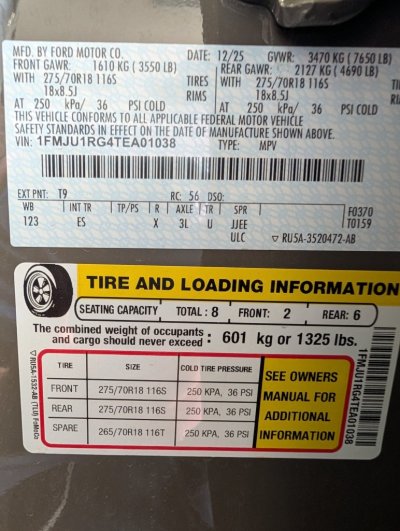
Sticker:
GCVR - 7650
(GAWR front - 3550)
(GAWR rear - 4690)
Payload - 1325
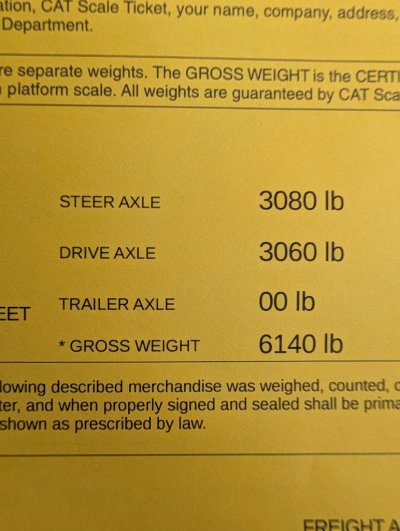
Cat Scale (including driver):
Steer axle - 3080
Drive axle - 3060
Gross - 6140
I estimated a net additional weight in the car of 180 lbs, that's +driver, -a bit of fuel, +minimal gear in car.
Real payload: 7650 - 6140 + 180 = 1690
That's 27% above sticker which seems extraordinarily conservative.
Side note: the 50/50 weight distribution is interesting, it suggests it should drive very balanced unloaded, however it's not optimal for towing. I thought it was strange that an f-150 rates it's hitch at 500 lbs tongue weight maximum without a weight distribution hitch and the 5th gen expedition at 600 lbs. You have to imagine an f-150 would be significantly more front heavy and therefore better off when towing without a WDH. On the other hand the axle ratings on the expedition suggest they are fine with the back being loaded up quite heavy.
Sticker:
GCVR - 7650
(GAWR front - 3550)
(GAWR rear - 4690)
Payload - 1325
Cat Scale (including driver):
Steer axle - 3080
Drive axle - 3060
Gross - 6140
I estimated a net additional weight in the car of 180 lbs, that's +driver, -a bit of fuel, +minimal gear in car.
Real payload: 7650 - 6140 + 180 = 1690
That's 27% above sticker which seems extraordinarily conservative.
Side note: the 50/50 weight distribution is interesting, it suggests it should drive very balanced unloaded, however it's not optimal for towing. I thought it was strange that an f-150 rates it's hitch at 500 lbs tongue weight maximum without a weight distribution hitch and the 5th gen expedition at 600 lbs. You have to imagine an f-150 would be significantly more front heavy and therefore better off when towing without a WDH. On the other hand the axle ratings on the expedition suggest they are fine with the back being loaded up quite heavy.
Last edited: