

Changing spark plugs in '97 5.4

Disclaimer: Links on this page pointing to Amazon, eBay and other sites may include affiliate code. If you click them and make a purchase, we may earn a small commission.

Shadetree

Active Member
Joined
Feb 14, 2010
Posts
43
Reaction score
1
Location
Apple Valley, CA
After reading all the horror stories about doing a plug change in my '97 5.4 I had decided to take it to the local dealer. I called and they quoted $560.00 to change the plugs...Is it really that tough and they are earning the money, or am I getting shafted? I have changed my own plugs for over 50 years but it used to be a 30 minute, no brainer, job...

I took it to the dealer at about 100 k for a recall fix and had asked them to do a tune up while it was there...I never gave it any thought until it started idling a little rough recently. I checked my records and the receipt says nothing about a plug change...I'm assuming it now has 157,000 miles on the factory plugs...I'm thinking about changing them myself because of the cost.. My question is, should I bite the bullet and let a pro do it, or do it myself...What should I be most concerned about....Thanks

 

SOLISIMO

Full Access Members
Joined
Apr 28, 2010
Posts
3,208
Reaction score
122
Location
Ft. Lauderdale
Some guys in here are hard core diy'rs. I have also heard of horror storys and it being a pain in the a55. Ill let some of the 1st gen guys chime in on this but I will tell you that on mine, the dealer will be doing it when it comes time.
 

Thermo

technical advisor
Joined
Apr 18, 2011
Posts
1,404
Reaction score
65
Shadetree, call me a hard core DIY'er, but doing the plugs isn't that bad. Yes, it takes time and you will need to have three 3" extensions. A 6" or 9" extension will not work. TRUST ME!!!!!! Having some flexible joints for your ratchet is somewhat helpful too. I would also tell you to spend the extra $5 and get a box of fuel injector O-rings. When you pull the fuel rail (makes the job much easier), it is very common for the o-ring to roll off of the injector and invariably it will fall down into the valley of the motor.

As for things to watch out for. You want the plugs snug, but not overly tight. too little torque, they will back out and you blow a plug out. Too tight and you stress the aluminum threads and the plug blows out. I seem to recall the proper torque is 15 ft-lbs. After that, do a good inspection of the tops of the COPs for any cracking (replace if they are cracked) and then also look at the rubber boots and make sure that they are in good shape (if not, you can buy just the boots and replace the ones that need to be).

What you will find is the front 4 plugs (2 on each side) are super simple and will take no time to get done. The back 4, well, that will be your challenge. That is where the 3 short extensions come into play due to the limited overhead clearance (much easier if you have a body lift installed). Those will take you about 30 minutes each in just trying to position your body right so you can drop the socket and 1 extension into the hole, add a second extension, then finally dropping the final extension and socket on to the plug. I normally found I could get 2 extensions on the socket and put that on to the plug and that whole assembly would be just about flush with the top of the head. From there you can bring in your ratchet to do the work.

Save your money and get quality double platinum plugs. The "multi-spark" plugs (Bosch +4's, +2's, Splitfires, etc) don't do anything for our trucks. ALl they do is lighten your wallet.
 

dougmcp

Full Access Members
Joined
Feb 3, 2011
Posts
175
Reaction score
1
Location
Roseville, CA
I have done my plugs in about 3 hours and it's not that difficult.

There are only 3 threads in the head that hold the plugs, with 157K miles the probability of carbon build up on the plug threads is likely so you will need to be careful.

There is a service bulletin and procedure from Ford specifically for these engines:
The TSB from Ford is here: http://www.phila.gov/fleet/Warranty%20Recalls/tsb08-07-06%20FORD.pdf

Here is the most important part:
CAUTION
DO NOT REMOVE PLUGS WHEN THE ENGINE IS WARM OR HOT. THE ENGINE MUST BE AT ROOM TEMPERATURE WHEN PERFORMING SPARK PLUG SERVICE. REMOVING THE SPARK PLUGS FROM A WARM/HOT ENGINE INCREASES THE CHANCE THE THREADS COULD BE DAMAGED.

Spark Plug Removal Procedure:
1. Remove the coil-on-plug assemblies and thoroughly blow out the spark plug wells and surrounding valve cover area with compressed air.
2. Back out the spark plugs no more than 1/8 to 1/4 of a turn.
Using Motorcraft Carburetor Tune-Up Cleaner, fill the spark plug well just above where the jamb nut hex sits (1/2 - 3/4 teaspoon).
A minimum period of 15 minutes of soak time is required. The cleaner will wick down to the ground electrode shield and soften the carbon deposits in this time. DO NOT WORK the spark plug back and forth at this point.
 

superexpy

Full Access Members
Joined
Oct 14, 2011
Posts
370
Reaction score
67
Location
Covington wa
I do mine about 2 - 3 times a year with out issue for the past 10 years. Just dont under or over tighten them.
 

Thermo

technical advisor
Joined
Apr 18, 2011
Posts
1,404
Reaction score
65
Baker, like with the spark plugs we are talking about, they are supposed to be tightened to 15 ft-lbs (as I recall). If you overtighten them (ie, take them up to say 20 ft-lbs), what you are doing is effectively pulling the threads out of the head (we are talking on the scale of 0.0001" or so), but it is still stressing the threads. The metal can only take so much stress before it finally gives. Now, keep in mind that when the cylinder fires, you are going to have a certain added stress being applied outwards (in the same direction as the overtorquing). This is what leads to the failure that way.

Now, for undertorquing, this doesn't seem quite so logical. But, in short, when you under torque something, you are not putting a significant amount of stress on the mounting surface (threads of the head in this case). So, the item that you are tightening can move around some (again, we are talking on the scale of 0.0001"). But this repeated moving of the plug (with each firing of the cylinder) will cause either 1) the spark plug to start to rotate, which then will cause it to get less and less torque and lead to it unscrewing itself, or 2) the plug doesn't rotate, but the metal is being hammered over and over which leads to accumulated stresses in the metal due to the "hammering", which will cause the metal to become weaker, leading to a sudden failure.

So, when you look at torquing items, you need it tight enough so the item doesn't move when it is stressed, but not so tight that it puts undo stress on the metal. Where a lot of people mess up is when they think they are doing a good thing and apply a lubricant to a bolt as they torque it (when it should be dry). Apply this lubricant causes the fastener to rotate easier. This will cause the fastener to see more torque (the friction preventing the dry fastener from rotating eats up some of the torque that is ultimately applied to the fastener). More torque, more stress on the fastener/metal surrounding, the more likely it is to fail due to too much stress.

I can go into more detail on this subject. I worked as a quality assurance specialist for awhile and I had to become very intimate with how torque affects various joints and how to ensure the proper amount of torque was applied. I used to have manuals upon manuals on various threaded materials being threaded into other materials with an assortment of lubricants applied. Needless to say, finding the right torque for something (when it is a very critical thing) can be a very detailed process.

The big thing to keep in mind is that metal actually gets slightly stronger when it is stressed slightly. The trick is that if you apply too much stress it will fail catastrophically.
 

jrjr

Full Access Members
Joined
Sep 30, 2011
Posts
197
Reaction score
1
Location
Central NY
The front plugs are pretty straight forward but when we get to the back ones and have to use a flex joint of one kind or another, that changes torque values and/or renders the applied torque inaccurate as I understand it. So do we just 'calibrate' our body and just do the closest we can by feel?

Kind of a rock/hard place scenario I guess.
 
OP
OP
Shadetree

Shadetree

Active Member
Joined
Feb 14, 2010
Posts
43
Reaction score
1
Location
Apple Valley, CA
Thanks Thermo for all the good info...I was hoping to hear something new that I haven't read or heard in my research and you did that..I've been intimidated by the different technology I'm not familiar with...and my Epxy is my DD I can't do without. I like being a DIYer and I'm afraid someone else won't do it right.(ie..not even change out the back plugs)..Did you have any trouble with the extensions coming apart when pulling the socket off the plug? do the three 3" extensions allow for more flexability, or what? Did you spray a nut & bolt loosener in the holes first? Should I go ahead and put in new cops? Did you use anti-sieze on the plugs?...Thanks for your time...
 

Thermo

technical advisor
Joined
Apr 18, 2011
Posts
1,404
Reaction score
65
Shadetree, keep in mind that I did mine at 60K miles. In your case, what I would tell you to do is to get a can of PB Blaster for this project. Granted, Kroil or 3 in 1 oil will probably do the same trick. Now, remove the fuel rail from both sides and then remove all 8 COPs. Now, squirt a healthy dose (about 1 teaspoon from what I have seen on TSBs about this) of fluid into each plug well. Go inside, enjoy a beer (or wait about 15 minutes, whatever works for you). From there, you can start removing the plugs.

As for the three 3" extensions, it isn't so mcuh that it is easier, keep in mind that you have limited overhead clearance. A socket and a 3" extension is about all that you can fit around the bend there. What I would recommend is getting one of the locking extensions (the ones with the knob on the end that you have to depress to let the socket loose) and put that against your plug socket. Then you can use two additional standard extensions from there. I never used a flexible joint when I did my plugs. I was able to get back to my plugs with relative ease as I have worked on a submarine for far too long and have just figured out how to reach my hands into those hard to reach spots.

The other "trick" I will clue you in on is using a little bit of electrical tap inside of a deep well socket. You have to be a little more careful this way, but it will help with getting the plug off of the socket. A little bit of di-electric grease is also a good helper for releasing the plug from a plug socket.

If there are any questions that you can think of, just ask. It isn't that bad and as long as you put some sort of lubricant inside the plug well before trying to loosen the plugs, you should be good. Besides, if you happen to mess up a plug hole, don't worry, I have a Timesert kit that I will send your way. THen all you have to do is pay for the shipping both ways and pay for a timesert ($12 plus S&H). I have your back.
 

2000eb

Full Access Members
Joined
May 9, 2011
Posts
722
Reaction score
4
I recommend using factory motorcraft plugs wth aluminum threads use proper tq look it up 15 ft lbs dont sound right but i am pumped full of hydromorphine post surgery tight now... o and do NOT use antiseize it changez your tq and there is no need to cause the aluminum spark plug threads. Spark plugs cause the most problems for our trucks use ford motorcraft plugs and do it by the book.
 
OP
OP
Shadetree

Shadetree

Active Member
Joined
Feb 14, 2010
Posts
43
Reaction score
1
Location
Apple Valley, CA
Thanks Thermo, and everyone, for all your input..I changed my plugs today without a hitch. I allowad myself 6 hours and was doing a test drive in 2 hours..What a difference in power. I was really surprised at the clean condition of the plugs. The old Motorcraft Platinum 22FS plugs were all in identical condition with about .060 gap and no carbon buildup at all. They look like they could be re-gapped and used again...Now I'm really at a loss as to why the dealer wanted so much to do it...Thanks again...
 

SWADE23

Full Access Members
Joined
Sep 14, 2009
Posts
102
Reaction score
6
Location
QUEENS
Great info....
Ive been looking to do this myself for sometime...
Can anyone recommend a do-it-yourself step by step or a youtube vid on how to do it???
 

Explor2Exped

Full Access Members
Joined
Mar 29, 2011
Posts
701
Reaction score
3
Location
Nashville, TN
This is a really good thread. I'm going to switch out my plugs pretty soon.

One question: How do you know how many pounds of torque your putting in? I see everyone says 25 or 15lbs of torque but I never really did understand what this means...
 

dougmcp

Full Access Members
Joined
Feb 3, 2011
Posts
175
Reaction score
1
Location
Roseville, CA
This is a really good thread. I'm going to switch out my plugs pretty soon.

One question: How do you know how many pounds of torque your putting in? I see everyone says 25 or 15lbs of torque but I never really did understand what this means...
There are 2 definitions:
1) Torque when referring to the installation of bolts, plugs, etc is the amount of force applied and measured either in foot pounds or inch pounds. You need a calibrated torque wrench for this, google is your friend.
2) Torque when going to the bathroom with a hardon is the amount of force it takes to bend it down until your heels lift off the ground. :roflsquared:

Here's a torque wrench for $10: Link to Harbor Freight 3/8" Torque Wrench
 
Last edited:

tinkering

Full Access Members
Joined
Jul 19, 2016
Posts
251
Reaction score
28
Location
Alberta Canada
I hope I'm not repeating some info that's already been posted in this thread. It's late and I am too tired to read the whole thing.
On my 1997 Expedition 5.4L I managed to change all 8 plugs without removing the fuel rails on either side. Let me say, it took me quite some time and if you don't have long fingers you might not succeed; I say might. Undo all hoses and electrical connectors you can to increase the very limited space for the 4 back plugs. The toughest plug is #7 cylinder. I managed to get the COP retaining screw started and fastened down by holding the COP in place with my left hand while turning the fastener one side of the hex head at a time, using a small #7 combination wrench with my right hand, by coming in from the inboard side of that fitting on the fuel rail (pressure regulator).
I didn't want to disturb the seals on the injectors becauae of the age and high mileage of the vehicle. 444000 kms/252000 mi.

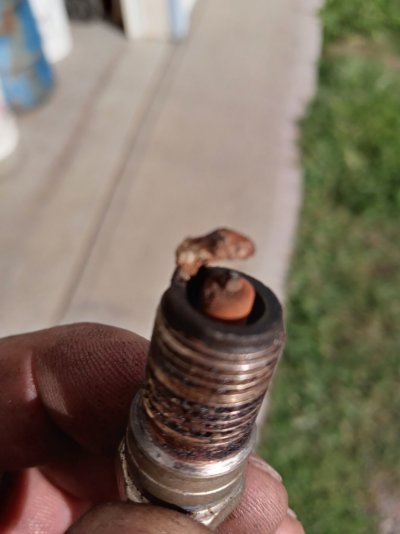
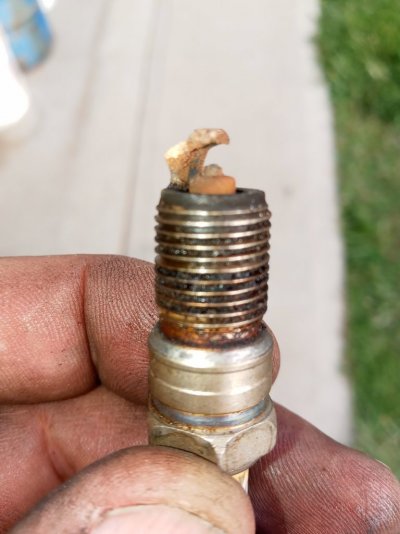
The old plugs were ancient, with heavy mineral build up, and the center electrode completely gone. The gap was 080"!!
I installed Denso T16TT iridium plugs. They came gapped at 038" or something. I know there is a problem with regapping that type of plug but I did them up to .047". See the discussion about regapping Titanium here: https://bobistheoilguy.com/forums/threads/denso-iridium-tt-spark-plug-gap.278530/20210904_173414_HDR.jpg20210904_173047.jpg
 
Last edited:
Top