


You are using an out of date browser. It may not display this or other websites correctly.
You should upgrade or use an alternative browser.
You should upgrade or use an alternative browser.
Help!
- Thread starter Gapafudus
- Start date
Disclaimer: Links on this page pointing to Amazon, eBay and other sites may include affiliate code. If you click them and make a purchase, we may earn a small commission.

OP
OP
Gapafudus
Active Member

OP
OP
Gapafudus
Active Member

98eb5.4
Full Access Members
if not obvious, prob have to get under the truck and have a better look where that part goes,
try to feel areas you may not be able see
try to feel areas you may not be able see
Last edited:
OP
OP
Gapafudus
Active Member
Somebody told me that it's the dirt separator for the evap system vent. But I do not know where does that end go to. Also have a little gas smell after I drive the truck and park it in the drive way. I wonder if this hose not being plugged in where it's supposed to be causes the gas smell?
0xowner
Full Access Members
Welcome Gapafudus... so what have you found is in the radius of the line?
yep it look fuel related.... have you found and snapped it back into a proper line connector?
yep it look fuel related.... have you found and snapped it back into a proper line connector?
OP
OP
Gapafudus
Active Member
No I didn't find where it snaps back, I was told that the dangling end usually sticks into the frame or filler neck trim ring, but I don't see nothing where it could snap in. I really hope that someone can tell me exactly the place that it would snap in and hopefully this will solve my gas smell situation.

Bedrck47
Full Access Members
Evaporative Emissions
Item Part Number Description
1 — Evaporative emissions test port
2 — Evaporative emissions return tube
3 9C915 Evaporative emissions canister purge valve
4 — Throttle body spacer
5 9B593 Fuel vapor vent valve
6 9C015 Tank vapor line assembly
7 9K007 Fuel tank assembly
8 9C016 Canister vapor line
9 9D925 Vapor line connector sleeve
10 9F945 Evaporative emissions canister vent solenoid
11 9D665 Evaporative emissions canister bracket
12 9K324 Rear vapor hose
13 9B328 Dust separator
14 9S320 Canister remote hose
15 9D653 Evaporative emissions canister
16 9B593 Fuel vapor vent valve
17 9C052 Fuel tank pressure sensor
The evaporative emissions (EVAP) system:
prevents hydrocarbon emissions from reaching the atmosphere.
stores fuel vapors in the evaporative emissions (EVAP) canister that are generated during vehicle operation or hot soak, until they can be consumed by the engine during normal engine operation.
routes the stored fuel vapors to the engine during engine operation.
is controlled by the powertrain control module (PCM), which uses various sensor inputs to calculate the desired amount of purge flow. The PCM regulates the purge flow, induced by the application of intake manifold vacuum, by varying the duty cycle applied to the EVAP canister purge valve.
has an evaporative emissions (EVAP) test port for test purposes.
The fuel vapors are routed:
from the fuel tank through the fuel vapor vent valves.
to the (EVAP) canister through a vapor line.
to the engine when the EVAP canister purge valve is opened by the PCM.
The fuel tank pressure (FTP) sensor:
monitors the pressure levels in the fuel tank.
communicates the pressure reading to the PCM during the OBD II leak test.
The evaporative emissions (EVAP) canister:
is located above the spare tire carrier behind the fuel tank.
contains activated carbon.
stores fuel vapors.
The fuel tank filler cap:
relieves system pressure above 14 kPa (56.21 inches H 2 O).
relieves system vacuum below 3.8 kPa (15.26 inches H 2 O).
The canister vent solenoid:
is normally open.
seals the evaporative emissions system for the OBD II leak and pressure tests.
is mounted to the evaporative emissions canister.
is repaired as a separate item.
The evaporative emissions (EVAP) canister purge valve:
is normally closed.
regulates the purging of the EVAP canister.
is controlled by the PCM.
The evaporative emissions (EVAP) system test port:
is located in the EVAP canister purge valve.
is used to connect the Evaporative Emissions System Leak Tester to the EVAP system.
Might be Item # 8 cant say for sure
Item Part Number Description
1 — Evaporative emissions test port
2 — Evaporative emissions return tube
3 9C915 Evaporative emissions canister purge valve
4 — Throttle body spacer
5 9B593 Fuel vapor vent valve
6 9C015 Tank vapor line assembly
7 9K007 Fuel tank assembly
8 9C016 Canister vapor line
9 9D925 Vapor line connector sleeve
10 9F945 Evaporative emissions canister vent solenoid
11 9D665 Evaporative emissions canister bracket
12 9K324 Rear vapor hose
13 9B328 Dust separator
14 9S320 Canister remote hose
15 9D653 Evaporative emissions canister
16 9B593 Fuel vapor vent valve
17 9C052 Fuel tank pressure sensor
The evaporative emissions (EVAP) system:
prevents hydrocarbon emissions from reaching the atmosphere.
stores fuel vapors in the evaporative emissions (EVAP) canister that are generated during vehicle operation or hot soak, until they can be consumed by the engine during normal engine operation.
routes the stored fuel vapors to the engine during engine operation.
is controlled by the powertrain control module (PCM), which uses various sensor inputs to calculate the desired amount of purge flow. The PCM regulates the purge flow, induced by the application of intake manifold vacuum, by varying the duty cycle applied to the EVAP canister purge valve.
has an evaporative emissions (EVAP) test port for test purposes.
The fuel vapors are routed:
from the fuel tank through the fuel vapor vent valves.
to the (EVAP) canister through a vapor line.
to the engine when the EVAP canister purge valve is opened by the PCM.
The fuel tank pressure (FTP) sensor:
monitors the pressure levels in the fuel tank.
communicates the pressure reading to the PCM during the OBD II leak test.
The evaporative emissions (EVAP) canister:
is located above the spare tire carrier behind the fuel tank.
contains activated carbon.
stores fuel vapors.
The fuel tank filler cap:
relieves system pressure above 14 kPa (56.21 inches H 2 O).
relieves system vacuum below 3.8 kPa (15.26 inches H 2 O).
The canister vent solenoid:
is normally open.
seals the evaporative emissions system for the OBD II leak and pressure tests.
is mounted to the evaporative emissions canister.
is repaired as a separate item.
The evaporative emissions (EVAP) canister purge valve:
is normally closed.
regulates the purging of the EVAP canister.
is controlled by the PCM.
The evaporative emissions (EVAP) system test port:
is located in the EVAP canister purge valve.
is used to connect the Evaporative Emissions System Leak Tester to the EVAP system.
Might be Item # 8 cant say for sure
Attachments


It's Item# 14 (9S320 Canister remote hose) on the picture and description Bedrck47 posted above...
On my 2003 that hose goes up parallel to the Fuel Filler Tube for the Fuel Tank and its zip tied to the Filler Neck at the top on the inside of the fender. Its the vent tube for the Emission Canisters... mine too smells a little like fuel when I drive the truck and park it in the drive way.
On my 2003 that hose goes up parallel to the Fuel Filler Tube for the Fuel Tank and its zip tied to the Filler Neck at the top on the inside of the fender. Its the vent tube for the Emission Canisters... mine too smells a little like fuel when I drive the truck and park it in the drive way.
Last edited:
OP
OP
Gapafudus
Active Member
It's Item# 14 (9S320 Canister remote hose) on the picture and description Bedrck47 posted above...
On my 2003 that hose goes up parallel to the Fuel Filler Tube for the Fuel Tank and its zip tied to the Filler Neck at the top on the inside of the fender. Its the vent tube for the Emission Canisters... mine too smells a little like fuel when I drive the truck and park it in the drive way.
Thanks for the info. Can you please, if it doesn't trouble you, take some pics of where exactly the hose goes on your Expy? I would really appreciate it.
OP
OP
Gapafudus
Active Member
Evaporative Emissions
Item Part Number Description
1 — Evaporative emissions test port
2 — Evaporative emissions return tube
3 9C915 Evaporative emissions canister purge valve
4 — Throttle body spacer
5 9B593 Fuel vapor vent valve
6 9C015 Tank vapor line assembly
7 9K007 Fuel tank assembly
8 9C016 Canister vapor line
9 9D925 Vapor line connector sleeve
10 9F945 Evaporative emissions canister vent solenoid
11 9D665 Evaporative emissions canister bracket
12 9K324 Rear vapor hose
13 9B328 Dust separator
14 9S320 Canister remote hose
15 9D653 Evaporative emissions canister
16 9B593 Fuel vapor vent valve
17 9C052 Fuel tank pressure sensor
The evaporative emissions (EVAP) system:
prevents hydrocarbon emissions from reaching the atmosphere.
stores fuel vapors in the evaporative emissions (EVAP) canister that are generated during vehicle operation or hot soak, until they can be consumed by the engine during normal engine operation.
routes the stored fuel vapors to the engine during engine operation.
is controlled by the powertrain control module (PCM), which uses various sensor inputs to calculate the desired amount of purge flow. The PCM regulates the purge flow, induced by the application of intake manifold vacuum, by varying the duty cycle applied to the EVAP canister purge valve.
has an evaporative emissions (EVAP) test port for test purposes.
The fuel vapors are routed:
from the fuel tank through the fuel vapor vent valves.
to the (EVAP) canister through a vapor line.
to the engine when the EVAP canister purge valve is opened by the PCM.
The fuel tank pressure (FTP) sensor:
monitors the pressure levels in the fuel tank.
communicates the pressure reading to the PCM during the OBD II leak test.
The evaporative emissions (EVAP) canister:
is located above the spare tire carrier behind the fuel tank.
contains activated carbon.
stores fuel vapors.
The fuel tank filler cap:
relieves system pressure above 14 kPa (56.21 inches H 2 O).
relieves system vacuum below 3.8 kPa (15.26 inches H 2 O).
The canister vent solenoid:
is normally open.
seals the evaporative emissions system for the OBD II leak and pressure tests.
is mounted to the evaporative emissions canister.
is repaired as a separate item.
The evaporative emissions (EVAP) canister purge valve:
is normally closed.
regulates the purging of the EVAP canister.
is controlled by the PCM.
The evaporative emissions (EVAP) system test port:
is located in the EVAP canister purge valve.
is used to connect the Evaporative Emissions System Leak Tester to the EVAP system.
Might be Item # 8 cant say for sure
Thank you so much for the info sir.

Hamfisted
Full Access Members
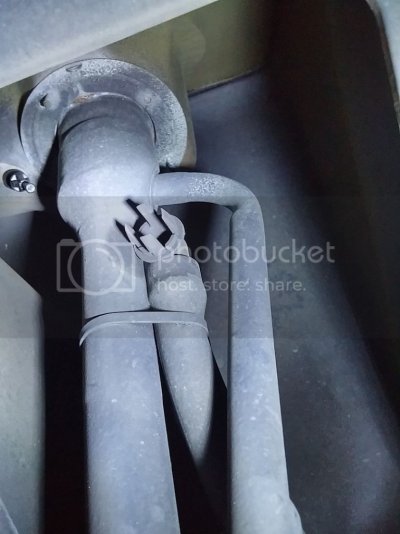
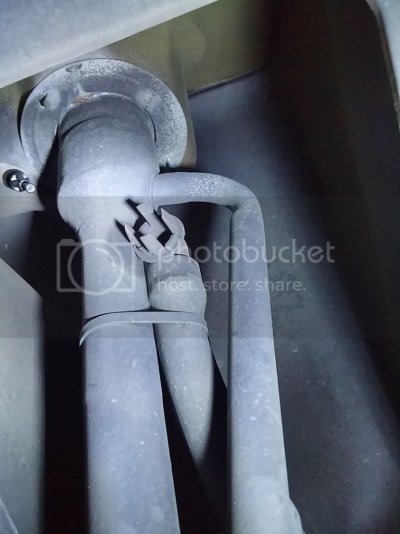
Yeah that hose is just zip tied along the fuel tank filler hose . Here's a pic.
-Mike
Fuel Tank Purge Canister Vent Hose .....

-Mike
Fuel Tank Purge Canister Vent Hose .....
OP
OP
Gapafudus
Active Member
Yeah that hose is just zip tied along the fuel tank filler hose . Here's a pic.
-Mike
Fuel Tank Purge Canister Vent Hose .....
Oh! So it doesn't clip anywhere?
98eb5.4
Full Access Members
just making sure, no engine codes here?
OP
OP
Gapafudus
Active Member
just making sure, no engine codes here?
No, don't have any engine code, I had one about 2 months ago, about vapor leak and a replace the gas cap. It never came back, but I wonder if this hose had something to do with it.

OP
OP
Gapafudus
Active Member
Nope... It doesn't clip anywhere. Its just a vent hose, but when I saw the nozzle at the end of it, I also thought it had to connect to something... very misleading if you ask me!
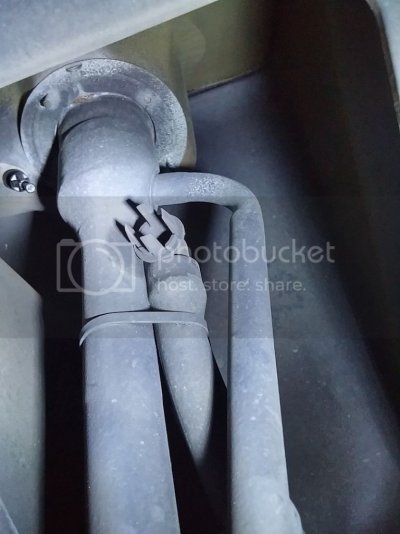
Thanks for the replay and pic. It's weird how it doesn't clip anywhere. I got under my Explorer today and look to see if it has it, and of course it has one and it was clipped into a hole where the gas door is. I wonder how come the expedition don't have it. Well now this cancels my fuel smell outside. Got to find the source. Maybe I need a new fuel filter and might as well change the air filter.
Similar threads
- Replies
- 4
- Views
- 1K
- Replies
- 2
- Views
- 2K

- Replies
- 3
- Views
- 831
- Replies
- 6
- Views
- 872
- Replies
- 16
- Views
- 3K

