Oil analysis as a predictor for cam phaser/timing chain/cam/follower issues?

Disclaimer: Links on this page pointing to Amazon, eBay and other sites may include affiliate code. If you click them and make a purchase, we may earn a small commission.

GaryH2

Full Access Members
Joined
May 6, 2006
Posts
322
Reaction score
53
Location
SE PA
I have a 2007 with 200k and have run synthetic and semi-syn (Motorcraft) 5W-20 at 5k intervals since I picked up the Bus. I've had regular oil analysis. A couple of comments - 1) Blackstone recommended I try 7500 mile interval from what they saw in the analysis and my driving habits, 2) No significant metals were present in the tests. "Your results may vary."

So, A) Try shortening intervals to 7500 B) I've seen no evidence that oil analysis can given indication of phaser or chain issues so far C) Granted you're in FL, but I'm not sure that I would run 10W-30 due to the small passages.

I'm doing this from my phone so I'll try to post my results later today. Hopefully it is of some help and interest.

Sent from my moto z3 using Tapatalk
 

jeff kushner

Full Access Members
Joined
Nov 30, 2014
Posts
2,330
Reaction score
1,276
Location
North of Annapolis
One should expect opinions on forums...if one doesn't wish for candid opinions, one could always pay a master mechanic to tell you his......

The banter is to be expected my friend, no apology necessary, right? JE...I love that picture!!

Funny as heck!

Anyway, I knew you were walking into a minefield the same as you did but I also understand scientific method and looking for the predictors or future issues.

The guys here know that I build high perf 2 stroke engines and to get super high perf, one needs to spin them rather rabidly (yes, you read that correctly)....when my engine spins at 13,000 rpm, (your 4 stroke would be spinning 26,000rpm) and bad things happen very quickly but I intentionally overstress them to see where the fail-points are so that, exactly as you are trying to do, I'm able to watch for those fracture areas which become a looking glass.

Good luck brother,

jeff
 

Boostedbus

Full Access Members
Joined
Mar 1, 2018
Posts
747
Reaction score
465
Location
Maryland
Now that the guys who know have chimed in, I'll say that whiles it's convenient to think oil passages closeup similarly to a radiator channel, they just don't do that without lots and lots of dirt. Any half-clean oil is going to flow w/o clogging up passages but let's keep in mind that engines are heavily "engineered" with goal of cost savings. The engineering in a perfect world has real world consequences when the "just enough", isn't enough due to some other issue cropping up.

Now, today, "cost savings" is calculated to include lower customer issues while saving weight/cost of each component in each assembly. It does no good for them to get a oil pump for free from the supplier if it causes massive warranty costs so all this is quantified both in monetary and cost production terms.

You didn't want comments bout your oil change intervals so I won't......but you do realize that filter goes into bypass in your engine, prob at 8000 or so? That known, it still takes a lot of abuse to beat a V8 to death, a lot more than 70K.

jeff
Absolutely about the filter! All this talk about the oil analysis and the filter is spent and restricting oil flow. Maybe have the 15,000 mi. filter flow tested and figure out how many miles you can go before compromising oil pressure and volume. Both are very important on these engines especially when it comes to cams as we all know. Keep the old oil in forever if you feel it checks out by analysis, but at least change the filter at sooner intervals.
 

Trainmaster

Old School Member
Joined
Jun 17, 2017
Posts
3,618
Reaction score
2,122
Location
Rockaway Beach, NY
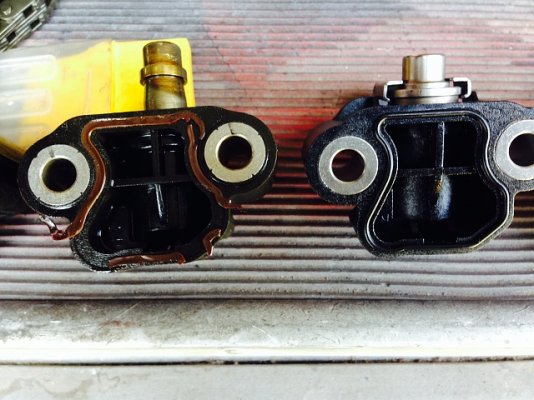
The failure point in these engines appear to be the gaskets on the tensioners and the timing chain guides... am I correct on that? The gaskets leaks and reduce front oil pressure and the plastic guides fall apart probably due to mechanical or chemical changes in the plastic, and the degradation of elasticizers caused by heat.

Would be interesting to see what variables exist with the parts, their assembly and of course oil composition and its breakdown. Then there's the introduction of different types of operation and heat. And, too the game of chance, as no two engines are truly equal.

Never seen anything on this... would be nice to see some scientific insight. Certainly Ford Engineering knows everything there is to know about it.

Would also be valuable to start a thread on an F-150 site, and there are many more of them and some extremely knowledgeable mechanics, engineers and Ford designers owning and breaking them.
 
Last edited:

jeff kushner

Full Access Members
Joined
Nov 30, 2014
Posts
2,330
Reaction score
1,276
Location
North of Annapolis
From just the posts on "longevity" on this forum over the past few days tell us that if we are lucky....5 or 6 out of 100 Expys will even make it to 200,000 and Expys are one of the longest!

Your results will vary.....

I agree with Train and the OP that finding these predictors would be invaluable to us as owners and more so for Ford.

My own experience is that once the traces of a failure are in the oil, the damage is done. You can see the evidence but there's no period of time between the appearance of evidence and the actual failure.

jeff
 

5150 pops

Full Access Members
Joined
Jul 30, 2018
Posts
296
Reaction score
81
Location
Virginia
From just the posts on "longevity" on this forum over the past few days tell us that if we are lucky....5 or 6 out of 100 Expys will even make it to 200,000 and Expys are one of the longest!

Your results will vary.....

I agree with Train and the OP that finding these predictors would be invaluable to us as owners and more so for Ford.

My own experience is that once the traces of a failure are in the oil, the damage is done. You can see the evidence but there's no period of time between the appearance of evidence and the actual failure.

jeff

Git 'er dun!!!!
There's a thread, somewhere on the interwebs, (can't remember where, Google is ur friend) mentioning the degradation/deterioration of the Puralator version of the Motorcraft FL500?oil filter (The effin same motorcraft filter that is recommended in 3.5 Ecoboost 2nd gen- possibly 1st gen too, but I don't care to verify) as a known problem with a certain "lot."
Puralator is the same company that produces the rebranded "Motorcraft" oil filter.
AFAIK there are zero published reports of ANY motorcraft branded oil filters for the same use - 3.5 Ecoboost. It strikes me a little more than weird, that essentially the exact same filter with possibly different paint and insignia, NEVER had ONE failure?????

Particulate matter being sent through the galley's and other passages within the engine, could easily lead to a FALSE reading with the "advanced" 2nd generation variable oil pump on Gen II's and cause almost instantaneous irreversible engine damage as a result.

There in lies my situation, for better or worse, no oil analysis could foretell of impending doom, unless the filter was immediately changed AND entire engine meticulously cleaned, (not likely).

I submit this, NOT as a bearer of doom and gloom, but simply as information. I do not believe if this problem (IF EVER confirmed by FORD) is ever brought to light, is widespread. I do believe it is a very real possibility based on information gleaned from professionals who most certainly will NOT, go public and support the assertions I've submitted here, simply because you don't bite the hand that feeds you.

Sure there will still be the TROLL(s) who don't comprehend that this is at all possible, and assert taking a vehicle to TEST AND TUNE session(s) at a closed course, as "Racing and Abuse", but as the saying goes...agree to ****** disagree!!!!


EDIT....Just realised this thread did not originally coincide with the 4th generation Expedition, as such, my comments should be taken, with even LESS than the proverbial grain of salt.

 
Last edited:
OP
OP
I

inmanlanier

Full Access Members
Joined
Jun 1, 2014
Posts
156
Reaction score
43
Location
Florida
Thanks for the feedback, gents. Trainmaster - I had not yet learned of what you purport regarding gaskets - I'll try and dig further on that. Your explanation makes much more sense to me regarding oil pressure degradation due to a failing gasket and my local bud/shops explanation of damage witnessed in numerous vehicles (typically passenger bank, front) are the ones that wear/fail.

If that is the primary cause for these issues (pressure related cause anyway) then degraded oil pressure would likely not be noticed in this shunt line since it's metered and likely won't affect pump output pressure where measured. Of course, as I understand it our gauge is an idiot on/off 'switch' that moves a needle to a fixed point anyway, so the on board indication likely would not show in advance.

Does anyone know the makeup of the 'plastic' chain guide pieces?
 
Last edited:
OP
OP
I

inmanlanier

Full Access Members
Joined
Jun 1, 2014
Posts
156
Reaction score
43
Location
Florida
If, in fact the pressure on this rail is metered (i.e. a small orifice on the feed side), then a ruptured gasket like that can have significant effects on pressure. It depends on total flow (design) through the line and how much extra flow these gasket leaks can allow.
 

Trainmaster

Old School Member
Joined
Jun 17, 2017
Posts
3,618
Reaction score
2,122
Location
Rockaway Beach, NY
That's exactly what happens. The pressure drops, the phasers stop phasing and the cam bearings loose lubrication. I don't know at what point the chain guides fall apart and get sucked up by the oil pickup. That's probably unrelated and just makes oiling problems worse when the plastic chunks clog up things.
 
OP
OP
I

inmanlanier

Full Access Members
Joined
Jun 1, 2014
Posts
156
Reaction score
43
Location
Florida
Do you have particular part numbers for those pieces? They don't look to be very involved. I would almost think as a preventive measure replacing them (if easy) would be a proactive thing to do at some point in time. In my usta career, gaskets was one of my areas of expertise. It's hard to tell, are there reliefs/recesses in the base part material for the gaskets to reside, or are these simply small beads of some polymer in between two flat surfaces?
 

JExpedition07

That One Member
Joined
Mar 30, 2017
Posts
6,530
Reaction score
3,140
Location
New York
Your pulling the timing cover to replace the tensioners, at that point replacing the whole timing set makes more sense.
 

jeff kushner

Full Access Members
Joined
Nov 30, 2014
Posts
2,330
Reaction score
1,276
Location
North of Annapolis
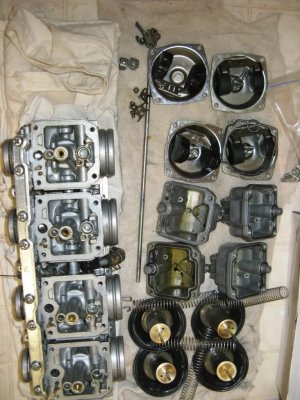
I think Train is referring to the same seated o-rings that we use on carbs's float bowls in the bike world........3 of the orings are present, one removed prior to cleaning.

82650turbo259.jpg
 

Trainmaster

Old School Member
Joined
Jun 17, 2017
Posts
3,618
Reaction score
2,122
Location
Rockaway Beach, NY
Yup, looks like that... I don't know why some of the Ford ones fall apart. They are under pressure on the trucks, but the pictures I've seen look like they broke up into pieces. Maybe a bad compound or poorly torqued components?
 

5150 pops

Full Access Members
Joined
Jul 30, 2018
Posts
296
Reaction score
81
Location
Virginia
Yup, looks like that... I don't know why some of the Ford ones fall apart. They are under pressure on the trucks, but the pictures I've seen look like they broke up into pieces. Maybe a bad compound or poorly torqued components?


These little jewels are part of a topic the Fordtechmakuloco (pronounced - Ford Tek make you loco - as he has said) has on one of his YouTube channel videos.

Still no definiteive reason given on my '18's ailments or cause of low oil pressure, but at least you fellas with pre '18 Expedition and pre F150 3.5's don't need to be concerned with yet another failure from a different area...because you have a mechanical oil pump. The new for 18 Expedition has potential for an oil pump to receive a "false reading (s) at which point it can relieve itself, starving other critical pressure dependant areas. All in the name of fuel economy increase. It's worth mentioning in the majority of Ford literature the second generation Ecoboost present in +17 F-150 and +18 Expedition coupled with the all new 10 speed tranny and aluminium body panels, are responsible for the increased fuel economy. After reading several articles including the one below, IMO that reference has more to do with planned obsolescence veiled as improvements, that have a duty cycle not much more than the basic powertrain warranty (engine) and bumper to bumper (paint and body panels). Which would net dealership traffic either to trade in, or their service department for work. So what if less than 1%-5% fail prior to warranty expiration.

Granted there's still quite a few years before any of this could come to fruition, but there are already quite a few 2017+ F-150 owners who have reported problems that are oil pressure related, but other parts have been replaced, and they're sent on their way. Before you say "what's your problem pops, theirs was fixed, and it was found to be something other than the variable oil pump?" all of these mysterious "unrelated failures" have another thing in common besides being contingent on oil pressure to operate normally as designed...they all mentioned noise. Noise from the passenger side bank, as well as the bottom of engine. Once the diagnosed part(s) are replaced and owner is sent on their way, they all mentioned the noise still being present, simply not as loud. Which sounds a lot like the absolute minimum was done inside of warranty (right head replacement is a common occurrence) yet damage to bearings and other soft material components located in both heads are not, expressly to save Ford money. Can't say I'd blame them, most for profit enterprises operate by lean margins, and the big 3 never really recovered from their near death. This hiding of the real problem will no doubt be the final nail...
Gt350 owners already have a suit for their engines willingness to expire.

Those of you who are pleased, I'm happy for you, but I have owned close to 100 maybe more internal combustion engined vehicles 2, 4, and 10 wheeled (road tractor), I've treated them all the same from day one. Some say it's abusive, I beg to differ, maintenance intervals on all of them were accelerated, and never half assed.
My Expy is the first to fail.

http://www.underhoodservice.com/variable-displacement-future-oil-pump/
 
Last edited:

jeff kushner

Full Access Members
Joined
Nov 30, 2014
Posts
2,330
Reaction score
1,276
Location
North of Annapolis
An interesting(to me anyway) observation following your post Pops is that the Oil pressure light was one of the first bits "tech" added to the Japanese motorcycle gauges. Honda routinely used 45-60PSI yet ask early 80's v4 users about top-end oiling. Since "insert" bearings are now commonplace, ANY loss of pressure and you are 100% correct. Damage is instant and typically catastrophic.

In the 4 stroke bike world, we see crank gallery common chambers to allow active cylinders to lower pumping losses and lots of other mods in search of that efficiency.

From reading everything, it would seem that an oil pressure gauge with warning, would be the ticket but I believe that all the top-end oiling is internal so I'm not sure where that gauge would be installed since between the pump and top end is where it needs to be.

jeff
 

5150 pops

Full Access Members
Joined
Jul 30, 2018
Posts
296
Reaction score
81
Location
Virginia
Another interesting tidbit, I forgot to mention, which is an abomination of epic proportions.

Imagine driving 60-65mph on freeway in sparse but present, traffic that is also merging on and off from both left and right sides of the freeway. Suddenly you get an alarm.via the dash warning of low oil pressure. First instinct, if you are like me and value their engine, warranty or not is to immediately press clutch select neutral, while killing the ignition, then worry about getting /coasting off roadway to shoulder/grass/exit ramp shoulder. If you're driving an automatic transmission, selecting neutral without regard to the non-existent clutch pedal, then killing ignition, etc.

Problem is...with the 10 speed auto transmission, as delivered/programmed from Ford, none of these actions are possible!!!
I shit you not, you can eventually get the vehicle in neutral to allow it to roll, for instance, for towing purposes where the engine is unable, or should not be run. But you absolutely can't go and kill your ignition, while in gear, without the tranny knob selecting Park.

Certain conditions are programmed to allow the vehicle to go into neutral, but on the fly when it is most imperative to shut the engine down to prevent further damage, due to oiling or other problems, (fire), can't be done.

Ain't this a glaring *****!?!?
 

JExpedition07

That One Member
Joined
Mar 30, 2017
Posts
6,530
Reaction score
3,140
Location
New York
Correct, only trucks with Keyed ignition can be shut down on demand.

Reason #546 why push to start is a not so good trend.
 
Last edited:
Top