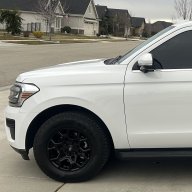

To go with 18” or 20” wheels on 23 Limited Max

Disclaimer: Links on this page pointing to Amazon, eBay and other sites may include affiliate code. If you click them and make a purchase, we may earn a small commission.

zeecarr

Well-Known Member
Joined
Jan 19, 2024
Posts
74
Reaction score
56
Location
Florida
Does anyone have a model and part number or direct link to some aftermarket or OEM 18" wheels with the correct offset that are bolt-on compatible with my 2023 Expo? I really would prefer not having to cut off the axle tips off. My 22 F-150 had to have rear axle replacement at 12,000 miles! I realize this is an independent rear and very different than F150, but still...

I'm going to be living in the mountains half the year dealing with steep wet roads and lot of gravel. The truck stays in 4A 100% of the time there. I want to have a set of 18s with moderately aggressive tires and keep my set of 22s for when I'm in Florida.
 

JAMADOR

Full Access Members
Joined
Sep 7, 2022
Posts
167
Reaction score
44
Location
Spring, TX
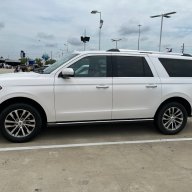
Our 18 Max Limited has OE 20s
Our pool car at work is a 2022 SWB XLT on 18s.

The 18s are definitely smoother on the road.
 

fordperfaddict

Full Access Members
Joined
Oct 22, 2022
Posts
105
Reaction score
31
Location
Michigan
Yes, trimming is required for all the F150 wheels that I know of. Needs to be done to fit the centercap. I did a bunch of measuring and then hit it with the sawzall. It's some hard metal, took my time and used a couple of blades but it was easy enough work as long as the weather is cooperative. Totally worth it to me as I love these wheels especially with the color of the truck, it's a fantastic match.

View attachment 81887

I wanted some decent tires as we were headed to Moab for Thanksgiving week and they worked great. They might be stiff tires but the ride is freaking plush compared to the ride with the 22's. I think if the tires were softer it'd affect the handling. It still handles curves pretty well with this setup for the big lumbering pig that it is.
any idea why ford would end up doing this in their design? why not just make it the same as the f150?
 

GixxerJasen

Full Access Members
Joined
Aug 8, 2022
Posts
554
Reaction score
513
Location
DFW TX
any idea why ford would end up doing this in their design? why not just make it the same as the f150?
Because the F150 is a truck designed to haul different things than the Expedition. Take a look at the rear suspension of your Expedition and you'll realize that it's not a solid axle with leaf springs but instead has independent rear suspension for a better ride quality. Two different designs, and one of them for some reason Ford felt like it needed a bunch of extra threads.

also, does cutting the axle affect anything when going back to stock?
It's just extra threads sticking out, you can swap wheels back and forth once it is cut, you don't do anything with those threads when swapping wheels.
 

bb37

Staff member
Super Moderator
Member Relations Specialist
Joined
Aug 14, 2017
Posts
408
Reaction score
285
Location
Indiana
Two different designs, and one of them for some reason Ford felt like it needed a bunch of extra threads.
On light duty solid rear axles, such as those used on a 1/2 ton truck, you have a flange with studs that is used to attach the brake disk and road wheel plus a rod that goes into the differential housing and splines into the differential. The flange and the rod are forged as one piece. There's no need for threads on the end of the rod to attach the flange to the rod. The axle bearings are in the end of the axle tube. To hold the axle in place, there's either a C-clip on the end of the rod inside the differential or a keeper that's bolted onto the end of the axle tube.

On an independent rear suspensions, you have a flange on the end of a short tube that spins in a bearing which rides in a bearing carrier (Ford calls it the knuckle). The axle has a universal joint at the differential housing and another universal joint at the bearing carrier. The outer U-joint has a short shaft that goes through the bearing, the short tube, and the flange. This shaft has external splines and the tube has internal splines so that torque from the differential can drive the wheels. But, you need a way to hold that short shaft in place inside the flange. Hence, the threads and a big nut which is torqued to 184 lb. ft.

This image from the shop manual shows the shaft (highlighted in blue) from the outer U-joint sticking through the flange:
1754488751328.png

Here's an image showing the axle shaft going to the differential (to the right) and the splined shaft on the outer U-joint (to the left). The yellow-shaded area is the threads.
1754488580165.png

I imagine that the long threads and the non-threaded pilot at the end of the shaft are there to assist in assembly. Once the nut is spun down on the shaft, the pilot is unnecessary.
 

zeecarr

Well-Known Member
Joined
Jan 19, 2024
Posts
74
Reaction score
56
Location
Florida
So I think I will go with the Tremor wheels and not use the factory caps, so I don't have to cut the axle. Looks like the caps are a standard size of 2-1/8 inch. I just need one that is a bit taller or I will make some on my 3D printer.

If this was an older car like my 2004 Yukon with 300K miles on it, I would cut off the threads without hesitation...and have done much worse already.
 

SilverStealth

Well-Known Member
Joined
Dec 13, 2024
Posts
75
Reaction score
76
Location
Northern California
So I think I will go with the Tremor wheels and not use the factory caps, so I don't have to cut the axle. Looks like the caps are a standard size of 2-1/8 inch. I just need one that is a bit taller or I will make some on my 3D printer.

If this was an older car like my 2004 Yukon with 300K miles on it, I would cut off the threads without hesitation...and have done much worse already.
Sounds like a solid plan. Cutting the axles sounds way more intensive than it actually is and opens up more wheel choices. If you go with aftermarket wheels, I'm pretty sure most companies offer "extended" caps as well. The Tremors look good though.
 

bb37

Staff member
Super Moderator
Member Relations Specialist
Joined
Aug 14, 2017
Posts
408
Reaction score
285
Location
Indiana
I've heard varying reports about how much you have to cut off. Looks like the un-threaded pilot is about 1/4" to 3/8". Don't know if just cutting off the pilot is enough or not.
 

GixxerJasen

Full Access Members
Joined
Aug 8, 2022
Posts
554
Reaction score
513
Location
DFW TX
Sounds like a solid plan. Cutting the axles sounds way more intensive than it actually is and opens up more wheel choices. If you go with aftermarket wheels, I'm pretty sure most companies offer "extended" caps as well. The Tremors look good though.
Changing your oil is more difficult than this. Seriously, you are cutting off the end of a "giant bolt" that, as stated by bb37 is only necessary during installation. There's still a ton of threads left afterwards.

As for how much, I measured with a caliper and got it pretty spot on. It's the end and a couple of threads that have to come off. Having factory caps will look much better than 3D printed ones will.

PXL_20221008_190535426-L.jpg
 

fordperfaddict

Full Access Members
Joined
Oct 22, 2022
Posts
105
Reaction score
31
Location
Michigan
On light duty solid rear axles, such as those used on a 1/2 ton truck, you have a flange with studs that is used to attach the brake disk and road wheel plus a rod that goes into the differential housing and splines into the differential. The flange and the rod are forged as one piece. There's no need for threads on the end of the rod to attach the flange to the rod. The axle bearings are in the end of the axle tube. To hold the axle in place, there's either a C-clip on the end of the rod inside the differential or a keeper that's bolted onto the end of the axle tube.

On an independent rear suspensions, you have a flange on the end of a short tube that spins in a bearing which rides in a bearing carrier (Ford calls it the knuckle). The axle has a universal joint at the differential housing and another universal joint at the bearing carrier. The outer U-joint has a short shaft that goes through the bearing, the short tube, and the flange. This shaft has external splines and the tube has internal splines so that torque from the differential can drive the wheels. But, you need a way to hold that short shaft in place inside the flange. Hence, the threads and a big nut which is torqued to 184 lb. ft.

This image from the shop manual shows the shaft (highlighted in blue) from the outer U-joint sticking through the flange:
View attachment 85444

Here's an image showing the axle shaft going to the differential (to the right) and the splined shaft on the outer U-joint (to the left). The yellow-shaded area is the threads.
View attachment 85442

I imagine that the long threads and the non-threaded pilot at the end of the shaft are there to assist in assembly. Once the nut is spun down on the shaft, the pilot is unnecessary.
thanks for the explanation!
 
Top