

You are using an out of date browser. It may not display this or other websites correctly.
You should upgrade or use an alternative browser.
You should upgrade or use an alternative browser.
Feel free to laugh... whats the socket size for the center nut to take wheel off?
- Thread starter Adieu
- Start date
Disclaimer: Links on this page pointing to Amazon, eBay and other sites may include affiliate code. If you click them and make a purchase, we may earn a small commission.
I believe its a 1 1/8" or 1 1/4". A very uncommon socket size. Years ago I had to buy one and could only find it in an impact socket version. Haven't used it since. Oh, and you're not supposed to re-use the nuts, they're TTY. Are you asking if you need to remove the hub to replace a shock? No, you shouldn't have to.
Edit: You don't need to remove the hub nut to remove the tire. Is that what you're asking?
Edit: You don't need to remove the hub nut to remove the tire. Is that what you're asking?
I believe its a 1 1/8" or 1 1/4". A very uncommon socket size. Years ago I had to buy one and could only find it in an impact socket version. Haven't used it since. Oh, and you're not supposed to re-use the nuts, they're TTY. Are you asking if you need to remove the hub to replace a shock? No, you shouldn't have to.
Edit: You don't need to remove the hub nut to remove the tire. Is that what you're asking?
The huge nut under the hubcap in the middle on the rear wheel, on what looks to be the axle... does it need to come off to remove the wheel?
What about to change rear shocks?
intelisevil
Member
No & no.
ExpeditionAndy
Full Access Members
Adieu can you post a picture so we are absolutely clear about what you are asking so we don't give you the wrong answer?The huge nut under the hubcap in the middle on the rear wheel, on what looks to be the axle... does it need to come off to remove the wheel?
What about to change rear shocks?
Adieu can you post a picture so we are absolutely clear about what you are asking so we don't give you the wrong answer?
The thing in the verry center on the rears. On the axle itself. Visible from outside if hubcaps are off
Big Brian
Full Access Members
no
ExpeditionAndy
Full Access Members
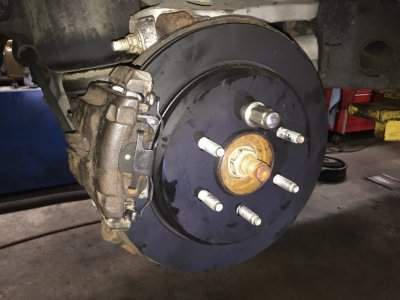
Does it look like the nut this picture? If not you only have to remove that nut to pull the axle half shaft. The picture is from my 05 when I had the rotors and pads changed.The thing in the verry center on the rears. On the axle itself. Visible from outside if hubcaps are off
USMCBuckWild
Full Access Members
Not sure if serious......
IIRC its 36mm. And no, you do not need to remove it to remove the wheel.
If you have removed all the lug nuts and the wheel is still stuck to the hub, you most likely have corrosion freeze. Squirt around the hub/wheel mating surface and inside the lugnut holes around the studs with some weasel piss (any penetrating lubricant of your choice). Give it an hour, squirt again then use a block of wood against the wheel and give it a few sharp whacks with a heavy instrument of your choice.
I do NOT recommend using a chisel to drive in between the hub and wheel. There are slots on the back of the wheel for that purpose but it never works out the way you want it to.
And no, you do not need to remove the axle nut and axle stub from the hub to change shocks.
IIRC its 36mm. And no, you do not need to remove it to remove the wheel.
If you have removed all the lug nuts and the wheel is still stuck to the hub, you most likely have corrosion freeze. Squirt around the hub/wheel mating surface and inside the lugnut holes around the studs with some weasel piss (any penetrating lubricant of your choice). Give it an hour, squirt again then use a block of wood against the wheel and give it a few sharp whacks with a heavy instrument of your choice.
I do NOT recommend using a chisel to drive in between the hub and wheel. There are slots on the back of the wheel for that purpose but it never works out the way you want it to.
And no, you do not need to remove the axle nut and axle stub from the hub to change shocks.
JimS
Member
LOL! I'm laughing because the first time I tried to take a tire off my used 11 Expy it wouldn't budge and I found myself thinking the same thing. I was like, "What the????"Lol yeah ....i did try searching for like 15 mins btw
Or is that just for hub removal? Do i need ot to do shocks or not?
It took me a bit to figure out the rim was just rusted on there real good.
Just loosen the lug nuts a tiny bit, drive it around the block slowly swerving a bit, and then it will come right off.
Oh no, I'm not struggling (yet)...was just planning ahead
Turns out I misunderstood anyway, the two atypical humongous sockets needed for a shock install are for the SHOCK bolt and nut (30mm and 27mm deep-ish and preferably impact sockets).... which is probably why the DIY guides never mention the rear axle nut size lol.
Anyway, I already own a 36mm
Turns out I misunderstood anyway, the two atypical humongous sockets needed for a shock install are for the SHOCK bolt and nut (30mm and 27mm deep-ish and preferably impact sockets).... which is probably why the DIY guides never mention the rear axle nut size lol.
Anyway, I already own a 36mm
theoldwizard1
Full Access Members
First, I don't think Ford has used a non-Metric fastener in over 20 years. Period.
Second, if the wheel is "frozen" to the rotor/drum there are a couple of different methods to get it off. Reinstall a couple of the lug nuts but leave them lose. Loser than even finger tight.
Second, if the wheel is "frozen" to the rotor/drum there are a couple of different methods to get it off. Reinstall a couple of the lug nuts but leave them lose. Loser than even finger tight.
- Put the car back on the ground and drive forward and hit the brakes HARD. Repeat going backward. 2 or 3 times. If that doesn't work, dry around the block trying to hit some potholes. Hard stops.
- With the car well supported on jack stands, start pounding on the tire, being careful NOT to hit the rim. Likely a full sized sledge will be required.
When a wheel sticks to hub, I take both hands and give top of tire(sidewall) a sharp hit/push. 99% of time, the wheel pops free. I do agree on cleaning rim, hub mounting surface(something no shop bothers to do). Alloy wheels get a crusty build up and may prevent wheel from seating(lug nuts, coming loose and vibration). Anti seize is good because, dissimilar metals, have corrosion issues.First, I don't think Ford has used a non-Metric fastener in over 20 years. Period.
Second, if the wheel is "frozen" to the rotor/drum there are a couple of different methods to get it off. Reinstall a couple of the lug nuts but leave them lose. Loser than even finger tight.
Before replacing the wheel, clean the corrosion off the center hole and on the obvious places on the back of the wheel. Anti-seize is best, but any greas on those contact points will help.
- Put the car back on the ground and drive forward and hit the brakes HARD. Repeat going backward. 2 or 3 times. If that doesn't work, dry around the block trying to hit some potholes. Hard stops.
- With the car well supported on jack stands, start pounding on the tire, being careful NOT to hit the rim. Likely a full sized sledge will be required.
Big Brian
Full Access Members
When a wheel sticks to hub, I take both hands and give top of tire(sidewall) a sharp hit/push. 99% of time, the wheel pops free. I do agree on cleaning rim, hub mounting surface(something no shop bothers to do). Alloy wheels get a crusty build up and may prevent wheel from seating(lug nuts, coming loose and vibration). Anti seize is good because, dissimilar metals, have corrosion issues.
lol you would still be yanking on mine
It took a few real good whacks with the 8 lb sledge to get them loose the first time I took them off

NASCAR Mike
Full Access Members
PB blaster and a rubber mallet so you dont damage the rotor. If you are putting on a new rotor then use a 5 lb hammer.
I always use anti-seize on the axle carrier where the rotor sits. This prevents it from rusting together.
I always use anti-seize on the axle carrier where the rotor sits. This prevents it from rusting together.
Similar threads
- Replies
- 27
- Views
- 16K
- Replies
- 3
- Views
- 756

- Replies
- 4
- Views
- 1K

- Replies
- 16
- Views
- 5K


