Premium fuel for longevity?

Disclaimer: Links on this page pointing to Amazon, eBay and other sites may include affiliate code. If you click them and make a purchase, we may earn a small commission.

LG_123

Full Access Members
Joined
Nov 1, 2019
Posts
159
Reaction score
76
Location
Toronto
I used premium fuel for the first 8 months of ownership of my 2019 platinum max, mostly 91 octave without ethanol. Then I thought I’d save some money by using regular gas instead.

Do any of the engineers on here have an idea of whether using premium gas, ethanol free gas, or any particular brand with cleansing additives might improve the life expectancy of the car?

Shell in particular advertises the cleansing properties of their high octane fuel (I’m in southern Ontario).
 

Michael D Morris

Active Member
Joined
May 6, 2020
Posts
43
Reaction score
19
Location
Florida
All "Top Tier" gasolines use higher levels of detergents than what is required by state law. This will prevent fuel system fouling better than non-Top Tier fuels. These fuels come in all octane grades, not just premium. I seriously doubt if these fuels will extend the longevity of your vehicle as fuel system issues are not typically the cause for ending their useful life.

Here is where you can read about Top Tier Fuels and where you can buy them:

https://toptiergas.com/
 

Fozzy

Full Access Members
Joined
Sep 5, 2019
Posts
1,199
Reaction score
1,161
Location
Riverton
Wow, that’s surprising that your EcoBoost liked the non ethanol fuel. Both of my EcoBoosts ran like crap on it.


Sent from my iPhone using Tapatalk
 

Backinblack

Active Member
Joined
Apr 3, 2019
Posts
28
Reaction score
7
Location
Buffalo, NY
I've used BJ's club regular 87 since day on with no issues. It's probably better to use a top tier fuel and if I was having issues I would use a Mobil or Exxon. But I'm a cheap SOB, sorry.
 

Alex Taylor

Well-Known Member
Joined
Oct 27, 2020
Posts
72
Reaction score
36
Location
Queen Creek, Arizona
While I'm a new owner (<1 month) currently I'm doing 87 Octane here in Arizona but do a bottle of Octane booster which should/does help. My next fuel up will do 91 Octane (the highest they offer here in AZ) then booster on top of that which should help and certainly won't hurt.) As I understand it higher octane gas is usually almost always better for our Eco Boost (perhaps it's a turbo thing) so when in doubt, go higher if you can.

My $.02.

Alex
 

JasonH

Full Access Members
Joined
Nov 12, 2018
Posts
1,557
Reaction score
895
Location
Houston, TX
Ford says used top tier fuel, and no more than 15% ethanol. Low octane = lower hp, apart from that, there's no additional benefit to using premium that I'm aware of.
 
Last edited:

Expedition Dave

Full Access Members
Joined
Jun 7, 2020
Posts
576
Reaction score
276
Location
A Tiny Little Dot in Florida
The 3.5 runs great on 87, or even less at elevation. The engine is smart that when it detects knock, it pulls timing (power) to keep things all nice-nice.

There IS A BONEFIDE advantage in power when running premium though. This smart engine bumps timing a bit if higher octanes are detected (or simply adds the timing it pulled in the first place from when it detected you using 87 in the first place) --I have felt it and some motor-rag proved it.

That being said, do you get 375hp/470tq on 87 and a smidge more over that when you run 92? I do not know. TTBOMK, there is nothing in the 2020 manual stating you need to run anything more than 87 octane (please tell me if I am wrong here) so if they report 375/470, I feel it has to be on 87 octane (again, could be wrong here).

I run 87 all the time, unless: Running a full load of weight, trailering, heavy 4x4ing (not yet), or where ambient temps are over 95 degrees.
YMMV
 

Lou Hamilton

Full Access Members
Joined
Nov 28, 2019
Posts
939
Reaction score
640
Location
Maryland
The 3.5 runs great on 87, or even less at elevation. The engine is smart that when it detects knock, it pulls timing (power) to keep things all nice-nice.

There IS A BONEFIDE advantage in power when running premium though. This smart engine bumps timing a bit if higher octanes are detected (or simply adds the timing it pulled in the first place from when it detected you using 87 in the first place) --I have felt it and some motor-rag proved it.

That being said, do you get 375hp/470tq on 87 and a smidge more over that when you run 92? I do not know. TTBOMK, there is nothing in the 2020 manual stating you need to run anything more than 87 octane (please tell me if I am wrong here) so if they report 375/470, I feel it has to be on 87 octane (again, could be wrong here).

I run 87 all the time, unless: Running a full load of weight, trailering, heavy 4x4ing (not yet), or where ambient temps are over 95 degrees.
YMMV

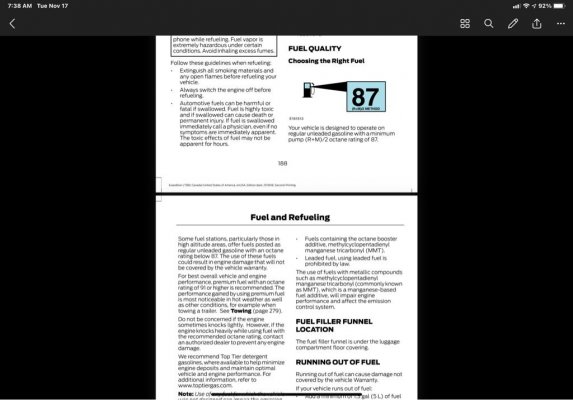
Here is a screen shot out of the 2019 Owners Manual. Clearly states for best performance, which I read as top HP and Torque, you need to use 91 or better octane fuel.

f9b926f1d754e17db2b73aeeae050643.jpg


Sent from my iPad using Tapatalk
 
OP
OP
LG_123

LG_123

Full Access Members
Joined
Nov 1, 2019
Posts
159
Reaction score
76
Location
Toronto
Thanks for the feedback, everyone. I also haven't been able to discover any evidence that premium fuel will yield any benefit other than increased HP and efficiency. So I'll stick with regular fuel except when towing.
 

sixstring

Full Access Members
Joined
May 13, 2020
Posts
188
Reaction score
129
Location
Florida
I ran cheap 87 on my 15 ecoboost and never noticed anything negative.

I run cheap 87 on my 20 ecoboost and am very happy with the performance.
 

Dice Roll

Full Access Members
Joined
Dec 19, 2019
Posts
833
Reaction score
359
Location
Craps Table
I’ve had good luck on most stuff in getting an mpg gain by running 89. 87 fuel doesn’t have as much btu in it. Some stuff will boost timing enough to see a net gain.

haven’t tried that in the expy as I tend to fill at Costco so not an option.
 

Expedition Dave

Full Access Members
Joined
Jun 7, 2020
Posts
576
Reaction score
276
Location
A Tiny Little Dot in Florida
Thanks Lou! Personally, I think it is a bit of "false advertising" unless it does deliver 375/470, and a bit more with higher octane.
Hmmm... thought they would have learned from the Cobra fiasco lol :buttkick:
 

Lou Hamilton

Full Access Members
Joined
Nov 28, 2019
Posts
939
Reaction score
640
Location
Maryland
Thanks Lou! Personally, I think it is a bit of "false advertising" unless it does deliver 375/470, and a bit more with higher octane.
Hmmm... thought they would have learned from the Cobra fiasco lol :buttkick:

Outside of power performance, I used 87 for the first 3000-3500 of ownership. My average mpg was around 13.1. I am now at 14,000 miles on my Expedition and the mpg using 93 is around 16. One difference if that I never towed with 87, but there has been about 500-600 miles of towing with 93.

Take that for what it is worth, but overall, I feel I get better mpg using 93. Do I feel I have a solid ROI by using 93? Probably not yet, but maybe eventually I will.
 

Matticus

Full Access Members
Joined
Apr 21, 2014
Posts
127
Reaction score
36
Location
Salt Lake City
I’ve had good luck on most stuff in getting an mpg gain by running 89. 87 fuel doesn’t have as much btu in it. Some stuff will boost timing enough to see a net gain.

haven’t tried that in the expy as I tend to fill at Costco so not an option.

Do you have something to back up your BTU claim? I'm not a fuel expert, but everything I have ever read from the "experts" has stated that octane rating has zero to do with the amount of energy a gallon of gasoline contains
 

haviland

Full Access Members
Joined
Oct 2, 2017
Posts
178
Reaction score
46
Location
MA
My '17 is the 4th Expy I've had. For over 50 years I have been buying the cheapest gas available and the lowest octane. I have had ZERO fuel issues.

This latest Expy gets about 4 to 5 better mpg than any of my earlier ones. It also pulls our 8,000 boat rig better as well. Better power and more mpgs, and they said it couldn't be done. Thanks eco-boost and the efforts to mandate better economy! (Too bad those efforts have been temporarily stalled.)
 

RobertM

Member
Joined
Oct 30, 2019
Posts
5
Reaction score
1
Location
Virginia
Two different discussions here. Octane and additives. I can assure you top tier additives are snake oil. Higher Octane can have benefits under the right circumstances, like trailer hauling.
 

Grey ghost

Full Access Members
Joined
Apr 26, 2019
Posts
360
Reaction score
134
Location
Melbourne fl
You make more power and get better mileage with the higher octane fuels. 87 octane retards your timing and puts you on the low edge of adjustability so if you happen to get a bad batch of gas. Or some other variable you could cause a problem.
I don't understand the logic of buying a reasonably expensive vehicle and trying to save what 3 bucks on a tank of fuel. Buy a Kia they probably will run on lamp oil.
 

LokiWolf

Staff member
Moderator
Joined
Apr 2, 2016
Posts
3,971
Reaction score
2,837
Location
Richmond VA
There is some excellent advice in this thread, and some fairly inaccurate info all the same. For clarity, I have hours of experience logging on Ecoboosts with various fuels and tunes, and I have a BS in Chemistry...so I might know what I am talking about.

1) Let's clarify BTU and Octane first. They are not directly related. In the past there was a correlation(will explain in a sec). 87/89/91/93 from the same station should have the same BTU's in most cases. Assuming they are all the same E(Ethanol) content. That being said, in the past(30+) years ago, it was actually quite the opposite of what one of the posts said above, 87 had higher BTU's than most 93 out there. The reason being the refinement process. The process actually had the negative result of decreasing the energy content, between the byproducts and additives, but the Octane was higher. Octane is merely the fuels ability to resist knock. Ethanol treated gas, typically E10, will have less BTU's than E0 and will get slightly less MPG if compared back to back under the same conditions.

2) Power Ratings, recommended Octane, and factory tuning. Power ratings and MPG's are based off a Federal standard using a fuel that is basically equivalent to 91(E10) Octane gas. It actually isn't really Gasoline, but it is a standard, so that all manufacturers that use the standard are on the same playing field. Anything less than 91(E10) and you are getting less than rated power most likely. EcoBoost motors to state it simply do not "Tune Up" to fuel they detune. Basically they ask for a certain power level(rated), and the Turbo, Fuel system and other things meet that demand. If knock is sensed, timing is pulled, fuel is decreased, and boost is decreased.

3) Ethanol vs Non-Ethanol Fuel. E10 is ALWAYS better for an Ecoboost vs E0. Ethanol has additional advantages like cooling and cleaning above it's octane advantages. Yes, if driving easy E0 91/93 will get you your best MPG, and will be slightly better than E10 91/93. E10 91/93 will yield the most power stock, and give the best experience all around.

Here is a good article to read...actual Data:
https://www.caranddriver.com/features/a28565486/honda-cr-v-vs-bmw-m5-ford-f-150-dodge-charger/

 

Matticus

Full Access Members
Joined
Apr 21, 2014
Posts
127
Reaction score
36
Location
Salt Lake City
1) Let's clarify BTU and Octane first. They are not directly related. In the past there was a correlation(will explain in a sec). 87/89/91/93 from the same station should have the same BTU's in most cases. Assuming they are all the same E(Ethanol) content. That being said, in the past(30+) years ago, it was actually quite the opposite of what one of the posts above, 87 had higher BTU's than most 93 out there. The reason being the refinement process. The process actually had the negative result of decreasing the energy content, between the byproducts and additives, but the Octane was higher. Octane is merely the fuels ability to resist knock. Ethanol treated gas, typically E10, will have less BTU's than E0 and will get slightly less MPG if compared back to back under the same conditions.
Could you cite a source for your BTU claim? I've been hearing different variations of this (literally for decades) but have yet to see a definitive piece of information that supported the claim that, all other things being equal, gas stations had different levels of energy density based on the octane rating. This is the first time I've heard the explanation that it was due to the refinement process. Why would the refinery refine fuel meant to be 93 octane more/less than the gasoline meant for the other octane levels?
 

LokiWolf

Staff member
Moderator
Joined
Apr 2, 2016
Posts
3,971
Reaction score
2,837
Location
Richmond VA
Could you cite a source for your BTU claim? I've been hearing different variations of this (literally for decades) but have yet to see a definitive piece of information that supported the claim that, all other things being equal, gas stations had different levels of energy density based on the octane rating. This is the first time I've heard the explanation that it was due to the refinement process. Why would the refinery refine fuel meant to be 93 octane more/less than the gasoline meant for the other octane levels?

BTU’s and Octane are not the same thing or directly related. Go do some googling that is not related to an Automotive forum. The processes have gotten better. 93 is more refined crude, hence why it is more expensive. It take more effort to get crude to 93 Octane.

The same people that think 93 Octane has more BTU’s are the same people that think Ethanol is bad for a modern fuel system. When in reality it was the opposite in the past. 93 E0 will have more BTU’s than 93 E10, so in Canada where many stations have E10 87, but E0 93/94, the Premium will have higher BTU’s.


Sent from my iPhone using Tapatalk Pro
 
Top