
Would love some folks thoughts on this, regarding oil changes on this engine.

Disclaimer: Links on this page pointing to Amazon, eBay and other sites may include affiliate code. If you click them and make a purchase, we may earn a small commission.

5280tunage

Full Access Members
Joined
Sep 17, 2019
Posts
1,875
Reaction score
1,154
Location
colorado
First, the video. I know this guy and his shop are highly regarded in the Ford automotive world, but something just feels off here.

https://youtu.be/eHPSgqipk-E

For the last three vehicles including this one, I've been very, very stringent on maintaining my oil change intervals, based on the ECU intelligent oil change platforms. I've never had issues in the past, and I've always used premium oils and oil filters, so I'm a little bit hesitant to think that it has to be 5,000 or fewer miles. These systems are supposed to be intelligent enough to take into account driving behaviors, wear and tear, and stress on the engine and components.

But I really am interested also in part of what this guy says, around the oil pickup filters for the turbos. Has anyone in this forum gone through the process of replacing those filters on their own? To me, this seems like something that realistically needs to be part of regular maintenance, maybe every 50,000 miles or so? Obviously this video doesn't go into how difficult it is to change those filters while the turbos are still installed in the vehicle, but I'd be curious. Seems to me like a pretty cheap fix if you can get to these and actually get them out without breaking something else. I'm fairly mechanically inclined, so I'm pretty sure I could do it, I'm just not really sure how easy these are to get to. Haven't even looked to be honest. Is this the kind of thing that during an oil change you could easily pop off both of these pick up units, pull the pipe a little bit out of the way and replace the filters?

If that's the case, I'm more than happy to buy a couple of sets of these just to have them around. I will say that every time I've changed the oil in this vehicle, I've never actually captured nearly as much as I expected, but I've also never had any major sludge issues either.

 

JasonH

Full Access Members
Joined
Nov 12, 2018
Posts
1,557
Reaction score
895
Location
Houston, TX
You can't get to them easily, as the engine bay is tight. You have to go through the wheel wells and it's a pita. The 5k m oci is intended to be preventive maintenance to ensure the filters never get clogged. Call it inexpensive insurance, especially if you're willing to do the changes yourself. Anecdotally, my gen 1 is at 148k and the timing chain rattles, but no turbo issues. I did the olm interval with full synthetic, but have no clue what the first 60k maintenance was like. Do the 5k oci and budget for a repair or replacement.
 

rd618

Full Access Members
Joined
Nov 1, 2021
Posts
745
Reaction score
389
Location
new york
First, the video. I know this guy and his shop are highly regarded in the Ford automotive world, but something just feels off here.

https://youtu.be/eHPSgqipk-E

For the last three vehicles including this one, I've been very, very stringent on maintaining my oil change intervals, based on the ECU intelligent oil change platforms. I've never had issues in the past, and I've always used premium oils and oil filters, so I'm a little bit hesitant to think that it has to be 5,000 or fewer miles. These systems are supposed to be intelligent enough to take into account driving behaviors, wear and tear, and stress on the engine and components.

But I really am interested also in part of what this guy says, around the oil pickup filters for the turbos. Has anyone in this forum gone through the process of replacing those filters on their own? To me, this seems like something that realistically needs to be part of regular maintenance, maybe every 50,000 miles or so? Obviously this video doesn't go into how difficult it is to change those filters while the turbos are still installed in the vehicle, but I'd be curious. Seems to me like a pretty cheap fix if you can get to these and actually get them out without breaking something else. I'm fairly mechanically inclined, so I'm pretty sure I could do it, I'm just not really sure how easy these are to get to. Haven't even looked to be honest. Is this the kind of thing that during an oil change you could easily pop off both of these pick up units, pull the pipe a little bit out of the way and replace the filters?

If that's the case, I'm more than happy to buy a couple of sets of these just to have them around. I will say that every time I've changed the oil in this vehicle, I've never actually captured nearly as much as I expected, but I've also never had any major sludge issues either.


You never really know what someone says they did vs what they were actually doing, or what oil they used. Like everything else on the internet you have to take some of this with a grain of salt. Is there some reality to it, probably, but could some of this been exaggerated a bit, most likely.

I also looked up those filters and how to change them, they are pretty coarse and not prone to much failure, especially like how he shows them collapsed. I do agree though if you're having turbo work done anyway, and all the parts are already taken apart, yes, throw on new filters and seals too.
My 2 cents, use the oil change monitor the same as your gas tank gauge, when it gets down to 1/3 start looking to get it done sooner than later. Waiting until the indicator says 0% or you run out of gas is just a recipe for disaster.
 
OP
OP
5280tunage

5280tunage

Full Access Members
Joined
Sep 17, 2019
Posts
1,875
Reaction score
1,154
Location
colorado
What strikes me a little bit here, is that if those pickups are prone to clogging over time, why wouldn't there be a flow monitor on them? i.e. given that those pickups in the video collapsed, logically from vacuum, one would think you could have a pressure switch that would do the same thing as the filter if too much vacuum builds, thereby notifying with a CEL for example. seems like something that simple could prevent thousands in damage.
 

LazSlate

Full Access Members
Joined
May 7, 2022
Posts
416
Reaction score
245
Location
Arizona
I agree with 5k and also look at the oil. If its still caramel color and clean chances of the turbo filter getting clogged is minimal to none. Willing to bet that oil from the you tube video was really dirty.
 

rd618

Full Access Members
Joined
Nov 1, 2021
Posts
745
Reaction score
389
Location
new york
What strikes me a little bit here, is that if those pickups are prone to clogging over time, why wouldn't there be a flow monitor on them? i.e. given that those pickups in the video collapsed, logically from vacuum, one would think you could have a pressure switch that would do the same thing as the filter if too much vacuum builds, thereby notifying with a CEL for example. seems like something that simple could prevent thousands in damage.
Good point. Or remove the screen all together. Not like it’s preventing wear particles from getting through.
 

GixxerJasen

Full Access Members
Joined
Aug 8, 2022
Posts
559
Reaction score
517
Location
DFW TX
Are those filters on all the ecoboost engines? Seems like if it were a high failure item we'd have heard about it by now on some of the higher mileage engines.
 
OP
OP
5280tunage

5280tunage

Full Access Members
Joined
Sep 17, 2019
Posts
1,875
Reaction score
1,154
Location
colorado
I'd have to imagine so, if not, then I'd actually be a bit more annoyed, in the sense that if you were experiencing issues with older Eco's, enough that engineers thought it would be important enough to put filters in the system, but not make them easily replaceable or something the ECU could monitor, seems like a half-ass fix.
 

LazSlate

Full Access Members
Joined
May 7, 2022
Posts
416
Reaction score
245
Location
Arizona
Good point. Or remove the screen all together. Not like it’s preventing wear particles from getting through.

That filter is important. The turbo bearings float on a coating of oil sort of suspended. Small particles may wear in the long run but large ones will destroy the bearings in no time.
 

BlackBetty

Full Access Members
Army
Joined
Feb 1, 2021
Posts
427
Reaction score
168
Location
Surprise, AZ
Are those filters on all the ecoboost engines? Seems like if it were a high failure item we'd have heard about it by now on some of the higher mileage engines.
I spoke with a Ford tech awhile back about getting these replaced. He told me he’s yet to change any. Told me it wasn’t as necessary as I might’ve thought. I was a bit shocked to say the least.

Thought he was blowing me off at first. Turned out he was in the middle of something. As soon as he was done wit that task he jumped on a computer to look up the part/ area to verify we were talking about the same item. He assured me it wasn’t a regular maintenance item.

The problem I have with that is the fact it has a screened surface that could definitely get clogged at some point. However, we’ve been given no guidance as to what, if anything, should be required of this part.
 

JamaicaJoe

Full Access Members
Joined
Dec 20, 2020
Posts
948
Reaction score
430
Location
Oviedo FL
Would it be possible to backflush those filters by opeing the line near the turbo and pouring some cleaner into the line before an oil change?
 

Benztech

Full Access Members
Joined
Feb 12, 2013
Posts
106
Reaction score
74
Location
Maryland
Blackstone Lab or some other lab could answer the OCI interval for you, but I don't need that for me. By 5k miles my oil looks and smells roasted with regular driving so 5k is max for me. As others have said I would only do the turbo filter if doing turbo work or at a high mileage mark- say 100k-150k.
 

Pancho258

Well-Known Member
Joined
Apr 13, 2019
Posts
48
Reaction score
17
Location
McALLEN, Texas
No one has really commented on oil types or weight which is interesting. After the first 3,000 miles I switched to Mobil 1 synthetic.

Are you still recommending frequency of oil changes to be 5K even with synthetic?
 

Benztech

Full Access Members
Joined
Feb 12, 2013
Posts
106
Reaction score
74
Location
Maryland
I use 5w-30 Kirkland Synthetic & factory filters and change it at 5k. There's no way based on color and smell I would let it go longer for me. Maybe if I only drove highway I would consider it, but most of my driving is mixed.
 

Mr Big

Full Access Members
Joined
May 29, 2023
Posts
1,005
Reaction score
587
Location
Tampa Bay, Florida USA
Regarding oil changes, a lot depends on driving habits and environment.
I regimentally change my oil and filter every 5000 miles or less, with 5w-30 full synthetic oil and a Motorcraft FL500S oil filter.
Also, twin turbos need clean oil and can also cause contamination faster in the oil and pan, due to poor maintenance.
For me, it is important to change my oil at shorter intervals.
Me being a do-it-yourselfer, it's an inexpensive task to push back the more expensive repair.
 
Last edited:

BMW2FORD

Full Access Members
Joined
Jul 18, 2021
Posts
322
Reaction score
309
Location
CT
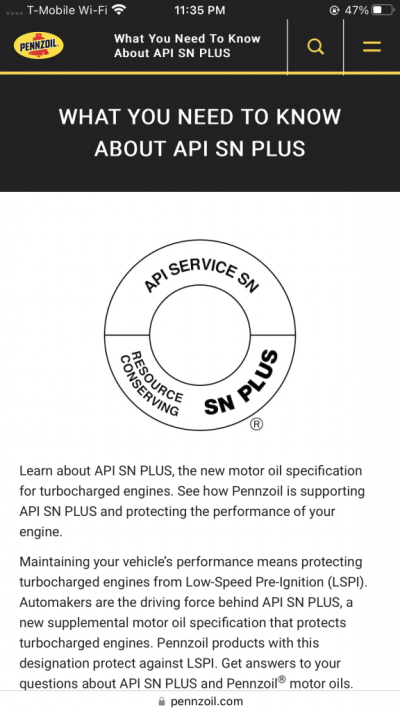
I’m also in the 4000-5000 opinion after seeing how it looks and smells at that point. Also don’t forget to use an API SN rated or better oil for spark knock. Ford does have good info in their maintenance manual about using a 5w-30 oil and does state about that rating as well as many other companies with turbocharged engines.
 

Attachments

  • FC90D872-9AB3-4563-989D-C372801F22B2.png
    FC90D872-9AB3-4563-989D-C372801F22B2.png
    199.4 KB · Views: 4

JasonH

Full Access Members
Joined
Nov 12, 2018
Posts
1,557
Reaction score
895
Location
Houston, TX
No one has really commented on oil types or weight which is interesting. After the first 3,000 miles I switched to Mobil 1 synthetic.

Are you still recommending frequency of oil changes to be 5K even with synthetic?

I think that number is used because it's fairly conservative. So much depends on driving conditions. An engine that spends most of its time out of boost and at operating temps will be easier on oil than one that gets short tripped and driven in boost often. These engines are also known for having issues with fuel dilution, so more frequent changes mitigates that issue as well. I've had my oil tested by Blackstone between 7K and 8K and they said it was still good, but I've also had timing solenoid issues that may or may not be related, as my water pump was failing and the oil may have been getting too hot. So it's hard to know the right answer for every operating condition.
 

GlennSullivan

Full Access Members
Joined
Jul 3, 2021
Posts
1,095
Reaction score
705
Location
NY & FL
We have a 2007 Tahoe (81K), a 2011 Expedition (63K) and a 2017 Expedition (44K). I have done the oil changes on all 3 between 3500 and 4500 since new and definitely see a big difference in the look / smell of the oil in the 2017 vs the other 2. The oil in the N/A Tahoe and Expy comes out looking like new and the T/T Expy oil comes out dark with a slight odor. Turbo engines are really hard on oil and engine components - increased cylinder pressures, temperatures as well as the engine oil being circulated through the super hot turbo units.
 

Mr Big

Full Access Members
Joined
May 29, 2023
Posts
1,005
Reaction score
587
Location
Tampa Bay, Florida USA
We have a 2007 Tahoe (81K), a 2011 Expedition (63K) and a 2017 Expedition (44K). I have done the oil changes on all 3 between 3500 and 4500 since new and definitely see a big difference in the look / smell of the oil in the 2017 vs the other 2. The oil in the N/A Tahoe and Expy comes out looking like new and the T/T Expy oil comes out dark with a slight odor. Turbo engines are really hard on oil and engine components - increased cylinder pressures, temperatures as well as the engine oil being circulated through the super hot turbo units.
This is why it is so important to change oil regularly. Like I said I always use full synthetic. blend is fine but full synth is just that much better, for not much more. And always use a Motorcraft filter.

They have , anti-drain back valves to help prevent dry starts, (Anti-drain back valves that are made of silicone provide greater cold/heat resistance )(down to -75 and up to +450 degrees F), Pressure relief valves help maintain supply of oil to the engine under extreme cold conditions or if the filter gets clogged, (Location of relief valve in the majority of Ford application filters prevents settled debris from entering and potentially damaging the engine).​

 
Top