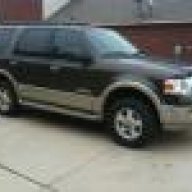
2009 EL sags towing trailer

Disclaimer: Links on this page pointing to Amazon, eBay and other sites may include affiliate code. If you click them and make a purchase, we may earn a small commission.

dspfeiffer

Member
Joined
Aug 23, 2012
Posts
13
Reaction score
12
Location
New Jersey
I have a 2009 Expedition Limited EL. It doesn't have the air suspension, but I would like to add it aftermarket. Are there any kits available (Monroe, Firestone, etc.) to add air suspension to a non-air suspension truck? I would like to add a little extra capacity to the rear end now that I'm towing a travel trailer. It does sag a little in the rear.

If no air suspension kits are available, are there stiffer springs or struts that could help?
 

Dib52

Full Access Members
Joined
Oct 30, 2011
Posts
383
Reaction score
23
Location
Wylie, Texas
When you say sags, by how much? Might just need to adjust the tongue weight to lessen the sag. Cheap and easy, rather than adding parts and pieces to the rear. I tow a boat on a dual axel trailer and tip the scales at about 6000 lbs, never felt the need to alter the rear. Just remember, tongue weight at +/- 10% of the load. Just something to think about before opting for heavier springs or air kit.
 

JUST4FUN

Admin
Staff member
Moderator Administrator
Joined
Oct 25, 2005
Posts
2,104
Reaction score
150
Location
Il
you really need to look into a weight distributing hitch , this moves the weight through the frame of the truck and the trailer to stop sag . just beefing up the rear hides the fact that the rear axle could be overloaded.
watch this vid Equal-i-zer Videos
 

JUST4FUN

Admin
Staff member
Moderator Administrator
Joined
Oct 25, 2005
Posts
2,104
Reaction score
150
Location
Il
When you say sags, by how much? Might just need to adjust the tongue weight to lessen the sag. Cheap and easy, rather than adding parts and pieces to the rear. I tow a boat on a dual axel trailer and tip the scales at about 6000 lbs, never felt the need to alter the rear. Just remember, tongue weight at +/- 10% of the load. Just something to think about before opting for heavier springs or air kit.
the weigh of a boat and a camper are two differnt things most of the weight of a boat is on the back of the trailer . boats are more aero dinamic than campers are like pulling two barn doors down the road
 

JUST4FUN

Admin
Staff member
Moderator Administrator
Joined
Oct 25, 2005
Posts
2,104
Reaction score
150
Location
Il
the problem with taking weight off the toung is you set your self up for sway , if your trailer GVW is 4000 then 400 lbs is the min on the toung. If this causes sag then you need to get the weight off the hitch and balanced bettween the trailer and the truck (including the front suspenion)
 

JUST4FUN

Admin
Staff member
Moderator Administrator
Joined
Oct 25, 2005
Posts
2,104
Reaction score
150
Location
Il
Once you figure out all your total trailer weights, you also need to know about weight distributing hitches (WDH).

A weight distribution system enables a tow vehicle to more effectively handle the tongue weight of a trailer by removing some of the load from the tow vehicle's rear axle and distributing it through the frame to the tow vehicle's front axle and the trailer's axle(s).

When are they required?

Check your owners manual for this information. Most manufacturers give thier tow rating and then say "when properly equipped". That usually means you have a factory towing package which may or may not include the following: hitch receiver, trans cooler, heavy duty battery and alternator, 4pin or 7pin wiring harness, a weight distrubution hitch, and sway control.


Also beware when buying a trailer so heavy, that your vehicle needs a WDH, then finding out that the trailer frame and tongue cannot accept the forces of a WDH. As a general rule of thumb, a trailer with a C channel tongue frame versus a box channel CAN'T take a WDH, but check with the trailer maker to be sure.

Without a WD system......

- The additional tongue weight on the back of your tow vehicle will cause the rear axle load to significantly increase. That causes your rear end to sag and make most tow vehicle/trailer combinations unlevel. The increase in weight may also exceed the axle's weight rating, and the heavy load on the receiver might exceed its rating.

- In addition to rear end sag the front axle load will be decreased. The decreased load on the front axle can cause a loss of steering control and braking difficulties.

With a WD system......

- Tow vehicle and trailer remain level. The weight of the tongue is properly displaced throughout both the front axle of your rig and the trailer axles. You will retain steering, braking, and traction. Thus have better control of your vehicle.

Note - When the WD system is engaged the actual tongue weight does not change. (Recommended tongue weight is from 10% to 15% of your trailers weight.)

Disadvantage? Added cost and a few minutes extra hitch up time.

Advantages? Less wear and tear on your vehicle, ans added safety for you, your family and all others on the road.

As I stated above, please consult your owner’s manual to determine if your vehicle and trailer are suited for a WD system

 

Dib52

Full Access Members
Joined
Oct 30, 2011
Posts
383
Reaction score
23
Location
Wylie, Texas
the weigh of a boat and a camper are two differnt things most of the weight of a boat is on the back of the trailer . boats are more aero dinamic than campers are like pulling two barn doors down the road

Understandable, but not knowing what kind of TT, weight, how it's loaded, etc., I was just throwing out a variable for the op before opting to purchase equipment to bolster the rear.
Agreed, a WD set up might be the way to go, but might not need if if he is under weight on the TT. If its a lighter version, a WD would be overkill and could cause additional problems. Kinda need more info on the set up before we can spend his money!
 
Top