

You are using an out of date browser. It may not display this or other websites correctly.
You should upgrade or use an alternative browser.
You should upgrade or use an alternative browser.
2022 Timberline Tire Pressures
- Thread starter LazSlate
- Start date
Disclaimer: Links on this page pointing to Amazon, eBay and other sites may include affiliate code. If you click them and make a purchase, we may earn a small commission.
99WhiteC5Coupe
Full Access Members
Anyone know what the tire pressures are?
The decal says 35 for all but from the Factory it has 50psi.
Is the decal a general psi and it depends on the tires? Does the TPS alter for over pressure?
If the tire pressure in your vehicle’s tires were set at 50 psi when you took delivery, it means that the dealer service department that did the pre-delivery inspection (for which they are paid by Ford) did a poor job.
The decal is the recommend cold pressure from the vehicle manufacturer. If you changed tires, but bought tires with the same tire specification on the sidewall, the recommended pressure would not change (unless Ford has a recommendation in the owner’s manual for specific situations such as towing or driving on sand).
I do not know if the TPMS will alert to an over-inflated tire.
chuck s
Full Access Members
- Joined
- Dec 20, 2006
- Posts
- 1,992
- Reaction score
- 754
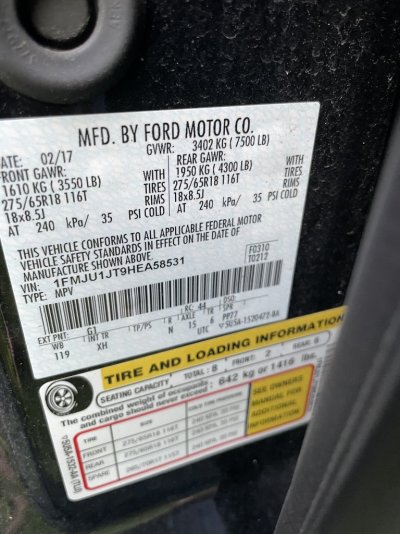
The decal in the drivers door jam is specific to the vehicle including the tires fitted at the factory. It's the pressure needed to support the maximum weight of the truck including all passengers and cargo. In this case 35psi will do it all. Increasing to 50psi will simply make the ride rougher but the truck won't have more capacity which is also listed on the placard.
-- Chuck
-- Chuck
Lou Hamilton
Full Access Members
The Goodyears should be 35psi.
I swapped out and run my Nitto's at 40-42. I liked how they felt on my old one, so why change.
BTW, I pump up the rears to 50psi when towing.
I swapped out and run my Nitto's at 40-42. I liked how they felt on my old one, so why change.
BTW, I pump up the rears to 50psi when towing.
chuck s
Full Access Members
- Joined
- Dec 20, 2006
- Posts
- 1,992
- Reaction score
- 754
Increased tire pressure lessens tire squirm when towing. Especially with the OEM P-metrics.
-- Chuck
-- Chuck
3rd Expyowner123
Full Access Members
I believe the 50psi is intentional from the factory, to prevent flat spots forming while having the vehicle stationary during shipping. As per LazSlate’s comments, tire pressure should be part of dealer’s pre-delivery review process.
chuck s
Full Access Members
- Joined
- Dec 20, 2006
- Posts
- 1,992
- Reaction score
- 754
Makes sense. Just fill 'em all to 50psi at the factory before they go on the car and eliminate one more thing to do after they're mounted on the truck.
Defyant
Active Member
51psi is maximum psi. Beyond that you risk a blow out. When tires roll down the road, they heat up increasing pressure. 35 psi is done to make the truck ride soft and smooth - very important when taking a test drive. When towing, I run mine at 43 psi cold. When headed towing 7K trailer, they heat up to about 45-47 psi -ish.
If you start out at 50psi, you leave no room for expansion. Naturally, this is if you are running regular air. Nitrogen will remain consistent pressure cold vs hot.
I'd like to upgrade the OEM tires to a heavier grade LT tire to cut down on the squirreliness and to add a bit more of a buffer from the max capacities of the oem tires.
If you start out at 50psi, you leave no room for expansion. Naturally, this is if you are running regular air. Nitrogen will remain consistent pressure cold vs hot.
I'd like to upgrade the OEM tires to a heavier grade LT tire to cut down on the squirreliness and to add a bit more of a buffer from the max capacities of the oem tires.
chuck s
Full Access Members
- Joined
- Dec 20, 2006
- Posts
- 1,992
- Reaction score
- 754
If your goal is to make your Expedition ride like a truck (instead of a Town Car) put LT (truck) tires on it. That's all they'll do for you. The Gross Vehicle Weight Rating -- the maximum legally allowable weight -- of the Expedition won't change and the tires on it now are more than capable.
My data:
GVWR: 7,500 pounds.
P-Metric OEM tires: 4 @ 2,735 pounds (each) = 10,940 pounds
My "Buffer" = 3,440 pounds.
-- Chuck
My data:
GVWR: 7,500 pounds.
P-Metric OEM tires: 4 @ 2,735 pounds (each) = 10,940 pounds
My "Buffer"
= 3,440 pounds.-- Chuck
Defyant
Active Member
I see. So an upgrade to the tire capacity wont help the stability of the rig? Maybe a tad bit wider, thicker sidewalls, but no increase in height or GVW that's currently within the limits. Not looking to increase towing capacity as outlined on the door jamb sticker. But perhaps in an emergency maneuver with a trailer, the thing that connects me to the road could use a bump in capacity. FWIW, the concept Timberline ran larger tires.
chuck s
Full Access Members
- Joined
- Dec 20, 2006
- Posts
- 1,992
- Reaction score
- 754
It's indisputable that LT tires can support more weight than the P-metrics. I'll probably put Bridgestone Dueler AT Revo 3 tires on this like I did with my former Expedition. In my 18" wheel size specs:
LT275/65R18: 3,415 (each) x 4 = 13,660 -- at 80psi.
P275/65R18: 2,601 (each) x 4 = 10,404 -- at 44psi.
GVWR (still): 7,500
Truck tires ride like a truck all the time.
-- Chuck
LT275/65R18: 3,415 (each) x 4 = 13,660 -- at 80psi.
P275/65R18: 2,601 (each) x 4 = 10,404 -- at 44psi.
GVWR (still): 7,500
Truck tires ride like a truck all the time.
-- Chuck

I agree and disagree with most of the above. On the tire is a max air pressure number. Which is the level to be used when the truck is loaded to it's total gross weight. I don't pay much attention to the door sticker.

Expedition Dave
Full Access Members
I am not a tire, oil, nor fuel expert--but TTBOMK:
1) The tire's maximum listed pressure is for max loading of the tire, not the truck.
2) The sticker is the proper tire pressure to support the maximum weight of the truck for that combination.
Changing tires of different sizes, weights, loads, etc. changes nearly all of the factory PSI formulas. There is some hard math behind it and other forums go into it in great detail.
As a general rule to be applied at your own risk, adding a few PSI above stock recommendation may offer better handling, especially where heavier tongue weights are concerned due to tire "squish".
Also, if you ran at full max load nearly all of the time (such as an overlander and we are talking 1500-1700 pounds of gear an passengers), you could see a benefit in LT (heavier load/duty) tires at the cost of some ride if emptied.
**This can be especially true if you are loaded heavy and air-down when off-roading.
**Airing down for off-roading is still bad for tire life overall, and heat buildup on road with too low pressure is terrible for tire carcass life (regardless of tread life). That is why the moment you get back on the road you really need to air up ASAP.
**Remember too, tires have a 'shelf life' due to exposure in years regardless of miles left on the tread, and this comes into play too.
1) The tire's maximum listed pressure is for max loading of the tire, not the truck.
2) The sticker is the proper tire pressure to support the maximum weight of the truck for that combination.
Changing tires of different sizes, weights, loads, etc. changes nearly all of the factory PSI formulas. There is some hard math behind it and other forums go into it in great detail.
As a general rule to be applied at your own risk, adding a few PSI above stock recommendation may offer better handling, especially where heavier tongue weights are concerned due to tire "squish".
Also, if you ran at full max load nearly all of the time (such as an overlander and we are talking 1500-1700 pounds of gear an passengers), you could see a benefit in LT (heavier load/duty) tires at the cost of some ride if emptied.
**This can be especially true if you are loaded heavy and air-down when off-roading.
**Airing down for off-roading is still bad for tire life overall, and heat buildup on road with too low pressure is terrible for tire carcass life (regardless of tread life). That is why the moment you get back on the road you really need to air up ASAP.
**Remember too, tires have a 'shelf life' due to exposure in years regardless of miles left on the tread, and this comes into play too.
BravoAlpha
Full Access Members
I believe the 50psi is intentional from the factory, to prevent flat spots forming while having the vehicle stationary during shipping. As per LazSlate’s comments, tire pressure should be part of dealer’s pre-delivery review process.
this.
they don’t know how long it will take to get out of storage and transport
mine were over. Dealers can get lazy with TPM System. It won’t alarm high pressure
Pawpaw
Full Access Members
P or XL rated tires on an offroad type vehicle is laughable. LT rated tires in 10 ply have stronger sidewalls which I find to stiffen up the IRS sway. When towing I air mine up to 65 psi cold and it really helps with our 7500 lb camper in addition to a WDH . Lots of flats around here from people rebuilding after Hurricane Ida last year. Traction doing light offroading is so much better than the stock Michelin Primacy tires. Better looks than the stocker's too!!
chuck s
Full Access Members
- Joined
- Dec 20, 2006
- Posts
- 1,992
- Reaction score
- 754
Wrong, of course! Pressure on the door sticker is the level to be used when the truck is loaded to it's total gross weight. Yep that sticker is there for a reason.I agree and disagree with most of the above. On the tire is a max air pressure number. Which is the level to be used when the truck is loaded to it's total gross weight. I don't pay much attention to the door sticker.
-- Chuck
Please explain what the max air pressure on the sidewall on the tire is for. Also when does it come into play.Wrong, of course! Pressure on the door sticker is the level to be used when the truck is loaded to it's total gross weight. Yep that sticker is there for a reason.
-- Chuck
chuck s
Full Access Members
- Joined
- Dec 20, 2006
- Posts
- 1,992
- Reaction score
- 754
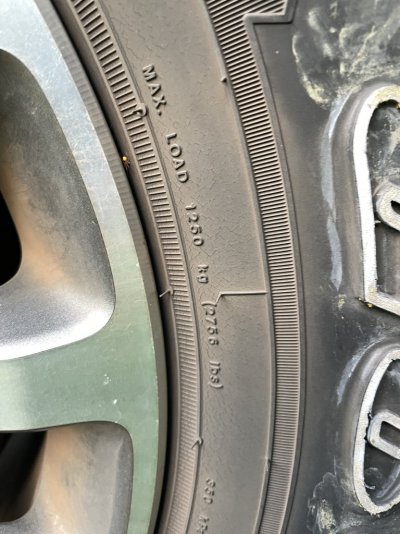
Maximum cold tire pressure is just what it says. Don't inflate (cold) to a higher pressure. Inflated to that pressure the tire will support the weight also listed on the side wall. In Post #11 I note two examples:
LT275/65R18: 3,415 (each) x 4 = 13,660 -- at 80psi.
P275/65R18: 2,601 (each) x 4 = 10,404 -- at 44psi.
GVWR (still) : 7,500
Maximum cold tire pressure never comes into play and can be ignored since at "sticker" pressure -- well below maximum cold tire pressure -- the tires will support the maximum allowable weight of the Expedition.
My OEM tire data and "sticker." Yours are very similar.
Bottom line: You can inflate up to and including the cold tire pressure but any pressure over the sticker pressure will not add additional carrying capacity although it may improve towing or other factors.
-- Chuck
LT275/65R18: 3,415 (each) x 4 = 13,660 -- at 80psi.
P275/65R18: 2,601 (each) x 4 = 10,404 -- at 44psi.
GVWR (still)
: 7,500Maximum cold tire pressure never comes into play and can be ignored since at "sticker" pressure -- well below maximum cold tire pressure -- the tires will support the maximum allowable weight of the Expedition.
My OEM tire data and "sticker." Yours are very similar.
Bottom line: You can inflate up to and including the cold tire pressure but any pressure over the sticker pressure will not add additional carrying capacity although it may improve towing or other factors.
-- Chuck
Attachments
Last edited:
Expedition Dave
Full Access Members
"Please explain what the max air pressure on the sidewall on the tire is for. Also when does it come into play."
Fastcar, I answered that, but maybe not completely.
The tire sidewall max PSI is to achieve max loading of the tire (x4 tires) and combined is always greater than max vehicle gross weight. At least it had better be...
**Below are rounded up even estimates to keep it simple:
Example--the factory plate & tires at 35 PSI says Tire X can support the Expy fully loaded Ford declared weight of 7,600 lbs (5600 lb truck + 2,000 pounds of people and gear).
Completely seperately--the tire company declares a max cold pressure of 50 PSI. That tire is rated by their company to carry 2500lbs at max air (50 PSIi), of course x4.
Max load for all 4 tires at 50 PSI is 10,000 pounds--far exceeding max load for that Expy as declared by Ford.
Some folks prefer higher load ratings and/or higher PSI for increased safety based upon added weight, towing, airing down for 4wheeling when loaded, rock slash reistrance, etc.
All of this info is on the tires sidewall (even breaks down if used in a dually configuration) and manufactures plate--just needs to sussed through.
YMMV.
Fastcar, I answered that, but maybe not completely.
The tire sidewall max PSI is to achieve max loading of the tire (x4 tires) and combined is always greater than max vehicle gross weight. At least it had better be...
**Below are rounded up even estimates to keep it simple:
Example--the factory plate & tires at 35 PSI says Tire X can support the Expy fully loaded Ford declared weight of 7,600 lbs (5600 lb truck + 2,000 pounds of people and gear).
Completely seperately--the tire company declares a max cold pressure of 50 PSI. That tire is rated by their company to carry 2500lbs at max air (50 PSIi), of course x4.
Max load for all 4 tires at 50 PSI is 10,000 pounds--far exceeding max load for that Expy as declared by Ford.
Some folks prefer higher load ratings and/or higher PSI for increased safety based upon added weight, towing, airing down for 4wheeling when loaded, rock slash reistrance, etc.
All of this info is on the tires sidewall (even breaks down if used in a dually configuration) and manufactures plate--just needs to sussed through.
YMMV.
Defyant
Active Member
P or XL rated tires on an offroad type vehicle is laughable. LT rated tires in 10 ply have stronger sidewalls which I find to stiffen up the IRS sway. When towing I air mine up to 65 psi cold and it really helps with our 7500 lb camper in addition to a WDH . Lots of flats around here from people rebuilding after Hurricane Ida last year. Traction doing light offroading is so much better than the stock Michelin Primacy tires. Better looks than the stocker's too!!
This is precisely what I am trying to accomplish. Not increase tow ability. Just add to the trucks stability while within the proper load and tow ranges. Increased off road performance would be nice also. I will accept a change in ride comfort.
Similar threads
- Replies
- 9
- Views
- 2K


- Replies
- 27
- Views
- 8K

- Replies
- 3
- Views
- 404


- Replies
- 0
- Views
- 422


Staff online
-
 MADDOGExploring Arizona
Members online
Total: 4,642 (members: 9, guests: 4,633)