Crack Powdered Rods and More Q’s (Modular V8 info)

Disclaimer: Links on this page pointing to Amazon, eBay and other sites may include affiliate code. If you click them and make a purchase, we may earn a small commission.

JExpedition07

That One Member
Joined
Mar 30, 2017
Posts
6,531
Reaction score
3,140
Location
New York
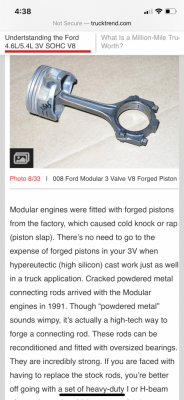
Regarding rods and pistons specifically....Anyone know about these crack powdered metal connecting rods and why they use them? There is a good article on the 5.4L Triton engine out there that explains we have “crack powdered forged” connecting rods and genuine forged pistons from the oem. The newer Modular 5.0 Coyote platform also uses crack powdered forged connecting rods. I was watching a tear down video on the new 2020 6.7L PowerStroke Diesel and the techs said they also use Powdered Rods. I have always heard cast were cheap, and forged was the way to go. Where do our powdered connecting rods fall on the spectrum? They have to be able to be made pretty stout if they use this tech in the 6.7 Diesel.
 
Last edited:

TobyU

Full Access Members
Joined
Apr 5, 2013
Posts
2,479
Reaction score
874
Location
Ohio
I assume they are a good version of PIM style even though I think PIM is mostly inferior and weak.
The "forged" could be a technicality definition for marketing.

Old style was cast- where you pour hot molten metal into a form (cast) and let it cool or
Forged where I guess the took a block of metal and cut and grinded and shaped it and beat in with hammers etc to forge it into shape.

The 'cracked' part is only about how they make the rod cap removable.
They use to cut them somehow or maybe cast the top long rod and the small bottom cap separately.
Cracked makes the whole rod at once and then they break (CRACK) the cap off like you would snap glass after scoring in with glass cutter.

The cracking makes two pieces which fit back together nicely since all highs and lows line up.

I still think we should be easily able and better off to finish both mating areas flat and maybe we can...but maybe these tiny imperfections that fit together hold it together BETTER with no lateral movement or walking etc.

I don't know exactly but I prefer overkill in pieces that are under high stress at high rpms inside of engines and hard to replace and do damage to other parts when they fail.

I likes to old strong forged rods. I don't even thing some of those were built strong enough.

I WANT BULLET PROOF!!
 

jeff kushner

Full Access Members
Joined
Nov 30, 2014
Posts
2,330
Reaction score
1,276
Location
North of Annapolis
Good question JE.....the various metal strengthening processes have progressed seemingly exponentially in the past 25 years or so.

The fundamental difference between cast & forged;

Cast is pouring metal into a mold....forging is working with a solid piece of metal, cutting and shaping to the final desired shape.

Back in the day......the thinking was...Cast=cheap & Forged=Stronger

One of the reasons for that paradigm was that manufacturer's were not quite up to speed with how much silicone was added to the castings. Suzuki most notably in the motorcycle world fell victim to this in the 80's when the too-high silicone content of their pistons caused catastrophic destruction after the mileage got much over 40K. The pistons often simply disintegrated!


I am a plumber by trade.....cast iron cracks....in fact I've cut 10" Cast iron piping inside of 20 minutes with nothing but a hammer and brick chisel.

My car, an '02 factory supercharged, has forged pistons.....all of my high performance 2 stroke engines have Wossner forged pistons & IMU forged rods.

My guess is that the bean counters place the cost of crack cast rods slightly above that for cast and slightly below that for forged rods but when you are dealing in counts of 300,000 or a millions rods, it adds up quickly.

Stippling the surface of metals, indents like a golf ball, which I think this process emulates to some extent does increase sheer/compression and tension strengths b/c of the changes in surface tension it causes but it can do nothing for the inside of the metal. That's why heat treating works so well, it envelopes the entire piece.

jeff
 

TobyU

Full Access Members
Joined
Apr 5, 2013
Posts
2,479
Reaction score
874
Location
Ohio
Good question JE.....the various metal strengthening processes have progressed seemingly exponentially in the past 25 years or so.

The fundamental difference between cast & forged;

Cast is pouring metal into a mold....forging is working with a solid piece of metal, cutting and shaping to the final desired shape.

Back in the day......the thinking was...Cast=cheap & Forged=Stronger

One of the reasons for that paradigm was that manufacturer's were not quite up to speed with how much silicone was added to the castings. Suzuki most notably in the motorcycle world fell victim to this in the 80's when the too-high silicone content of their pistons caused catastrophic destruction after the mileage got much over 40K. The pistons often simply disintegrated!


I am a plumber by trade.....cast iron cracks....in fact I've cut 10" Cast iron piping inside of 20 minutes with nothing but a hammer and brick chisel.

My car, an '02 factory supercharged, has forged pistons.....all of my high performance 2 stroke engines have Wossner forged pistons & IMU forged rods.

My guess is that the bean counters place the cost of crack cast rods slightly above that for cast and slightly below that for forged rods but when you are dealing in counts of 300,000 or a millions rods, it adds up quickly.

Stippling the surface of metals, indents like a golf ball, which I think this process emulates to some extent does increase sheer/compression and tension strengths b/c of the changes in surface tension it causes but it can do nothing for the inside of the metal. That's why heat treating works so well, it envelopes the entire piece.

jeff
I don't really know if the metal strengthening processes have progressed exponentially in the past 25 years... But things have certainly changed some. They were already pretty smart 30 years ago knowing how to make strong connecting rods and such. Most of the changes have either been done to save money, or to increase the speed of production or the ease of production.
I think usually what happens is the thought process is they need to change something to make it cheaper or easier or at least someone wants them to and they start doing that but they end up with and figure products or problems so then they have to try to use technology and work to get back to the quality or durability they had in the first place. There are some things we have improved quality on but most things today are not as good as they used to be.
It is also sad that sometimes instead of improving the quality to where it used to be or needs to be to hold up they will just redesign lots of things or items around that component to makeup for it's inferior qualities in that particular application.

And the high performance auto world I don't remember there being a problem with high-quality connecting rods as long as you were willing to spend the money.
Also, I look back at what we used to get some of the high quality performance parts for price wise and really wish we could get things for those prices today! We have been spoiled for the past 25 + years with stuff being mass-produced and copied and prices dropping down to super cheap. Yes, the quality suffered at least some but most of the cheap things we buy especially in electronics are at least adequate if not better than that.
Today, even when you're willing to spend good money or Top Dollar on performance parts, metal, Etc... You still have a fear or concern that you might be getting inferior quality because sometimes even companies with the best of intentions don't have any control of the raw product they have to buy.
 

jeff kushner

Full Access Members
Joined
Nov 30, 2014
Posts
2,330
Reaction score
1,276
Location
North of Annapolis
Agreed Toby that often parts are made smaller/lighter/cheaper at the expense of long term reliability.

In the motorcycle world, makers will often revise a model by trimming weight EVERYWHERE! Honda even went to the extreme of going to thinner lens on the speedometer and odometers!

Frames cracking at headjoints b/c of weight savings. Kaw and Suz got into real trouble with cracked frames on 175HP bikes!

No where do we consumers see this more than in the Appliance world.....cheap parts cause the breakdown of expensive machines.


jeff
 

TobyU

Full Access Members
Joined
Apr 5, 2013
Posts
2,479
Reaction score
874
Location
Ohio
Yes, they've been cheap eating the quality of parts to keep the price low or to lower the price for decades. But I don't remember having any problem in the old days with Crower rods or Carrillo or the other brand-name forged Rod makers. You also had high quality aluminum rods for certain applications to.
 
OP
OP
JExpedition07

JExpedition07

That One Member
Joined
Mar 30, 2017
Posts
6,531
Reaction score
3,140
Location
New York
Toby is pretty backwards in a lot of his opinions. Fact is metallurgy has gotten a lot better in the last 25 years and engines last longer. The Modular V8 is built a lot stronger than the Windsor series pushrod V8 engine it replaced, that is evident just by looking at the main caps/bolts and the block itself.
 

TobyU

Full Access Members
Joined
Apr 5, 2013
Posts
2,479
Reaction score
874
Location
Ohio
Toby is pretty backwards in a lot of his opinions. Fact is metallurgy has gotten a lot better in the last 25 years and engines last longer. The Modular V8 is built a lot stronger than the Windsor series pushrod V8 engine it replaced, that is evident just by looking at the main caps/bolts and the block itself.
Not really. We can all nitpick certain things that show either positive or negative. The modular engines were great engines. They had them perfected by right around 96 to 97. These go 300-plus Thousand Miles without ever having a valve cover off. They are great. Now with the three valves they are not so great anymore. They have to have timing chains and cam phasers replaced often head under a hundred twenty five thousand. I understand I think it's you who have had three or four of them with no problems but as you start researching there are a lot of people with problems. Sure the percentages are still pretty low but with the millions of these on the roads a lot of people have problems with the timing components and cam phasers. This simply did not happen on the two valve motor. Same basic design but things have changed some. This is actually not a metallurgical problem. They didn't cheap and anything to cause the problem. This was about because for fuel mileage and infinitely or constantly variable valve timing Etc. The Honda VTEC was one of the first engines commonly in America to have variable valve timing but it was a much more simplistic design with only two positions. It really gave any problems.
Let's talk about firearm manufacturer parts being made out of PIM metal, then tell me that metallurgy is better than it was 20 years ago.
But as I said, this is just another example of us being able to nitpick certain things that are better or certain things that are worse.
Overall, the longevity and durability of engines in cars improved a lot from from the cars in the 60s through late 80s.
The ones built from the late 80s on we're much better then these older decades. Now, for many of them the trend is going the other way.
It's not quite an epidemic yet but it's getting to epidemic proportions.
Forged steel connecting rods are not better today than they were 25 years ago! In fact, it's hard to get as good of quality iron or steel as it was 25 or 30 years ago. Most of the stuff is recycled and not as good as the old original stuff we had.
Expensive, high-performance block manufacturers are forced to buy steal from Chinese foundry's because there's no suppliers in the US supplying it from what I read just a few months ago.
They don't care about costs as the people buying their blocks will pay an extra few hundred to couple of thousand for the quality without asking any questions.
I read two or three different manufacturers who said they would have gladly paid more for us sourced Steel but there was none available. They often have problems with the quality of the import steel or forgings.
Technology does often improve things but sometimes when people are insistent on applying technology to tried-and-true things that already worked just fine, they introduce problems that then have to be overcome. Often you only get back to where you started from and sometimes you don't, and sometimes you end up a little better off. But almost always the end result is a little bit cheaper for them and that's what they're going for.
The only thing that's improved and they high performance race car world and aftermarket parts has been tolerances and replicating these tolerance is so part uniformity and consistency.
They have also improved valve sealing because of very minut an exact machinery. In the old days a 3 angle valve job was top-notch until like around 2000.
Now people consider that a joke. They have like 6 Plus sealing angles or whatever and if you were to do a 3 angle valve job on a newer set of heads you would be diminishing the performance and the sealing ability.
This has nothing to do with Metallurgy though or the quality of the valves or aluminum heads being machined.

 

rjdelp7

2000 XLT
Joined
Nov 30, 2014
Posts
1,529
Reaction score
378
Location
NY
The Coyote, Powerstroke and EB are producing way more power than the old engines. The rods are stout and not an issue. The Coyote and Voodoo engines have had ring issues. The long timing chains and guides, scare the hell out of me.
 

theoldwizard1

Full Access Members
Joined
Jul 29, 2013
Posts
320
Reaction score
81
Location
SE MI
Crack/fractured sintered (just means compressed and heated but not to melting) rids have been around for quite some time and have proved themselves to be very durable. The big win is low cost. I am sure the forged or billet steel (typically H-beam) would be lighter, but much more expensive. Making the rod as one piece and then cracking the big end off means that there is perfect alignment of the cap to the top half of the rod (no machining is done on the mating surfaces so the the small irregularity between the two piece make for perfect alignment when re-assembled). This is also a big win because cast rods will actually experience a small amount of "wiggle" at the joint under extreme loads.


TobyU, I have a "problem" accepting a few things you presented as "facts".

Expensive, high-performance block manufacturers are forced to buy steal from Chinese foundry's because there's no suppliers in the US supplying it from what I read just a few months ago.
They don't care about costs as the people buying their blocks will pay an extra few hundred to couple of thousand for the quality without asking any questions.
I read two or three different manufacturers who said they would have gladly paid more for us sourced Steel but there was none available. They often have problems with the quality of the import steel or forgings.
Are we talking blocks or rods ? Not sure about cast iron blocks, but the NASCAR boys have near "infinite money" and I am sure they can throw enough money at "the problem" to get the quality they want, whether it is cast in the US or overseas.

As for forgings or extrusions of smaller steel items, there ARE small batch furnaces in the US that have extremely high quality control to make "specialty" steels. As long as the steel has the correct amount of elements (iron, carbon, manganese, etc, etc) which can only be determined will the steel is still molten, who cares where those elements came from.

If you look around the Internet there is a story about NASCAR valve strings. About 20(?) years ago, NASCAR engines would routinely break springs as the RPM started to exceed 9,000. Engine builders were buying thousand of spring and having a person sort them for height and compression, but that was still not good enough. A couple of smart engineers realized that the metal "wire" used to wind the spring was the real culprit and that they could solve the problem. It took them a few tries, but they came up with an alloy and a reliable manufacturer to make the wire to their spec. They bought the machinery to wind the springs. The result is, everyone in NASCAR buys valve springs from this one source and you almost never hear of a valve spring failure anymore (and NASCAR has changed some rules that have kept the WOT RPM from creeping up further).
 

TobyU

Full Access Members
Joined
Apr 5, 2013
Posts
2,479
Reaction score
874
Location
Ohio
We started out talking about rods but then we were talking about different engines durability, problems, and got into different types of Metal Manufacturing and forging versus cast.
That's when I brought up the fact that I have read several times that high quality block manufacturers we're having to use overseas, mainly Chinese, steel for their blocks.
I mentioned that money wasn't an issue for them because they can easily pay the premium because their customers will also.
They were just complaining that there weren't any US ones or U S Steel steel available. I don't know how widespread this is or how accurate it was.

I did mention earlier about the cool fact that when you crack the rods it makes them line backup perfectly from all the little minor imperfections and high and low spots when they crack. That is just a cool naturally occurring thing in nature that gives you a benefit of a better connection with less movement.
I'm not sure about reconditioning these if they spin a bearing. I think they do it now but it one time they might have said you couldn't do it. A lot of things in engines are that way.
I can think of at least another one right off the top of my head that when they were fairly new, the Machine Shop said you couldn't do this or couldn't do that because of some design or some way they were made. Then, a few years later they figured out how to do it and it became standard practice.
As far as costs, I guess is slightly cheaper to just have a machine that snaps off the ride but she would think it wouldn't be that much more expensive to have a machine that cuts the ride in half so you can still make them as one piece. You would just design the casting so it makes the whole a little bigger or oblong so once you cut it in the middle and put it back together it's perfect.
I guess this might require some final Machining. I'm wondering if when they make these cracked rods if they are absolutely done once they crack them. Do they not put them back together and mic the inside or run a hone in them to make them closer to perfect?
Maybe they're close enough. I don't know. There is a slight amount of Tolerance allowed on rod bearing gaps.
 

theoldwizard1

Full Access Members
Joined
Jul 29, 2013
Posts
320
Reaction score
81
Location
SE MI
I'm not sure about reconditioning these if they spin a bearing. I think they do it now but it one time they might have said you couldn't do it.
Probably not worth the cost. PM does not machine well, but it does hold tolerance and give a "good" finish when sintered.
I'm wondering if when they make these cracked rods if they are absolutely done once they crack them. Do they not put them back together and mic the inside or run a hone in them to make them closer to perfect?
I am pretty certain there is no further inspection done after the cap is cracked off.
 

TobyU

Full Access Members
Joined
Apr 5, 2013
Posts
2,479
Reaction score
874
Location
Ohio
Probably not worth the cost. PM does not machine well, but it does hold tolerance and give a "good" finish when sintered.

I am pretty certain there is no further inspection done after the cap is cracked off.

I believe it is common for machine shops to recondition the modular rods if a bearing is spun.

I can't say for sure but I though I remembered it being listed when I checked on a 4.6 rebuild back in 2002.
 

Greg Coleman

Active Member
Joined
May 9, 2019
Posts
37
Reaction score
16
Location
Southeast Michigan
I believe it is common for machine shops to recondition the modular rods if a bearing is spun.

I can't say for sure but I though I remembered it being listed when I checked on a 4.6 rebuild back in 2002.

There are bearing shells offered for some engines so you can bore the rod big end as a "reconditioned rod". Don't do it. Modern conn rods are dirt cheap.

Aside from the cost advantages, the parting line has 2 or 3X the surface area at the parting line compared to a machined interface. High-end conn rods have tight-fitting dowels between the cap and shank to prevent cap walk, or fretting between the 2 parts under high load / speed. Cracked rods have more resistance to cap walk because of the much greater surface area. Down side is you can't actually recondition them. Boring to an oversize bearing is NOT an acceptable way to go IMO.

The manufacturing process for fractured rods is pretty much done when the cap is snapped off. All the machining of the Big End, drilling and tapping for bolts, etc. is done first.
 

TobyU

Full Access Members
Joined
Apr 5, 2013
Posts
2,479
Reaction score
874
Location
Ohio
There are bearing shells offered for some engines so you can bore the rod big end as a "reconditioned rod". Don't do it. Modern conn rods are dirt cheap.

Aside from the cost advantages, the parting line has 2 or 3X the surface area at the parting line compared to a machined interface. High-end conn rods have tight-fitting dowels between the cap and shank to prevent cap walk, or fretting between the 2 parts under high load / speed. Cracked rods have more resistance to cap walk because of the much greater surface area. Down side is you can't actually recondition them. Boring to an oversize bearing is NOT an acceptable way to go IMO.

The manufacturing process for fractured rods is pretty much done when the cap is snapped off. All the machining of the Big End, drilling and tapping for bolts, etc. is done first.

That's what I was thinking that if they spin you just replace them because since they're cracked they're not machined and you're not supposed to machine them after the fact. On the Old Rods it was common to cut the rod cap mating surfaces and then bore the big end back to round.
I just wasn't sure if I have seen it listed before on rebuild papers for modular Ford's.
I have a local machine shop nearby that does the mechanical work too. They will pull your engine out and fully rebuild it and put it back in for a very fair price. They have been in business for probably 40 plus years and they don't do anything halfway. They pride themselves on very quality work.
Most of the work is people buying complete engines from them or taking their engine in and having stuff done to it but they started offering the actual removal and reinstall about 20 years ago.
I would defer to them because I definitely know their stuff.

Back in 2001 I thought I was going to need a 4.6 L replaced in a town car I bought across the country.Even with my commercial discount at the local part stores the price of the long block was going to be so much that these people would have pulled the engine fully rebuilt it and gave me a 15 month 15000 mile warranty for $400 more. It wasn't worth getting the engine hoist out for $400. Luckily it was just a minor problem and I didn't have to pull the engine or even pull the heads once I got the car home.
 
Top