
Front Brake Pad Replacement - Gen4

Disclaimer: Links on this page pointing to Amazon, eBay and other sites may include affiliate code. If you click them and make a purchase, we may earn a small commission.

Overtow

Well-Known Member
Joined
Jun 4, 2018
Posts
57
Reaction score
68
Location
CLEVELAND
I'm back with the next installment on how to save yourself $400 by replacing your own brakes - Front Pad edition. This time however I'm only replacing the pads as the rotors were fine.

Like the rears, this is an 8-bolt job - six lug nuts (21mm) and two caliper bolts (13mm). I did the second wheel in <20 minutes from wheel up to wheel down and torqued, mostly because there is no need to mess with the parking brake maintenance mode. Also, I used a regular C-clamp to compress the pistons - no special tools required.

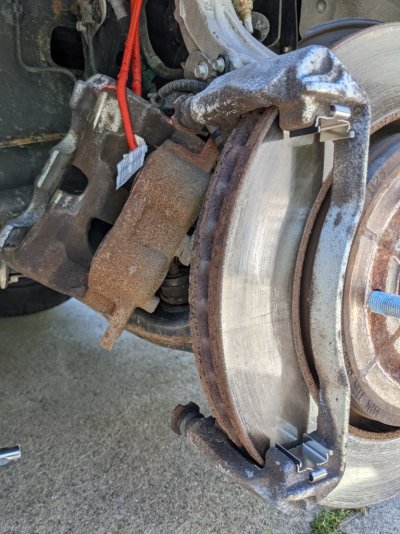
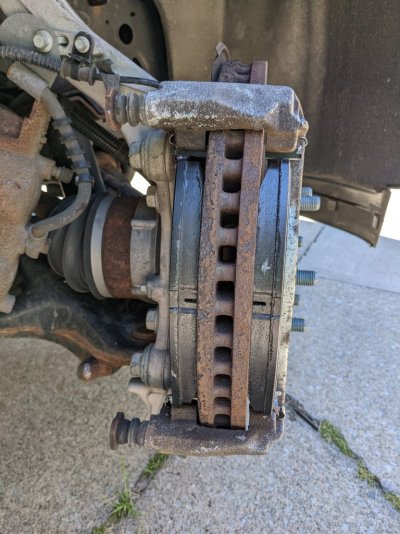
Jumping into the process photos after jacking the car up, securing it with a jack stand, and then removing the wheel:
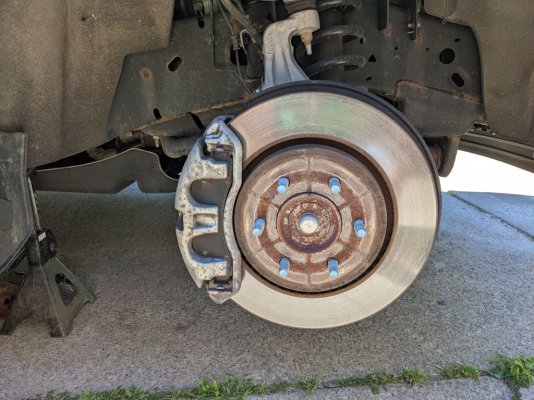
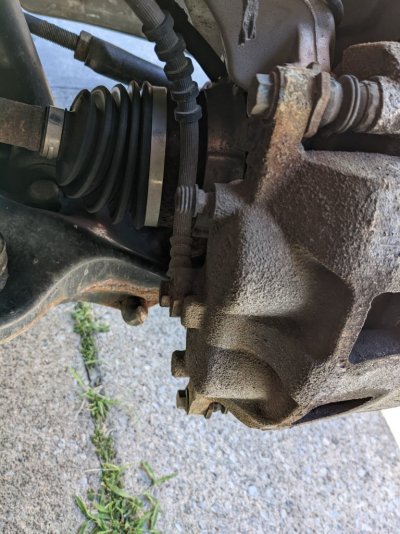
PXL_20220618_141142133.jpg


PXL_20220618_141148262.jpg

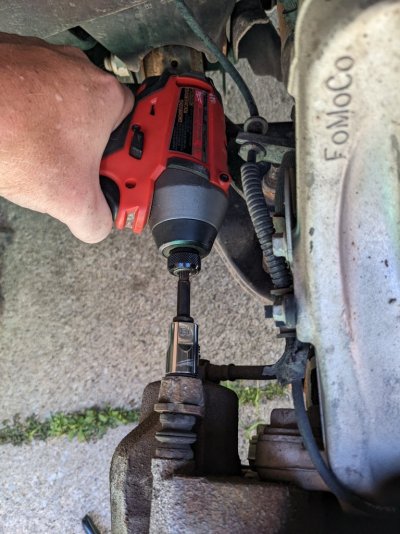
Caliper bolts are 13mm:

PXL_20220618_141353632.jpg


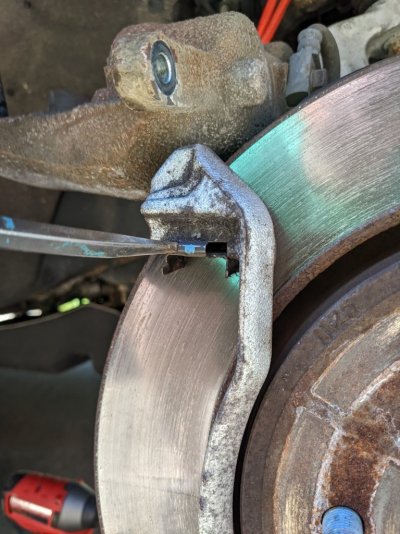
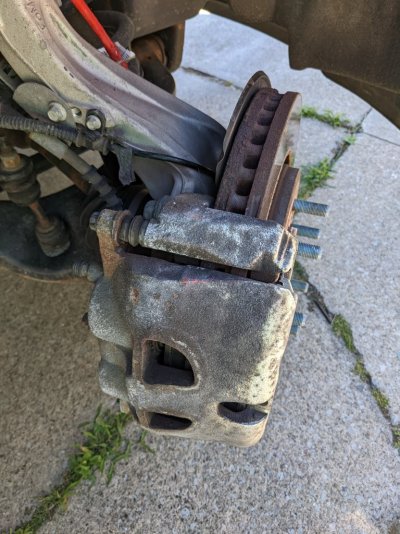
Pry the caliper off with a flat head screw driver, preferably something with some strength:
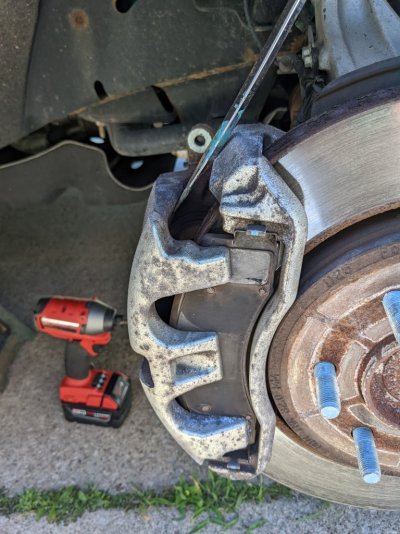
PXL_20220618_141534546.jpg


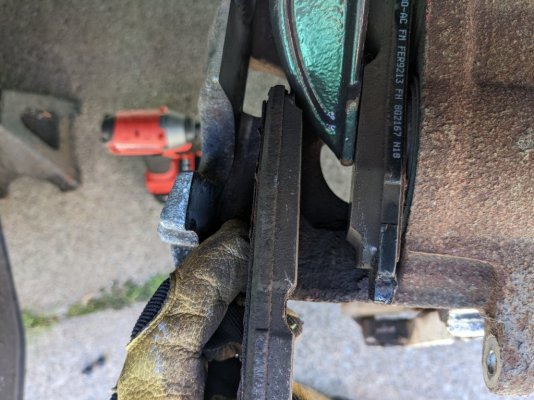
Now pry the pads out of the caliper. I will note here that on the other (driver) side, my inside pad was stuck. The front pads had lots of material remaining and I was actually going to save them, but I destroyed the friction face on the other pad prying it out.
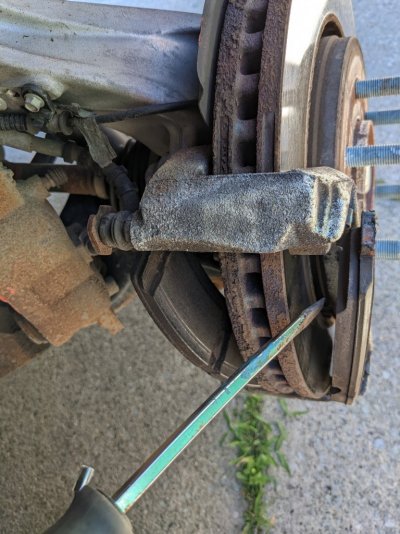
PXL_20220618_141702174.jpg


5 pic limit reached....continuing in next post...
 
OP
OP
O

Overtow

Well-Known Member
Joined
Jun 4, 2018
Posts
57
Reaction score
68
Location
CLEVELAND
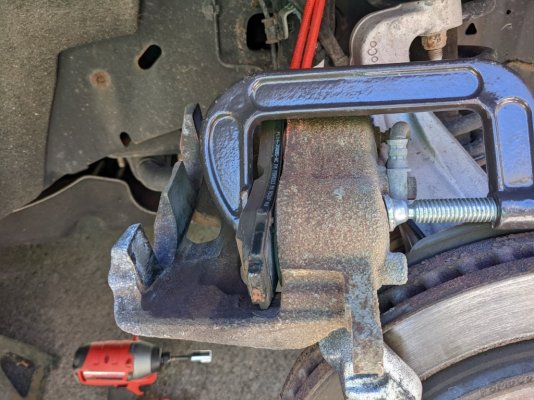
With the old pads removed, I used one to compress the pistons back into the caliper using a regular 6" C-clamp. Make sure you compress the pistons all the way - I did not on the first try and when reinstalling the caliper over the new pads one of the pistons would not clear a tab that was on the backing plate of the new pads. I had to pull the caliper back off and then compress again to get it to fit over that tab.

PXL_20220618_141903257.jpg


My back brakes were down to metal, but the fronts were still in decent shape. I almost stopped the job and left these on but I figured what the heck, I've got it torn down already, might as well swap them out...

PXL_20220618_141912222.jpg


Pop the mounting hardware out and replace with new:

PXL_20220618_142139460.jpg

PXL_20220618_142709859.jpg


After applying anti-seize to the mounting ears on the pads, install them into the mounting slots:

PXL_20220618_143405041.jpg
 
OP
OP
O

Overtow

Well-Known Member
Joined
Jun 4, 2018
Posts
57
Reaction score
68
Location
CLEVELAND
I noticed that my bottom caliper bolt was a little seized, so I pulled both pins out, wiped them off and then liberally applied anti-seize and reinstalled. #Cleveland
Reinstall the caliper and torque it down, then reinstall the wheel (after liberally applying anti-seize to the face of the rotor so I can get the wheel off in the future without having to sit on my ass and kick it). #easypeasy

PXL_20220618_144600585.jpg


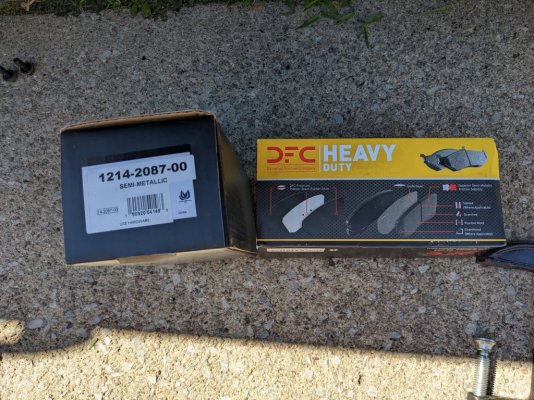
After this, I took it for a test drive and bedded the brakes. I'll post a response in the future on whether I like the pads or not. Here is what I installed, I went semi-metallic because I'll be towing a 7000# boat to Lake Cumberland next month...

PXL_20220618_142106348.jpg

$45 from Rock Auto:


HtownHog

Full Access Members
Joined
Jan 7, 2022
Posts
130
Reaction score
60
Location
Houston
This is wild that the rears west out so much faster than the fronts. Typically you would expect the opposite, wonder why these have such high rear bias.
 

Going_Going_Gone

Full Access Members
Joined
Aug 31, 2018
Posts
574
Reaction score
328
Location
Phoenix
Thanks for another illustrated tutorial. Seeing your rusty parts bring back (unpleasant) memories of winters growing up in the Cleveland area and the effects of snow and salt on vehicles.
 

keny01998

Full Access Members
Joined
Aug 31, 2019
Posts
221
Reaction score
106
Location
Arkansas
I think Ford Expedition has the easiest brake job than all other brands. I had to replace my rear pads at 28k miles and I'm going to replace my front pads soon. I just hit 37k miles this week and the pads have 5mm left because I tow a boat.
 

keny01998

Full Access Members
Joined
Aug 31, 2019
Posts
221
Reaction score
106
Location
Arkansas
This is wild that the rears west out so much faster than the fronts. Typically you would expect the opposite, wonder why these have such high rear bias.
I think it has to do with the adaptive cruise. My rear pads were gone around 28k miles.
 

Zig10

Full Access Members
Joined
May 8, 2019
Posts
215
Reaction score
167
Location
Mid Atlantic
I think it has to do with the adaptive cruise. My rear pads were gone around 28k miles.
I think it's just the bias. Mine wore out in the same timeframe and I rarely use my cruise control at all, and have only used the adaptive twice in 3 years.

I do tow a pretty heavy boat, though.
 

gural

Full Access Members
Joined
Jan 26, 2022
Posts
116
Reaction score
17
Location
Poland / Europe
I drive in Europe and most on the highways and after 6 k i do not see that the pads are used at all (do not have addaptive)
but in 2 car driven in city after 6k i see at least 20% of pads are used
 

TX-EXPMAX

Full Access Members
Joined
Jun 24, 2019
Posts
100
Reaction score
42
Location
Texas
Thanks for another great writeup. You've confirmed my suspicion on the front brakes...I can hear my back one squealing at 36k but front seems fine, so i'll probably just replace the rears and keep on truckin
 

SublimeHiPpOs

Well-Known Member
Joined
Apr 16, 2020
Posts
73
Reaction score
25
Location
Omaha, NE
This is wild that the rears west out so much faster than the fronts. Typically you would expect the opposite, wonder why these have such high rear bias.
I have a Jeep Wrangler as well as the Expy, they are also known to go through rear pads much more quickly than the fronts for some reason. Maybe they bias towards the rear on taller SUVs to help combat nose dive under heavy breaking? Or maybe in the case of the Expy it could be due to potentially extra weight on the rear while towing?
 

Peter L

Member
Joined
Nov 14, 2021
Posts
23
Reaction score
17
Location
Colorado
Great post! I've recenlty noticed that there seems ot be a "rumble" noise coming from the front under braking. It's not real loud and it's not s shudder like you'd get with a warped rotor. There also isn't any shimmy at all in the steering and no squeaking or squealing, just sortt of a low hum.... 2019 Expedition Limited with about 30,000 on the odometer. Any thoughts?
 

Peter L

Member
Joined
Nov 14, 2021
Posts
23
Reaction score
17
Location
Colorado
Great post adn timely as I may need to do something with my front brakes. Mine seem to have a low rumble or hum when braking. It' snot a shudder adn there' no shimmy like you'd exepct with a warped rotor...it's just a sort of rumble for lack of a better word. There is no squeaking or squealing and there doesn't seem to eb any loss of baraking power, nor does there seem to be any noise form the rear. I have a 2019 Limited 4x4 and I just passed 30,000 miles. Any thoughts would be appreciated.
 

Peter L

Member
Joined
Nov 14, 2021
Posts
23
Reaction score
17
Location
Colorado
Sorry about the double post - it looked like the original didn't take - My bad........
 

Leadfoot17

New Member
Joined
Jan 8, 2022
Posts
4
Reaction score
2
Location
Melbourne, FL
Thanks for another great writeup. You've confirmed my suspicion on the front brakes...I can hear my back one squealing at 36k but front seems fine, so i'll probably just replace the rears and keep on truckin
If you hear any level of squeal from the rears, you're likely metal on metal already. I have a 2018--mine started squealing at 40K miles and I figured it was the wear indicator...welp, there is no wear indicator so...needed a new rotor...hope not same for you.

#goodluck
 

2020ExpyPlatinum

Well-Known Member
Joined
Aug 4, 2020
Posts
57
Reaction score
28
Location
Cleveland, OH
Front brakes do 70% of the braking and rears usually only do about 30%.

The rear pads end up getting stuck in their holders since they don't get used as much. This is common with a lot of manufacturers. Honda rear brakes sometimes were gone after 20,000 miles.

The best way to prevent the rears from wearing out prematurely is to clean and lubricate the slide pins and clean the areas where the brake pads slide on the brackets.

Good write up by the OP!
 

duneslider

Full Access Members
Joined
Mar 20, 2019
Posts
902
Reaction score
438
Location
Utah
I don't know what pad composition the ford is using stock (haven't looked) but in the example of the jeep wrangler above, the jeep used a semi-metallic pad in front and an organic in back. The organic pads wear really fast. I don't know the reason they spec it that way but since I stopped using the organic pads on my jeep the front and rear wear out at a pretty similar rate.

I wonder if ford is doing this also. I have also heard that the traction control is the cause for more rear wear, most of the traction control is performed by applying rear brake.
 

TX-EXPMAX

Full Access Members
Joined
Jun 24, 2019
Posts
100
Reaction score
42
Location
Texas
I experienced the same thing in my wife’s Land Rover LR4. Never made sense to me but rears always went faster than fronts.
 

rd618

Full Access Members
Joined
Nov 1, 2021
Posts
745
Reaction score
389
Location
new york
I’m interested if the semi make an improvement in stopping distance.
 
OP
OP
O

Overtow

Well-Known Member
Joined
Jun 4, 2018
Posts
57
Reaction score
68
Location
CLEVELAND
The truck seems to stop better, but thats all subjective, I have no data to back up that statement.

A low rumble would seem to me to be a wheel bearing, which I feel like a number of people have had replaced early on in life. The way I diagnose this is to find two freeway exits/onramps, one that banks left and the other banking right. If the noise diminishes while turning left (putting pressure on right side of vehicle), its likely a bearing on the left side. Opposite if quiet while turning to the right.
 
Top