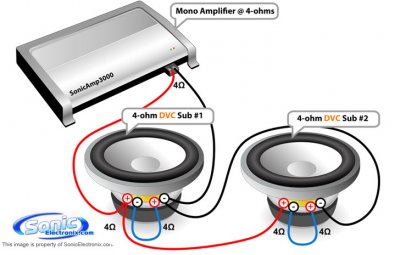
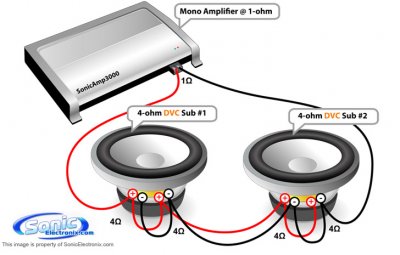
DR3W, the only way that you can run the speakers at 2 ohms is to get single voice coil speakers (SVC's) or if the amp outputs a low enough power, you only need to wire up a single coil on each speaker. BUt, like I mentioned, you need to make sure that the power of the single coil in each speaker is more then sufficient to handle the sub. An example would be if you have a speaker that each coil is rated for say 200 W RMS, you can run up to 800 W RMS if you used all 4 coils. So, any amp below 800 W RMS would work for these speakers. But, if you only wire up a single coil on each speaker, then you are back to 400 W RMS (200 W RMS for each speaker). I don't know the specs for the speakers that you bought, but it might be something to consider.
As for running amps into the 1 to 0.5 ohm range, most people do this to get additional power out of the amp. This is true to a point depending on the amp that you buy. If you get a true Class A amp, yes, by dropping the resistance in half, you double the power. The problem lies in that most amps made these days are not Class A amps (mainly due to the cost of making them, very expensive). So, most amps are what are called Class AB. So, they have a lot of the characteristics of a Class A amp, but not quite. So, what you will see is that the power may double for going from 4 ohm to 2 ohm, but when you step up to 1 ohm, you may only get 3 times (or less) from 4 ohms (vice 4 times). I've seen some amps actually loose a little bit of power when run at low ohms due to the heating of the internal components. So, without knowing a very specific manufacturer and model amp, it is hard to say what gains you may get from lowering the resistance. So, there is a bit of truth to both sides of this.

 ?
?