
Is an aftermarket intercooler really worth it for towing??

Disclaimer: Links on this page pointing to Amazon, eBay and other sites may include affiliate code. If you click them and make a purchase, we may earn a small commission.

42pilot

Member
Joined
Oct 14, 2021
Posts
21
Reaction score
25
Location
Blairsville, GA
I used to build early turbo Porsche motors (air cooled), including EFI conversions and designing intercoolers to match turbos for each HP application. HP/TQ numbers were 525/520 up to 675/640 on 3.3L up to 3.6L, 2500 lb cars.

With this in mind, I am trying to decide whether it really makes sense to upgrade the IC as the OEM is really not bad. The end tanks seem fine as they are molded plastic focusing on flow and the core seems fine in stock application. I don't give comments like, "it feels faster" or "better throttle response" or "engine is definitely smoother" (all actual comments on this forum) any credit as you cannot measure pressure, volume or temp through your butt. So, I bought an OBD II reader and started logging data.

Here are my parameters:

1. I own my 2020 Expedition, so longevity and reliability are paramount.
2. I tow a 6200 lb travel trailer A LOT and want to improve performance, keeping #1 above at the forefront.
3. I will NOT be buying a tune.
4. Any IC will have to be bolt-on.
5. I rarely exceed 64 mph while driving. It is the sweet spot for economy. BUT, I limit the transmission to 7th gear to eliminate constant shifting. It is also the sweet spot for torque (according to published dyno runs for stock 3.5 motors).
6. East of the Rockies, I use 87 octane fuel. Above 5,000 ft, I use 91 octane.

During my 2 hour logging today, on relatively flat, light traffic, 64 mph cruising pulling tandem axle, 6200 lb trailer, I learned the following:

1. Calculated engine load value - 27.84% (nice)
2. Engine RPM - 2546
3. Ambient Air Temp - 66.2 F
4. Air intake 1 (pre-turbos) - 78.8 F
5. Air intake 2 temp at manifold - 111.2 F (IC adding no value given ambient vs IAT 2)
6. Throttle position - 25.1%
7. Timing advance - 20 degrees (obviously no boost, so that's great - under boost, timing will be nearly 0)
8. Catalytic converter 1 temp - 1474.88 degrees (cat 2 is nearly identical)
9. Absolute load value - 66.3% (clearly no boost as that will begin at 100%)
10. Calculated boost - 0.13 bar (technically, the turbos are producing 1.9 lbs of boost)

Overall, this motor is impressive pulling a 6200lb camper. It is really not working at all at ~28%. For my application, this is the perfect platform as an everyday driver, and a vacation tow vehicle.

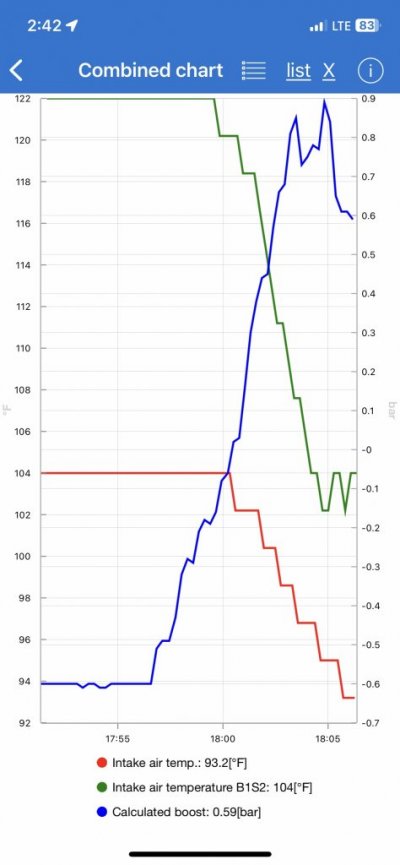
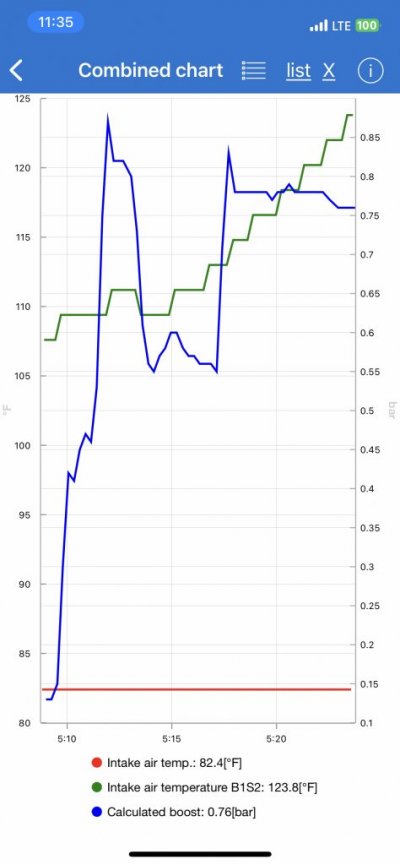
So, what is happening under boost? I did not log all the above parameters, but I did screen shot the live data (see attached):

1. IAT temp 1 pre-turbo is steady 82.4 degrees during the nearly 15 second pull.
2. IAT temp 2 at the manifold increases sharply under load and likely increases more over time.
3. Boost approx .76 bar (~ 11psi).

My main problem, and the primary reason I am considering an aftermarket IC is this - why in the hell does Ford have louvers blocking air to the IC that only open under load? Why not have them open all the time? Why close them at all? On air to air ICs, the holy grail was lowering the charge temp to ambient - it never happened or happens now to my knowledge. But blocking cooling air until its needed makes no sense. By the time they open, its too late.

So, I am going to lock the louvers open and see if the attached graph improves. If it does not, then I will buy an aftermarket IC AND remove the louvers.

Cooling the charge air temp will reduce the possibility of detonation (longevity and reliability), produce more torque (HP is overrated as it is simply a measurement of work over time - no need for a tune with the possible exception to lock the transmission sooner), and provide a more efficient (absolute load value) engine. Maybe, even a bit more MPG.

More later...
 

Attachments

  • boost AIT CAT.jpg
    boost AIT CAT.jpg
    56.9 KB · Views: 11

Expy Gator

Full Access Members
Joined
Jan 3, 2022
Posts
120
Reaction score
140
Location
Florida
Pilot sounds like you are educated and have done your homework - if it were me and I had that data I would do exactly what you are contemplating - open up the air flow to the IC. If you are not going to tune and increase boost - based upon your load values I dont see much advantage in a new IC. And too many people dont research new IC's they just buy them - I have found you get what you pay for - need to see how efficient the new IC is - what is the pressure differential between inlet and outlet. Some look good but definitely don't perform.
 

2020FordRaptor

Full Access Members
Joined
Sep 1, 2022
Posts
389
Reaction score
191
Location
Nevada
I used to build early turbo Porsche motors (air cooled), including EFI conversions and designing intercoolers to match turbos for each HP application. HP/TQ numbers were 525/520 up to 675/640 on 3.3L up to 3.6L, 2500 lb cars.

With this in mind, I am trying to decide whether it really makes sense to upgrade the IC as the OEM is really not bad. The end tanks seem fine as they are molded plastic focusing on flow and the core seems fine in stock application. I don't give comments like, "it feels faster" or "better throttle response" or "engine is definitely smoother" (all actual comments on this forum) any credit as you cannot measure pressure, volume or temp through your butt. So, I bought an OBD II reader and started logging data.

Here are my parameters:

1. I own my 2020 Expedition, so longevity and reliability are paramount.
2. I tow a 6200 lb travel trailer A LOT and want to improve performance, keeping #1 above at the forefront.
3. I will NOT be buying a tune.
4. Any IC will have to be bolt-on.
5. I rarely exceed 64 mph while driving. It is the sweet spot for economy. BUT, I limit the transmission to 7th gear to eliminate constant shifting. It is also the sweet spot for torque (according to published dyno runs for stock 3.5 motors).
6. East of the Rockies, I use 87 octane fuel. Above 5,000 ft, I use 91 octane.

During my 2 hour logging today, on relatively flat, light traffic, 64 mph cruising pulling tandem axle, 6200 lb trailer, I learned the following:

1. Calculated engine load value - 27.84% (nice)
2. Engine RPM - 2546
3. Ambient Air Temp - 66.2 F
4. Air intake 1 (pre-turbos) - 78.8 F
5. Air intake 2 temp at manifold - 111.2 F (IC adding no value given ambient vs IAT 2)
6. Throttle position - 25.1%
7. Timing advance - 20 degrees (obviously no boost, so that's great - under boost, timing will be nearly 0)
8. Catalytic converter 1 temp - 1474.88 degrees (cat 2 is nearly identical)
9. Absolute load value - 66.3% (clearly no boost as that will begin at 100%)
10. Calculated boost - 0.13 bar (technically, the turbos are producing 1.9 lbs of boost)

Overall, this motor is impressive pulling a 6200lb camper. It is really not working at all at ~28%. For my application, this is the perfect platform as an everyday driver, and a vacation tow vehicle.

So, what is happening under boost? I did not log all the above parameters, but I did screen shot the live data (see attached):

1. IAT temp 1 pre-turbo is steady 82.4 degrees during the nearly 15 second pull.
2. IAT temp 2 at the manifold increases sharply under load and likely increases more over time.
3. Boost approx .76 bar (~ 11psi).

My main problem, and the primary reason I am considering an aftermarket IC is this - why in the hell does Ford have louvers blocking air to the IC that only open under load? Why not have them open all the time? Why close them at all? On air to air ICs, the holy grail was lowering the charge temp to ambient - it never happened or happens now to my knowledge. But blocking cooling air until its needed makes no sense. By the time they open, its too late.

So, I am going to lock the louvers open and see if the attached graph improves. If it does not, then I will buy an aftermarket IC AND remove the louvers.

Cooling the charge air temp will reduce the possibility of detonation (longevity and reliability), produce more torque (HP is overrated as it is simply a measurement of work over time - no need for a tune with the possible exception to lock the transmission sooner), and provide a more efficient (absolute load value) engine. Maybe, even a bit more MPG.

More later...
Man your knowledge is amazing. All I can say is with all the towing you'll be doing I don't think it will hurt, and I agree on no tune.
 

JasonH

Full Access Members
Joined
Nov 12, 2018
Posts
1,557
Reaction score
895
Location
Houston, TX
If I had to guess, the louvers are for aerodynamics. Many EVs use them to reduce turbulence from air flowing in the front motor compartment. I think you answered your own question re: closure. The additional air flow isn't needed. The only time you're likely to demand full power while towing is while accelerating to highway speeds, or while passing. Like you, I limit my speeds to 65 mph +/- 2 depending on traffic conditions. For that use case, the stock setup works fine. That's not to say an upgraded intercooler would not improve performance. But most of the time we're not demanding peak horsepower while towing. The only other area it might provide some benefits is at high altitude towing in hot weather, since air is thinner and will cool less. Fords manual actually reduces max towing limits at high altitude to compensate for lower air density. I've contemplated upgrading intercoolers, radiators, gearing (mine is 2017 EL w/ 3.31). But really, my 4x2 does very well towing my 7K camper and any upgrades are me being a hobbyist, not due to necessity.
 
Last edited:

LazSlate

Full Access Members
Joined
May 7, 2022
Posts
416
Reaction score
245
Location
Arizona
Lots of you tube videos on this for the F150 (some on the expys) They seems to add some value as the aftermarket are bigger and require cutting of the shroud. On the stealth and Timberline those come with intercooler fans which could make a big difference giving flow all the time when needed. IDK.
 
OP
OP
4

42pilot

Member
Joined
Oct 14, 2021
Posts
21
Reaction score
25
Location
Blairsville, GA
On the stealth and Timberline those come with intercooler fans which could make a big difference giving flow all the time when needed. IDK.
That's interesting. Just proves that airflow - and supplementing airflow - matters. I built a motor years ago, and to prove my point in how important cold air was, I put dry ice all over the IC (the IC sat on top of the motor in the old air cooled motors). I then dyno'd the motor with the ice cold cooler and found it added 20 tq and 25 hp. Interesting experiment.

Getting electric fans of nearly any size is easy. I wonder if using the louver plug could be used to turn on an electric fan. Delete the louvers, but use the plug to trip a relay to provide amps to a high speed fan. This could be fun to try. Thanks for the heads up.
 
OP
OP
4

42pilot

Member
Joined
Oct 14, 2021
Posts
21
Reaction score
25
Location
Blairsville, GA
If I had to guess, the louvers are for aerodynamics. Many EVs use them to reduce turbulence from air flowing in the front motor compartment. I think you answered your own question re: closure. The additional air flow isn't needed. The only time you're likely to demand full power while towing is while accelerating to highway speeds, or while passing. Like you, I limit my speeds to 65 mph +/- 2 depending on traffic conditions. For that use case, the stock setup works fine. That's not to say an upgraded intercooler would not improve performance. But most of the time we're not demanding peak horsepower while towing. The only other area it might provide some benefits is at high altitude towing in hot weather, since air is thinner and will cool less. Fords manual actually reduces max towing limits at high altitude to compensate for lower air density. I've contemplated upgrading intercoolers, radiators, gearing (mine is 2017 EL w/ 3.31). But really, my 4x2 does very well towing my 7K camper and any upgrades are me being a hobbyist, not due to necessity.
Any time you introduce cooler air, you increase the density of air, and therefore oxygen. This means, the lower the temp, the more O2 is available, and less fuel needed to do the same amount of work. Therefore, your fuel economy should improve. Why would Ford impede that? It might have something to do with emissions.

I looked for the comment you made that Ford reduces max towing at altitude to compensate for lower air density in the manual. However, this makes no sense to me when we are talking about forced air induction systems. The whole idea of adding turbos or supercharges is to compress air, and therefore "force" a lower oxygen-rich density altitude. Its the same principle of flying in an airplane. They cruise at +30,000 feet, but pressurize the cabin to simulate an altitude of 7,000 ft. The reason I really like the 3.5L ecoboost is what it does above 5,000 ft. It leaves naturally aspirated motors (even in larger displacements) in the dust because it does not care the altitude (within reason). My F450 6.7L diesel pulled just as hard at 8,000 ft as it did at sea level and so does the 3.5L.

I completely agree with you about the majority of our driving, as 95% is near-naturally aspirated. However, the turbos as still there, compressing a certain amount of air, and therefore heating the intake. I still think it makes sense to cool as much of the air as possible, whether at low cruise rpm, or while towing (under load), to improve overall efficiency.
 

LazSlate

Full Access Members
Joined
May 7, 2022
Posts
416
Reaction score
245
Location
Arizona
That's interesting. Just proves that airflow - and supplementing airflow - matters. I built a motor years ago, and to prove my point in how important cold air was, I put dry ice all over the IC (the IC sat on top of the motor in the old air cooled motors). I then dyno'd the motor with the ice cold cooler and found it added 20 tq and 25 hp. Interesting experiment.

Getting electric fans of nearly any size is easy. I wonder if using the louver plug could be used to turn on an electric fan. Delete the louvers, but use the plug to trip a relay to provide amps to a high speed fan. This could be fun to try. Thanks for the heads up.
You may want to see if there is a plug for the fans in the harness. They may not have a separate harness for the Timberline and the plug is just tucked away. This way you can get the factory fans from the TImberline and install them relatively easy.
 

JasonH

Full Access Members
Joined
Nov 12, 2018
Posts
1,557
Reaction score
895
Location
Houston, TX
Any time you introduce cooler air, you increase the density of air, and therefore oxygen. This means, the lower the temp, the more O2 is available, and less fuel needed to do the same amount of work. Therefore, your fuel economy should improve. Why would Ford impede that? It might have something to do with emissions.

I looked for the comment you made that Ford reduces max towing at altitude to compensate for lower air density in the manual. However, this makes no sense to me when we are talking about forced air induction systems. The whole idea of adding turbos or supercharges is to compress air, and therefore "force" a lower oxygen-rich density altitude. Its the same principle of flying in an airplane. They cruise at +30,000 feet, but pressurize the cabin to simulate an altitude of 7,000 ft. The reason I really like the 3.5L ecoboost is what it does above 5,000 ft. It leaves naturally aspirated motors (even in larger displacements) in the dust because it does not care the altitude (within reason). My F450 6.7L diesel pulled just as hard at 8,000 ft as it did at sea level and so does the 3.5L.

I completely agree with you about the majority of our driving, as 95% is near-naturally aspirated. However, the turbos as still there, compressing a certain amount of air, and therefore heating the intake. I still think it makes sense to cool as much of the air as possible, whether at low cruise rpm, or while towing (under load), to improve overall efficiency.
Cooler air does increase the density, but ICE have a narrow stoichiometric range for combustion, so more oxgyen = more fuel. By your criteria, efficiency would be improved by increasing boost since more boost = more oxygen. That's not quite how it works since additional fuel is needed to ensure a suitable stoichiometric mix.

Here is an article from Edmunds on how the active shutters work:

The reduced towing capacity is straight from the manual. You may have seen comments online about Ecoboost engines overheating while towing. Part of the reason why is that the air is thinner at high elevations, so the engines can't exchange heat as quickly. Here's a link to the 4th gen manual regarding towing at altitude. It says reduce gross weight by 2% for every 1,000 foot increase in elevation.


5280tunage

Full Access Members
Joined
Sep 17, 2019
Posts
1,875
Reaction score
1,154
Location
colorado
@JasonH That's an interesting last sentence, on reducing gross weight. That number seems very similar to one we've used for years when talking about tuning, even carbureted engines. We always went by 2-3% loss in oxygen per 1K feet elevation gain. But then again, I'm not sure on the loss of cooling, as generally gaining altitude reduces ambient temperatures. To me it's kind of a wash.

@42pilot One of the very first things I did was put in a good IC. I have built and tuned other Turbo engines (mainly high RPM 4 CYL's) and I've always liked better IC's with larger volume, more efficient heat transfer. I like to think (no real proof to this) that anything you can do to help reduce turbo temps can help them last longer. Realistically I also wonder about the charge pipes, etc. Reducing turbulence and improving flow would be great. I actually wish some of these companies could make them using a concentric design, to help reduce the engine heat raising air temps on the cold side. Of course the pipe kits are already stupid expensive, that would make them only worse. Also, you're note about the dry ice, that's awesome, we used to do a lot of tinkering with cold water injection systems, and even using dry ice blankets on NOS bottles.

the louvers are interesting, they've been talked about quite a bit on here. Many cars have them these days, regardless of aspiration design, and yes, the primary reason is to improve aerodynamics. My understanding is that they are supposed to closed during engine warmup and generally at highway speeds depending on engine temps. what's kind of interesting is it kind of shows how good these engines are at keeping a pretty consistent temp at normal output, if you can effectively cut off airflow to the radiator too.
 
OP
OP
4

42pilot

Member
Joined
Oct 14, 2021
Posts
21
Reaction score
25
Location
Blairsville, GA
@JasonH - thanks for the Edmunds link. Even though they address the what I think is the radiator louvers, the IC probably applies. And the total frontage the IC represents is probably 120 sq in or so and they are looking for that as an aerodynamic advantage vs cool air charge? Wow. So I am trashing those first regardless what or if I buy.

And thanks for manual info. As a pilot, I am intimately acquainted with density altitudes and performance at altitude. But I would have been wrong on what you pointed out for the expedition.

@5280tunage - I think a new IC will probably make sense, but I hate throwing big money that yields little to no advantage. Not to mention adding parts that weren’t exactly designed for the application. For example, I used 1 1/2 in primaries on my flat six turbo header using a GT35 turbo. This created a full bar of boost at 2800 rpm. But allowed it to efficiently provide boost past 6000 rpm. But the popular thought was a bigger pipe is better because more air flow. In reality it fell on its face and took well over 4000 rpm to spool. And the other popular thought, aftermarket dealers know more than the collective knowledge of the Ecoboost engineers. Ah, no.

We looked at water methanol injection for more power but the weight gain for the water tank, and the volume of water needed to cool during a track day was significant. So, we decided to go for bigger more effective brakes, coupled with tires that provided a larger contact patch. The result was, we could stay on power longer into turns than to big HP did, and could out-brake our competitors. I had 6 piston calipers (996) on all four corners. Anyway, I try to look at all angles and get data before I spend money. I’ve spent far too much my net over the years chasing performance based on an internet theory.
 
OP
OP
4

42pilot

Member
Joined
Oct 14, 2021
Posts
21
Reaction score
25
Location
Blairsville, GA
Quote - Cooler air does increase the density, but ICE have a narrow stoichiometric range for combustion, so more oxgyen = more fuel. By your criteria, efficiency would be improved by increasing boost since more boost = more oxygen. That's not quite how it works since additional fuel is needed to ensure a suitable stoichiometric mix. - unquote
Well, kind of. But we are talking about work here, not keeping stoichiometric ratio. The engine will be producing more HP per unit, but it will have to work less to maintain ~2400 rpm. This means less fuel. Probably not much, but it will be less.

 
OP
OP
4

42pilot

Member
Joined
Oct 14, 2021
Posts
21
Reaction score
25
Location
Blairsville, GA
Today I disconnected the IC louvers by simply unplugging the power source, and manually opened the louvers. I then drove the car to get the intake system heat soaked and did a short half bar boost run. Ambient air was 78 degrees. With the louvers basically locked open, you can see the the IAC2 dropped from 122 degrees to around 104 within 5 seconds and reacted before boost was introduced (it dropped 2 degrees when MAP started to show any positive pressure). You can at least argue temps and boost moved concurrently which tells me the intake system on this car is pretty good. This is completely opposite of what happened when the louvers were operational in my original post. AIT1 dropped a split second after boost as well which is really interesting as it pulls directly from ambient but took just a bit longer to register. Maybe the stock IC is not so bad when it has access to airflow...
 

Attachments

  • boost AIT CAT 2.jpg
    boost AIT CAT 2.jpg
    59.4 KB · Views: 8

LovinPSDs

Full Access Members
Joined
Mar 2, 2020
Posts
112
Reaction score
50
Location
Houston
Interesting post, and I like the approach…

Makes me wonder how many aftermarket IC reports are in some way related to the louvers. I mean you probably remove those if your spending time putting an aftermarket unit in

Now that said… lots and lots of people report favorable results in conditions where the louvers shouldn’t be at play… long hill towing, boosted launches, etc.

Also, I follow the F150 EB pages so that’s where a lot of my feedback comes from… I do like your approach though!
 

BlackBetty

Full Access Members
Army
Joined
Feb 1, 2021
Posts
433
Reaction score
170
Location
Surprise, AZ
If you were to get a new intercooler tuning would be the next step to get the most potential out of the swap. An aftermarket intercooler would be an upgrade from stock, so it will have different flow characteristics that would need to be accounted for. Also, the biggest thing is if you were to get one that mounts above the current location.; like say, a Full Race for example.

I did a full Race swap in my garage. There is a big difference between the two assemblies. Mounting location, flow capability, dimensions, etc.

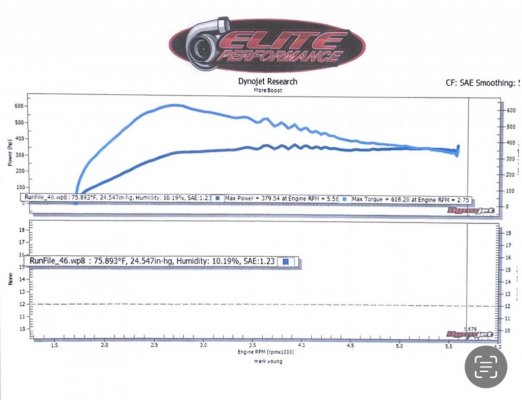
As far as performance goes… no, I guess I can’t measure HP gains through my butt. However, the dyno says otherwise; see attached dyno sheet. Remember, those numbers are at the wheels, and not what’s produced at the crank. Thought about another mod(s) to render a bit more horsepower… it’s on hold for the moment. I did put a Full Race CAI on, but I couldn’t take the noise. Not to mention it needed a bit more tuning to be effective. But, the noise factor was a big deal. Took it off. My truck pulls like crazy. The power at the wheels is stupid compared to pre-install. The first time I got on it I remember it shifting so hard that it made a little “bark” noise. The truck still spins the tires before Traction Control can kick in. Albeit, I had to have a custom tune loaded to harness all that power. The week before the time was installed it was slightly noticeable that I had done something. Not until the trucks visit to Elite Performance and Tune in Littleton, CO did it wake up to it’s current form.

I do understand not wanting to alter the PCM. Trust me… I’ve struggled with the decision to do it. I still struggle wondering if it were a good idea. However, if you’re will to make a mechanical mod that’s not what Ford intended for the PCM to look for, then the vehicle won’t make the best of the part, time, and money spent. I’d just keep it stock.

I will tell you that just after New Year’s I hauled my wife’s Buick Encore full of Christmas gifts on my 16ft trailer, along with my toolbox, her luggage, work computer, work printer, my toolbox, etc. from Atlanta to Arizona… absolutely no problems!!! The power was on tap every time I needed it. Honestly, didn’t really get in it because I was trying to snatch the Encore around on the trailer obviously. But, I have snatched that trailer from a stop ONCE just to see. Enough power to easily spin the tires.

What I’m trying to say is the thing can tow… Np !!! That was approximately 9000lbs it handled with no issues. No issues controlling speed coming down the mountain in the snow from I-40 in Flagstaff down I-17 to Phoenix. Between 4wd, manual shifting, and light feathering of the brake pedal (CDL OTR experience) it went well.

I’ve only ever towed my small 6ftx12ft single axle trailer before the mod. With the truck stock it handled that one fine. When I had it loaded with my workbench, engine pulled and stand, wall locker, toolboxes, and all the miscellaneous garage stuff it did ok. But the modded version with the more recent heavier load handled it like butter.
 

Attachments

  • 0C408F85-77F9-4942-B08B-140A3A255369.jpeg
    0C408F85-77F9-4942-B08B-140A3A255369.jpeg
    78.8 KB · Views: 24

2020ExpyPlatinum

Well-Known Member
Joined
Aug 4, 2020
Posts
57
Reaction score
28
Location
Cleveland, OH
I used to build early turbo Porsche motors (air cooled), including EFI conversions and designing intercoolers to match turbos for each HP application. HP/TQ numbers were 525/520 up to 675/640 on 3.3L up to 3.6L, 2500 lb cars.

With this in mind, I am trying to decide whether it really makes sense to upgrade the IC as the OEM is really not bad. The end tanks seem fine as they are molded plastic focusing on flow and the core seems fine in stock application. I don't give comments like, "it feels faster" or "better throttle response" or "engine is definitely smoother" (all actual comments on this forum) any credit as you cannot measure pressure, volume or temp through your butt. So, I bought an OBD II reader and started logging data.

Here are my parameters:

1. I own my 2020 Expedition, so longevity and reliability are paramount.
2. I tow a 6200 lb travel trailer A LOT and want to improve performance, keeping #1 above at the forefront.
3. I will NOT be buying a tune.
4. Any IC will have to be bolt-on.
5. I rarely exceed 64 mph while driving. It is the sweet spot for economy. BUT, I limit the transmission to 7th gear to eliminate constant shifting. It is also the sweet spot for torque (according to published dyno runs for stock 3.5 motors).
6. East of the Rockies, I use 87 octane fuel. Above 5,000 ft, I use 91 octane.

During my 2 hour logging today, on relatively flat, light traffic, 64 mph cruising pulling tandem axle, 6200 lb trailer, I learned the following:

1. Calculated engine load value - 27.84% (nice)
2. Engine RPM - 2546
3. Ambient Air Temp - 66.2 F
4. Air intake 1 (pre-turbos) - 78.8 F
5. Air intake 2 temp at manifold - 111.2 F (IC adding no value given ambient vs IAT 2)
6. Throttle position - 25.1%
7. Timing advance - 20 degrees (obviously no boost, so that's great - under boost, timing will be nearly 0)
8. Catalytic converter 1 temp - 1474.88 degrees (cat 2 is nearly identical)
9. Absolute load value - 66.3% (clearly no boost as that will begin at 100%)
10. Calculated boost - 0.13 bar (technically, the turbos are producing 1.9 lbs of boost)

Overall, this motor is impressive pulling a 6200lb camper. It is really not working at all at ~28%. For my application, this is the perfect platform as an everyday driver, and a vacation tow vehicle.

So, what is happening under boost? I did not log all the above parameters, but I did screen shot the live data (see attached):

1. IAT temp 1 pre-turbo is steady 82.4 degrees during the nearly 15 second pull.
2. IAT temp 2 at the manifold increases sharply under load and likely increases more over time.
3. Boost approx .76 bar (~ 11psi).

My main problem, and the primary reason I am considering an aftermarket IC is this - why in the hell does Ford have louvers blocking air to the IC that only open under load? Why not have them open all the time? Why close them at all? On air to air ICs, the holy grail was lowering the charge temp to ambient - it never happened or happens now to my knowledge. But blocking cooling air until its needed makes no sense. By the time they open, its too late.

So, I am going to lock the louvers open and see if the attached graph improves. If it does not, then I will buy an aftermarket IC AND remove the louvers.

Cooling the charge air temp will reduce the possibility of detonation (longevity and reliability), produce more torque (HP is overrated as it is simply a measurement of work over time - no need for a tune with the possible exception to lock the transmission sooner), and provide a more efficient (absolute load value) engine. Maybe, even a bit more MPG.

More later...

You are way
I used to build early turbo Porsche motors (air cooled), including EFI conversions and designing intercoolers to match turbos for each HP application. HP/TQ numbers were 525/520 up to 675/640 on 3.3L up to 3.6L, 2500 lb cars.

With this in mind, I am trying to decide whether it really makes sense to upgrade the IC as the OEM is really not bad. The end tanks seem fine as they are molded plastic focusing on flow and the core seems fine in stock application. I don't give comments like, "it feels faster" or "better throttle response" or "engine is definitely smoother" (all actual comments on this forum) any credit as you cannot measure pressure, volume or temp through your butt. So, I bought an OBD II reader and started logging data.

Here are my parameters:

1. I own my 2020 Expedition, so longevity and reliability are paramount.
2. I tow a 6200 lb travel trailer A LOT and want to improve performance, keeping #1 above at the forefront.
3. I will NOT be buying a tune.
4. Any IC will have to be bolt-on.
5. I rarely exceed 64 mph while driving. It is the sweet spot for economy. BUT, I limit the transmission to 7th gear to eliminate constant shifting. It is also the sweet spot for torque (according to published dyno runs for stock 3.5 motors).
6. East of the Rockies, I use 87 octane fuel. Above 5,000 ft, I use 91 octane.

During my 2 hour logging today, on relatively flat, light traffic, 64 mph cruising pulling tandem axle, 6200 lb trailer, I learned the following:

1. Calculated engine load value - 27.84% (nice)
2. Engine RPM - 2546
3. Ambient Air Temp - 66.2 F
4. Air intake 1 (pre-turbos) - 78.8 F
5. Air intake 2 temp at manifold - 111.2 F (IC adding no value given ambient vs IAT 2)
6. Throttle position - 25.1%
7. Timing advance - 20 degrees (obviously no boost, so that's great - under boost, timing will be nearly 0)
8. Catalytic converter 1 temp - 1474.88 degrees (cat 2 is nearly identical)
9. Absolute load value - 66.3% (clearly no boost as that will begin at 100%)
10. Calculated boost - 0.13 bar (technically, the turbos are producing 1.9 lbs of boost)

Overall, this motor is impressive pulling a 6200lb camper. It is really not working at all at ~28%. For my application, this is the perfect platform as an everyday driver, and a vacation tow vehicle.

So, what is happening under boost? I did not log all the above parameters, but I did screen shot the live data (see attached):

1. IAT temp 1 pre-turbo is steady 82.4 degrees during the nearly 15 second pull.
2. IAT temp 2 at the manifold increases sharply under load and likely increases more over time.
3. Boost approx .76 bar (~ 11psi).

My main problem, and the primary reason I am considering an aftermarket IC is this - why in the hell does Ford have louvers blocking air to the IC that only open under load? Why not have them open all the time? Why close them at all? On air to air ICs, the holy grail was lowering the charge temp to ambient - it never happened or happens now to my knowledge. But blocking cooling air until its needed makes no sense. By the time they open, its too late.

So, I am going to lock the louvers open and see if the attached graph improves. If it does not, then I will buy an aftermarket IC AND remove the louvers.

Cooling the charge air temp will reduce the possibility of detonation (longevity and reliability), produce more torque (HP is overrated as it is simply a measurement of work over time - no need for a tune with the possible exception to lock the transmission sooner), and provide a more efficient (absolute load value) engine. Maybe, even a bit more MPG.

More later...
Your over thinking this way to much. It's a very simple solution, unplug the louvers if you want them open the whole time

Those louvers open and close to improve aerodynamics on the vehicle and that is the only reason they are there.

If you are happy with the performance as you state why would you change the intercooler?

You seem educated, than you should also know lowering the charge air temperature will increase the density of the charge and if you decrease the air charge temperature you can cause condensation which is not a good thing.

I would not touch the expedition until it is out of warranty than mess with whatever you would like.
 

Grey ghost

Full Access Members
Joined
Apr 26, 2019
Posts
360
Reaction score
134
Location
Melbourne fl
I have a vortec cold air kit itis a sealed box and isn't noisy. I have a cooler thermostat and a 5 star tuner and it drives nice and is an animal when I need the power. I wouldn't be afraid of a tuner for a company like 5 star thier service is great.
 

LazSlate

Full Access Members
Joined
May 7, 2022
Posts
416
Reaction score
245
Location
Arizona
The louvers on the IC in are also for fuel economy, in addition to helping warm up quickly as others have stated.
Ford makes these to run in all temps so I would imagine in sub zero temps the system would want them closed to help keep the engine at operating temps. Much like semis in sub zero have their grills almost completed blocked.
 
OP
OP
4

42pilot

Member
Joined
Oct 14, 2021
Posts
21
Reaction score
25
Location
Blairsville, GA
SNIP - If you were to get a new intercooler tuning would be the next step to get the most potential out of the swap. An aftermarket intercooler would be an upgrade from stock, so it will have different flow characteristics that would need to be accounted for. Also, the biggest thing is if you were to get one that mounts above the current location.; like say, a Full Race for example.

I did a full Race swap in my garage. There is a big difference between the two assemblies. Mounting location, flow capability, dimensions, etc.

As far as performance goes… no, I guess I can’t measure HP gains through my butt. However, the dyno says otherwise; see attached dyno sheet. - SNIP
First of all, thanks for the dyno chart. That's an impressive result. When I calculate your HP, I come up with approx 650 HP given your 618 ft lbs of torque at 5500 rpm. Nonetheless, a quick and relatively flat torque curve is far more important than HP.

I don't want to get a tune because, quite frankly, I own this vehicle; its my daily driver; it has to last (have you seen the price of new/used vehicles??!!) and I don't want to wear the engine with increased pressures, etc. In addition, I just don't trust aftermarket tunes. If you look at the software, i.e., the tables and inputs to produce a result, it is complicated. I used to use Link G4 ECUs to tune, and we only used 12-14 tables, for example fuel delivery rate, fuel correction by IAT temperature, manifold pressure, timing, boost, acceleration rate, cold start, hot start and so on. There are probably well over 50 tables in our ECUs. You just need one corner to be cut, or be too aggressive on timing on boost, and so on. For me, I'm ok with the power delivery using 87 octane or 91 towing. Personal opinion.

Since our ECUs learn, installing a new aftermarket IC needs no tuning package to get the benefits.

Thanks again for the chart.
 
OP
OP
4

42pilot

Member
Joined
Oct 14, 2021
Posts
21
Reaction score
25
Location
Blairsville, GA
You are way

Your over thinking this way to much. It's a very simple solution, unplug the louvers if you want them open the whole time

Those louvers open and close to improve aerodynamics on the vehicle and that is the only reason they are there.

If you are happy with the performance as you state why would you change the intercooler?

You seem educated, than you should also know lowering the charge air temperature will increase the density of the charge and if you decrease the air charge temperature you can cause condensation which is not a good thing.

I would not touch the expedition until it is out of warranty than mess with whatever you would like.
You're right - I might be over thinking this, but that's me...

I did unplug the louvers. I've had them unplugged for quite a few miles and will keep it unplugged as I see no benefit of the louvers. And around town, aerodynamics is a thing for me. FYI - no CEL either.

As stated, I am looking at changing the IC because I tow a lot, and I feel a higher capacity IC will provide better overall performance, but as you might know, keeping intake air temps low also reduces the chance of detonation under load in higher ambient temps. Think of it as engine insurance while keeping performance.

There is no condensation in the IC during operation. Unless you have a venturi in your IC (where it lowers pressure), you are not going to cool it so much that you'll have condensation.

Adding an IC to the car now, even under warranty, will not void the engine warranty. Even if I had a problem, I can swap it out with OEM...
 
Top