

Or why you should pull the intake when your starter is screeching..
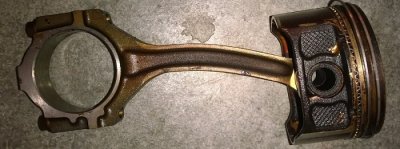
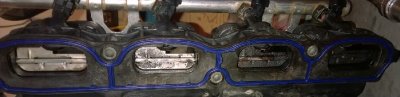
I bought a 2006 XLT with 106 K Miles and not a week later, the engine is toast. I had the occasional starter noise where it screeched quite loud and would not turn over. So I replaced the starter and the frequency at which I had the starting issue improved but it didn't go away. A few days later, it screeched and after a few attempts, it finally started but ran very rough and made a horrible knocking sound. So I bit the bullet and pulled the engine to do that, the intake has to come out first to make room for the engine hoist attachment. When I got the intake out, the Charge Valve flap of cylinder #4 was clean as a whistle, the 7 other flaps were crusted with carbon (as you would expect). After I got the engine out and disassembled, I found the rod of cylinder #4 bent and a 3" section of teeth in the flywheel ground out. The section with the bad teeth was located at the starter just before #4 TDC.
So it looks like a leaking injector in cylinder #4 (thus the clean flap) dripped fuel into the cylinder and the starter could not compress it but rather ground down the teeth on the flywheel. The new starter eventually mustered enough torque to get the rotating assembly moving just enough to bend the rod.
The moral or the story: If you have the occasional starter grind, it might be a good idea to pull the intake (not that hard) and check for clean charge modulation flaps which indicates a leaky fuel injector.
I bought a 2006 XLT with 106 K Miles and not a week later, the engine is toast. I had the occasional starter noise where it screeched quite loud and would not turn over. So I replaced the starter and the frequency at which I had the starting issue improved but it didn't go away. A few days later, it screeched and after a few attempts, it finally started but ran very rough and made a horrible knocking sound. So I bit the bullet and pulled the engine to do that, the intake has to come out first to make room for the engine hoist attachment. When I got the intake out, the Charge Valve flap of cylinder #4 was clean as a whistle, the 7 other flaps were crusted with carbon (as you would expect). After I got the engine out and disassembled, I found the rod of cylinder #4 bent and a 3" section of teeth in the flywheel ground out. The section with the bad teeth was located at the starter just before #4 TDC.
So it looks like a leaking injector in cylinder #4 (thus the clean flap) dripped fuel into the cylinder and the starter could not compress it but rather ground down the teeth on the flywheel. The new starter eventually mustered enough torque to get the rotating assembly moving just enough to bend the rod.
The moral or the story: If you have the occasional starter grind, it might be a good idea to pull the intake (not that hard) and check for clean charge modulation flaps which indicates a leaky fuel injector.
Attachments

Last edited: