Putting a tire on, because it looks cool(they do), it something no one under 21 should do. LT tires are 8-10ply, they have an extra steel belt and thicker tread. They are loud, at highway speeds. They also are more expensive. Running them will kill fuel mileage. They do not require more air. You vehicle rides on the air, not the tire. The amount of air is calculated by the tire size and loaded weight of vehicle. Try Setting cold air at 36psi. Take it for a ride. Craigslist always has people looking for tires.


You are using an out of date browser. It may not display this or other websites correctly.
You should upgrade or use an alternative browser.
You should upgrade or use an alternative browser.
Tire Warning
- Thread starter Dawgbyt
- Start date
Disclaimer: Links on this page pointing to Amazon, eBay and other sites may include affiliate code. If you click them and make a purchase, we may earn a small commission.
chuck s
Full Access Members
- Joined
- Dec 20, 2006
- Posts
- 1,990
- Reaction score
- 753
The M+S (mud/snow) tires fitted at the factory should be fine. There are AT (all terrain) tires available in OEM sizes.
But I'm not what wheels are on the truck we're discussing.
-- Chuck
But I'm not what wheels are on the truck we're discussing.
-- Chuck
AllBoostNoEco
Full Access Members
https://toyo-arhxo0vh6d1oh9i0c.stac...ication_of_load_inflation_tables_20170203.pdf
Everything you could ever want to know is in here. Including how to convert from P-Metric inflation pressures to LT-Metric inflation pressures. You WILL be running higher pressures in an LT tire unless it is really big.
The LT275/70R18 only supports 1885 pounds per tire at 35 psi. In my Expedition, that doesn’t even get me to my GVWR at 7,760 pounds. So the logic of running the placard pressure is already out the window. And not even CLOSE to my RAWR of 4300 pounds. I would have to run them at 48 PSI to match the factory tire rating of 2,600 pounds at 35 psi.
There is absolutely nothing wrong with running LT tires on an Expedition. Are they perfect for the application? No.
Do they really hurt anything? Also no.
Run the correct pressure and they work just fine regardless of what they are on. Run them at the placard pressure and they will feel squirmy and wear prematurely because the contact patch is wrong.
In regards to the OP, what is the factory tire size and pressure on the door placard?
ETA: thanks @chuck s for pointing out my error from before in calculating pressure based on max load. It doesn’t account for the non-linear nature of pressure versus load. It’s always gotten me in the ballpark (within 3-4 psi of ideal) so I’ve stuck with it. May not work in every scenario.
Everything you could ever want to know is in here. Including how to convert from P-Metric inflation pressures to LT-Metric inflation pressures. You WILL be running higher pressures in an LT tire unless it is really big.
The LT275/70R18 only supports 1885 pounds per tire at 35 psi. In my Expedition, that doesn’t even get me to my GVWR at 7,760 pounds. So the logic of running the placard pressure is already out the window. And not even CLOSE to my RAWR of 4300 pounds. I would have to run them at 48 PSI to match the factory tire rating of 2,600 pounds at 35 psi.
There is absolutely nothing wrong with running LT tires on an Expedition. Are they perfect for the application? No.
Do they really hurt anything? Also no.
Run the correct pressure and they work just fine regardless of what they are on. Run them at the placard pressure and they will feel squirmy and wear prematurely because the contact patch is wrong.
In regards to the OP, what is the factory tire size and pressure on the door placard?
ETA: thanks @chuck s for pointing out my error from before in calculating pressure based on max load. It doesn’t account for the non-linear nature of pressure versus load. It’s always gotten me in the ballpark (within 3-4 psi of ideal) so I’ve stuck with it. May not work in every scenario.
Last edited:
The best way to figure out the correct pressure for an LT tire versus a passenger car tire is by doing the math.
For instance, a factory P265/70R18 tire is rated for a max load of 2679 at 44 PSI. Divide max load by PSI to get pounds/PSI (60.89). Multiply that by the factory tire pressure (i.e., 35 PSI) to determine the factory expected load (in this case 2131.15 pounds per tire).
Do the same math for the LT tire (a LT275/70R18 rated at 3640 pounds at 80 PSI; which is 45.5 pounds per PSI).
Divide the factory expected load by the LT tire’s pounds per PSI (2131.15 / 45.5), and you get your new pressure (in this case 46.8 PSI).
Now you have a pretty good idea of what a ‘correct’ pressure is for LT tires. I run 50 in my LT tires on my 15 with TPMS warning at 45.
In other words, LT tires at 38 - 40 is actually unsafe.
Wow, thx for the info
Pardon me if this is a stupid question, but don't all tires have a load capacity and max inflation right on the tire? For example (made up numbers here) if the tire says max load of 2500 pounds and also max pressure of 65 psi, why would anyone say the tires are overloaded if they are filled to 60 psi unloaded? I always thought anything under the max inflation was fine, just a stiffer ride. Then you should max inflate for heavy loads (towing or hauling).
Thing is, in a 7-9 seater vehicle with serious interior cubic footage and a V8, you're quite likely to push load ratings without really noticing.
And if you mount up a big badass-looking tire that says its for trucks and then inflate to door sticker pressure....your rated weight actually decreases
Most people got no clue. Max pressure is just some maximum, aint no passenger tire car driving naive person ever even gonna CONSIDER trying to inflate a tire to 70 or 80 psi.
AllBoostNoEco
Full Access Members
Tires are non-linear as was pointed out by chuck. It depends on the specific tire size.
Generally speaking, smaller LT tires need more pressure than larger ones. On my 15, running a P265/70R18 at 35 PSI converts to an LT265/70R18 at 53 PSI. I would consider running 15-17 PSI too little a pretty significant difference.
With an LT315/70R18 (35x12.50) , I would be looking at 35 PSI. In this case there is no appreciable difference. I run an LT285/75R18, and mine would be ideal at 42. I run higher because my trailer puts 900-1,000 pounds on the tongue and the tires feel squirmy at lower pressures.
Forgot to add this is just this particular tire (Open Country M/T). Finding load versus pressure charts for other tires is proving difficult.
Generally speaking, smaller LT tires need more pressure than larger ones. On my 15, running a P265/70R18 at 35 PSI converts to an LT265/70R18 at 53 PSI. I would consider running 15-17 PSI too little a pretty significant difference.
With an LT315/70R18 (35x12.50) , I would be looking at 35 PSI. In this case there is no appreciable difference. I run an LT285/75R18, and mine would be ideal at 42. I run higher because my trailer puts 900-1,000 pounds on the tongue and the tires feel squirmy at lower pressures.
Forgot to add this is just this particular tire (Open Country M/T). Finding load versus pressure charts for other tires is proving difficult.
OP
OP
Dawgbyt
Member
https://toyo-arhxo0vh6d1oh9i0c.stac...ication_of_load_inflation_tables_20170203.pdf
Everything you could ever want to know is in here. Including how to convert from P-Metric inflation pressures to LT-Metric inflation pressures. You WILL be running higher pressures in an LT tire unless it is really big.
The LT275/70R18 only supports 1885 pounds per tire at 35 psi. In my Expedition, that doesn’t even get me to my GVWR at 7,760 pounds. So the logic of running the placard pressure is already out the window. And not even CLOSE to my RAWR of 4300 pounds. I would have to run them at 48 PSI to match the factory tire rating of 2,600 pounds at 35 psi.
There is absolutely nothing wrong with running LT tires on an Expedition. Are they perfect for the application? No.
Do they really hurt anything? Also no.
Run the correct pressure and they work just fine regardless of what they are on. Run them at the placard pressure and they will feel squirmy and wear prematurely because the contact patch is wrong.
In regards to the OP, what is the factory tire size and pressure on the door placard?
ETA: thanks @chuck s for pointing out my error from before in calculating pressure based on max load. It doesn’t account for the non-linear nature of pressure versus load. It’s always gotten me in the ballpark (within 3-4 psi of ideal) so I’ve stuck with it. May not work in every scenario.
OP
OP
Dawgbyt
Member
AllBoostNoEco here is the info from my door about the standard tires PSI info.
In regards to the OP, what is the factory tire size and pressure on the door placard?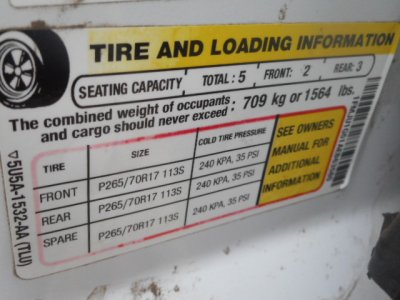
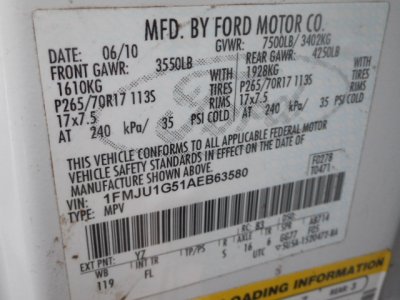
In regards to the OP, what is the factory tire size and pressure on the door placard?
AllBoostNoEco
Full Access Members
AllBoostNoEco here is the info from my door about the standard tires PSI info.
Based on the information I’ve found from the Tire and Rim Association, your stock tire size is rated for 2305 pounds at 35 psi.
For your current LT275/70R18E tires, they are rated for 2310 pounds at 41 PSI. So in your particular situation, 48 is a little bit high.
About as close to an apples to apples comparison as can be made.
The numbers, you are giving are for 5 passengers and cargo. 95% of my driving is just me. Wouldn't that lower the pressure/gawr?In other words, LT tires at 38 - 40 is actually unsafe.
Wow, thx for the info
AllBoostNoEco
Full Access Members
That’s the difficult thing about determining an “ideal” pressure to run. Manufacturers base their pressures off load ratings for the overall vehicle at GVWR plus an overage (hence the OPs GVWR of 7500, but all four tires combined can support 9220; narrow it to just the back tires and it’s 4300 RAWR versus 4610 tire capacity), not base curb weight (and there’s other considerations that play a significant factor; how much load is transferred to the front tires under hard braking? I don’t know the g-forces or CG L/R F/R to do the math).
Let’s say you want to run a lower pressure because you never carry cargo or other passengers: you can’t simply subtract the actual axle weight from the axle weight rating, because the combined FAWR and RAWR are higher than the GVWR. Which end do you account for that difference? Since you’d need to account for weight transfer under cornering, braking, and acceleration; you could do that, but you need to know the CG location and how many g’s the truck can pull under each situation.
The engineers at Ford have all of this information and make their decisions for tire pressure based on it. Since I don’t, I rely on the information I do have available to me, which is the factory tire load rating based on size and pressure.
Let’s say you want to run a lower pressure because you never carry cargo or other passengers: you can’t simply subtract the actual axle weight from the axle weight rating, because the combined FAWR and RAWR are higher than the GVWR. Which end do you account for that difference? Since you’d need to account for weight transfer under cornering, braking, and acceleration; you could do that, but you need to know the CG location and how many g’s the truck can pull under each situation.
The engineers at Ford have all of this information and make their decisions for tire pressure based on it. Since I don’t, I rely on the information I do have available to me, which is the factory tire load rating based on size and pressure.
The numbers, you are giving are for 5 passengers and cargo. 95% of my driving is just me. Wouldn't that lower the pressure/gawr?
Ive had up to 9 passengers and up to 7 passengers + ~500 lbs cargo
Pretty sure I've loaded 1700-2000 lbs in one way or another quite often.
Which means I should inflate for a weight rating of 7.5-8k lbs. 2k per wheel actual, so probably, what, 3k per wheel maximum for lean and whatnot? 4k would be nice for absolute safety, but is that possible???
NOPE: looked, LT 265/70r17 load e BFG KO2's max out w/ 3200 lbs "single" @ 80psi (wth does single mean?? and it says 2900 for dual)
Last edited:
OP
OP
Dawgbyt
Member
OK, cool. So sounds like 40 PSI is a good number for these tires?
I have been averaging 15 - 18 MPG with these at the 45 - 50 PSI I was using. Roads not bumpy and the tires arent all that noisy or wearing funny. People are surprised at the smooth ride actually.
I have been averaging 15 - 18 MPG with these at the 45 - 50 PSI I was using. Roads not bumpy and the tires arent all that noisy or wearing funny. People are surprised at the smooth ride actually.
AllBoostNoEco
Full Access Members
Ive had up to 9 passengers and up to 7 passengers + ~500 lbs cargo
Pretty sure I've loaded 1700-2000 lbs in one way or another quite often.
Which means I should inflate for a weight rating of 7.5-8k lbs. 2k per wheel actual, so probably, what, 3k per wheel maximum for lean and whatnot? 4k would be nice for absolute safety, but is that possible???
Overlooking the fact that you would be exceeding the GVWR by quite a bit, there can be as much harm done by overinflating as underinflating. And you don’t need a full 100% safety margin, because under those conditions, weight transfer is going to be far less because the weight reduces the vehicle’s capabilities.
If you’re running 500 pounds over GVWR, due to the design of the truck, it’s probably nearly all on the rear axle. If factory spec is 2150 per wheel in the back, add in 300 pounds per (adding extra for safety) to get to 2450 and base your pressure on that number. The TRA tables I have stop at 35-36 PSI, but upping it by 6-7 PSI over stock should be in the ballpark. Assuming your tires are rated for the pressure.
AllBoostNoEco
Full Access Members
OK, cool. So sounds like 40 PSI is a good number for these tires?
I have been averaging 15 - 18 MPG with these at the 45 - 50 PSI I was using. Roads not bumpy and the tires arent all that noisy or wearing funny. People are surprised at the smooth ride actually.
I don’t see any reason you wouldn’t be fine at 40.
You could put airplane tires on your SUV if wanted to. Those tires are fine. "LT" simply means "Light Truck". SUVs are "Light Trucks". F-150s are "Light Trucks".I also am on dirt roads a LOT, if that makes any difference?
Most people use tires that give the best performance for their environment. Some people use tires that make a statement. As long as they fit, it makes no difference what kind of tire is on your vehicle.
They're fine.Great info, thanks everyone!
So these tires are not meant for an Expedition 4x4?
Overlooking the fact that you would be exceeding the GVWR by quite a bit, there can be as much harm done by overinflating as underinflating. And you don’t need a full 100% safety margin, because under those conditions, weight transfer is going to be far less because the weight reduces the vehicle’s capabilities.
If you’re running 500 pounds over GVWR, due to the design of the truck, it’s probably nearly all on the rear axle. If factory spec is 2150 per wheel in the back, add in 300 pounds per (adding extra for safety) to get to 2450 and base your pressure on that number. The TRA tables I have stop at 35-36 PSI, but upping it by 6-7 PSI over stock should be in the ballpark. Assuming your tires are rated for the pressure.
Uhm... LT 265/70r17 bfg ko2, E rating truck tires. Max psi on sidewall: 80.
NOT passenger tires
cullinan18
Full Access Members
Other question, why would the sticker on the door apply to non-OEM tires? The manufacturer has no idea what tires I put on after replacing the factory tires. On my wife's vehicle I swapped the OEMs with max psi of ~41 to an XL load tire with max PSI of 50 psi.
(I still remember the Explorer recommending 28 psi.....)
Is the general consensus here saying that the suspension of the vehicle is also relying in springy tires and that "too stiff of a tire - (" too high psi") - will harm the suspension? Never heard that before.
I usually keep the psi on the high side, but below limits, as I prefer the stiffer ride versus the spongy ride of the door placard.
(I still remember the Explorer recommending 28 psi.....)
Is the general consensus here saying that the suspension of the vehicle is also relying in springy tires and that "too stiff of a tire - (" too high psi") - will harm the suspension? Never heard that before.
I usually keep the psi on the high side, but below limits, as I prefer the stiffer ride versus the spongy ride of the door placard.
Similar threads

- Replies
- 17
- Views
- 2K

- Replies
- 23
- Views
- 4K


- Replies
- 10
- Views
- 2K


- Replies
- 9
- Views
- 3K

