Tire Weight

Disclaimer: Links on this page pointing to Amazon, eBay and other sites may include affiliate code. If you click them and make a purchase, we may earn a small commission.

LazSlate

Full Access Members
Joined
May 7, 2022
Posts
416
Reaction score
245
Location
Arizona
To those who upgraded to bigger tires do you notice any difference on acceleration and braking? I know MPG will be affected in the city with stop and gos.
Looking at the stock tire on the Timberline its about 40lbs and upgrades to bigger tires avg 60-73 lbs. The 2 tires I am looking at are 63lbs and 73lbs.
 

cptbligh

Active Member
Joined
Dec 27, 2021
Posts
25
Reaction score
24
Location
GA
Yes! I have LT285/60/R20 Open Country Mud Terrains on my Limited and 9th and 10th gear are basically useless now and I generally drive in sport/tow mode at lower speeds to have any torque available. Maybe the Timberline is a little better if the rear gear is shorter.

Nitto Terra Grappler G2s and BFG KO2s are available in P rating in larger sizes I believe so they are lighter than LTs. I'd probably go with them if I had a choice to do over.
 

rd618

Full Access Members
Joined
Nov 1, 2021
Posts
745
Reaction score
389
Location
new york
Yes! I have LT285/60/R20 Open Country Mud Terrains on my Limited and 9th and 10th gear are basically useless now and I generally drive in sport/tow mode at lower speeds to have any torque available. Maybe the Timberline is a little better if the rear gear is shorter.

Nitto Terra Grappler G2s and BFG KO2s are available in P rating in larger sizes I believe so they are lighter than LTs. I'd probably go with them if I had a choice to do over.

I don’t follow this?
285/60-20 is marginally larger than stock wheels. (285/45-22 on mine). It’s roughly 1.5” larger diameter. With the same width.
I drive like normal and have plenty of power. I don’t see how a 4-5” tire circumference will cause you to require driving in tow/haul in lower gears or making 9/10 useless.
 

cptbligh

Active Member
Joined
Dec 27, 2021
Posts
25
Reaction score
24
Location
GA
I don’t follow this?
285/60-20 is marginally larger than stock wheels. (285/45-22 on mine). It’s roughly 1.5” larger diameter. With the same width.
I drive like normal and have plenty of power. I don’t see how a 4-5” tire circumference will cause you to require driving in tow/haul in lower gears or making 9/10 useless.

285/60 (33.5") is ~5% larger diameter than the stock 275/55/20 or your 285/45/22(32"). Combine that with the stock Hankooks only weighing 40 lbs vs the MTs I have at 69 lbs. I can't maintain 60mph on level ground without going into boost in 9th gear.

The Limited has a tall 3.31 gear ratio. I think the Timberlines have 3.73s so that would help.
 
OP
OP
LazSlate

LazSlate

Full Access Members
Joined
May 7, 2022
Posts
416
Reaction score
245
Location
Arizona
285/60 (33.5") is ~5% larger diameter than the stock 275/55/20 or your 285/45/22(32"). Combine that with the stock Hankooks only weighing 40 lbs vs the MTs I have at 69 lbs. I can't maintain 60mph on level ground without going into boost in 9th gear.

The Limited has a tall 3.31 gear ratio. I think the Timberlines have 3.73s so that would help.

Wow that is strange. Never heard this from tires that size on the standard epys. Do you have the tires aired up to the upper levels? Any aftermarket roof racks or such?
 

cptbligh

Active Member
Joined
Dec 27, 2021
Posts
25
Reaction score
24
Location
GA
Wow that is strange. Never heard this from tires that size on the standard epys. Do you have the tires aired up to the upper levels? Any aftermarket roof racks or such?
In my case it's more the weight than the size of the tires I believe. I removed my roof rack to fit in my garage but I do have a leveling kit. I have AT3s on my F150 and it's not near as big of an issue.
 

LokiWolf

Staff member
Moderator
Joined
Apr 2, 2016
Posts
3,971
Reaction score
2,837
Location
Richmond VA
Going to larger, heavier, more aggressive tires will ALWAYS negatively affect power and MPG. It is just physics. More unsprung weight, and rolling resistance. Takes more energy to get moving and stay moving.

Also the Timberline and a Limited with 4x4 Max Tow are both 3.73. Actually it looks like according to the 2022 Tow guide, if you have the ELSD equipped it is the 3.73. So really has nothing to do with trim, and more about equipped options.
 

Pawpaw

Full Access Members
Joined
Dec 2, 2021
Posts
207
Reaction score
148
Location
Raceland, La.
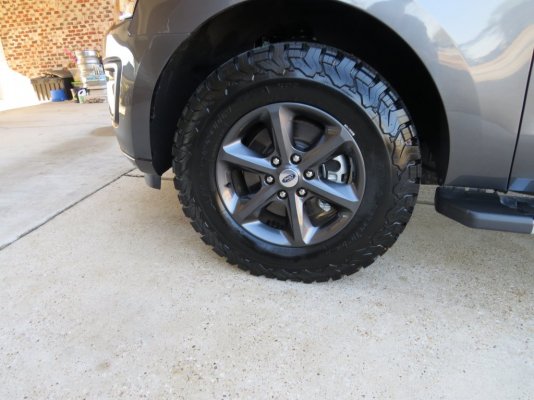
I have a '21 FX4 that came with Michelin Primacy 275x65x18 all terrains but P rated. Went with 275x70x18 BFG KO2's that are 10 ply E rated that weigh 57 lbs ea. Bought these for minor offroading and towing our almost 8K pound camper. About 1 mpg loss in fuel mileage and some decrease in braking but not bad at all. Still can get up to 22 mpg hwy and 17 to 18 mpg out in the country town where I live. The FX4 has the max tow package with 3.73 gearing ..trailer backup assist and brake controller. Very pleased with these tires and run 42 psi cold for daily use and air them up to 60 psi when towing. Have 8K miles on them and no signs of wear.

IMG_6209.JPG
 

JohnSC

Full Access Members
Joined
Aug 24, 2022
Posts
153
Reaction score
69
Location
Aiken SC
Going to larger, heavier, more aggressive tires will ALWAYS negatively affect power and MPG. It is just physics. More unsprung weight, and rolling resistance. Takes more energy to get moving and stay moving.

Also the Timberline and a Limited with 4x4 Max Tow are both 3.73. Actually it looks like according to the 2022 Tow guide, if you have the ELSD equipped it is the 3.73. So really has nothing to do with trim, and more about equipped options.
This seems wrong at first glance, it seems like the tire is rolling and should not need a lot to keep that happening. Until you consider that when the car is running at 60 MPH, the outside tread of the tire is going from zero when it is in contact with the road to 120 MPH at the top of the tire, to zero again when it reaches the bottom again. Hundreds of times per minute. That is a lot of mass to accelerate and slow that often.
 
OP
OP
LazSlate

LazSlate

Full Access Members
Joined
May 7, 2022
Posts
416
Reaction score
245
Location
Arizona
This seems wrong at first glance, it seems like the tire is rolling and should not need a lot to keep that happening. Until you consider that when the car is running at 60 MPH, the outside tread of the tire is going from zero when it is in contact with the road to 120 MPH at the top of the tire, to zero again when it reaches the bottom again. Hundreds of times per minute. That is a lot of mass to accelerate and slow that often.


Thats not quite how it works. The tire is not going 120 MPH and it's not stopping and starting from zero?

The 285/60/20 has a circumference of 105"
At 60 MPH this equates to the tire rotating at 602 RPM
To get the surface speed in minutes you multiply: 105" x 602 rpm = 63,210 inches per minute
Divide it by the inches in a mile 63,360
63,210 / 63,360 = 0.9976 this is the surface speed in miles per minute

Multiply by 60 to get the MPH and its of course 60 since it has to be at least the speed of the vehicle.
But its rotating a constant velocity so it never changes speed. This is why larger tires like on a semi spin slower because the larger the diameter the higher the surface speed for a given RPM.

I do endless calculations like this for my job all the time.

 

rd618

Full Access Members
Joined
Nov 1, 2021
Posts
745
Reaction score
389
Location
new york
Agreed. The physics checks out.
The other poster’s comment about such poor fuel economy and performance seemed off to me, as I don’t understand how a modest change in size and weight impacted them so much.
I’d expect some loss of economy as the vehicle has to work slightly harder, But not more than 10-15% given the minimal tire size increase and moderate weight difference. granted it will take more effort to move a heavier larger tire but we’re talking 30-40 more lbs per tire (rolling) and 5% increase in circumference.
 

Deadman

Full Access Members
Joined
Mar 17, 2019
Posts
2,561
Reaction score
1,684
Location
Wisconsin
My neighbor took his F150 and put 10Ply tires on it and they immediately dropped him 2mpg because they were so heavy. Same exact size tires and not a mud tire.

Read up on Unsprung weight, it affects performance A LOT!
 

Fastcar

Full Access Members
Army
Joined
Dec 14, 2013
Posts
1,115
Reaction score
707
Location
FL
i believe the taller your tire is the more you cut your gear ration down. Just a ****** example, if your stock tire are 30" and your gears are 3:73's and you jump to say 32" your actual gear ratio is around 3:33. This is by no way accurate but is what happens when you start going with taller tires.
 

LokiWolf

Staff member
Moderator
Joined
Apr 2, 2016
Posts
3,971
Reaction score
2,837
Location
Richmond VA
My Statement was 100% accurate. It is not weight but unsprung weight. Size increase is a small part of the puzzle, weight and tread pattern are a bigger part of it. Weight being the most important part. Tire weight is the worst weight too, because it contributes to high moment polar inertia, because the added weight is closer to the edges of the rotating mass(Wheel/Tire Combo). Adding tire weight makes acceleration slower, stopping longer, and lowers fuel economy, because it take more energy to do everything.

Edit/Addition: We didn't even take the added wind resistance, both because of increased airflow under the vehicle if the tire is taller, but if the tire has increased surface area. That additional surface area and contact patch also increases rolling resistance. All of these add to the decreased MPG.
 

LokiWolf

Staff member
Moderator
Joined
Apr 2, 2016
Posts
3,971
Reaction score
2,837
Location
Richmond VA
This seems wrong at first glance, it seems like the tire is rolling and should not need a lot to keep that happening. Until you consider that when the car is running at 60 MPH, the outside tread of the tire is going from zero when it is in contact with the road to 120 MPH at the top of the tire, to zero again when it reaches the bottom again. Hundreds of times per minute. That is a lot of mass to accelerate and slow that often.
Like Laz said, not quite how it works. "Object in motion tends to stay in motion", it is the changing of the direction of that motion that takse the most energy.
 

rd618

Full Access Members
Joined
Nov 1, 2021
Posts
745
Reaction score
389
Location
new york
i think it’s straight forward, more weight, bigger, lower performance and economy.
The question should be, how much of an impact is made on average for the increased weight and tire size?
The math is do-able, but I’m not a mechanical engineer or physics expert.
20lbs increase in unsprung weight will impact performance, how much is “expected” impact all else equal?
like I said above 15-20% performance and economy hit is expected for a 20-30% increase in weight is what I’ve seen. It’s not directly linear relationship. But that’s not “scientific”.
 

LokiWolf

Staff member
Moderator
Joined
Apr 2, 2016
Posts
3,971
Reaction score
2,837
Location
Richmond VA
i think it’s straight forward, more weight, bigger, lower performance and economy.
The question should be, how much of an impact is made on average for the increased weight and tire size?
The math is do-able, but I’m not a mechanical engineer or physics expert.
20lbs increase in unsprung weight will impact performance, how much is “expected” impact all else equal?
like I said above 15-20% performance and economy hit is expected for a 20-30% increase in weight is what I’ve seen. It’s not directly linear relationship. But that’s not “scientific”.
Correct, it makes a bigger impact than most expect. It is definitely not linear. In addition driving surface, and style will make a difference also.
 

JohnSC

Full Access Members
Joined
Aug 24, 2022
Posts
153
Reaction score
69
Location
Aiken SC
Has anyone moved from 22" factory tires to 18" wheels and LT tires for towing safety? What should I expect to see in ride and fuel economy effects with that change?
 

rd618

Full Access Members
Joined
Nov 1, 2021
Posts
745
Reaction score
389
Location
new york
Was eating at me so here’s part of the math to get the physics portion. https://www.maplesoft.com/content/E...4/MapleDocument_30/Rotation MI and Torque.pdf

Long story short, your wheel can weigh a lot. But the more it weighs the slower you have to accelerate to achieve the desired speed. If you try to accelerate at the same rate as before, you require more power to spin the larger size of mass. The actual dimensions of the wheel we are discussing are small, they will have a negligible impact.
As Loki and others point out also, tire compound, friction, and rolling resistance will more significantly impact the “maintenance” of the desired RPM.
Bigger and heavier = more power to move and keep moving. The amount of power is actually up to the user. Time to achieve speed and maintain it will determine the power and efficiency needed.
 

JasonH

Full Access Members
Joined
Nov 12, 2018
Posts
1,557
Reaction score
895
Location
Houston, TX
Has anyone moved from 22" factory tires to 18" wheels and LT tires for towing safety? What should I expect to see in ride and fuel economy effects with that change?

I put LT tires on my 20s. It rides a bit harder and lost ~1 mpg, but the peace of mind and improved stability while towing was worth it. Try finding a shop that will let you swap back if you don't like the LT tires.
 

Members online

Forum statistics

Threads
57,016
Posts
535,899
Members
54,714
Latest member
Budman55
Top