
Battery Charging Light Was Coming On ...

Disclaimer: Links on this page pointing to Amazon, eBay and other sites may include affiliate code. If you click them and make a purchase, we may earn a small commission.

RustyOval

Full Access Members
Joined
Sep 4, 2017
Posts
148
Reaction score
47
Location
Illinois
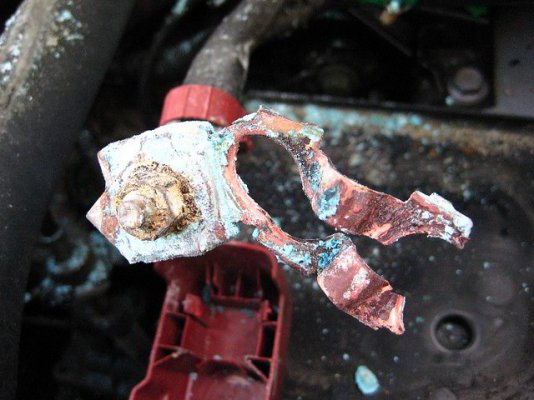
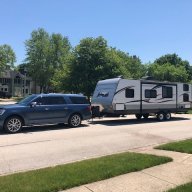
On our final camping trip of the season the battery light icon on the dash was coming on sporatically. I read some forums and decided to check the battery conections. Low and behold the positive side cable clamp had sigificant corrosion and not making good contact.

I found a replacement clamp , a ford part for a car supposidly NOT for an expedition (Ford BT4Z-14450-AA) FOR $14.90. This part worked great albeit I had to grind the old clamp off the cable and crimp the new part onto the cable. There is one extra terminal on the clamp that I did not need, but much better than hundreds of dollars for an Expy clamp that comes with all the cables attached!


71Vwx3AiODL._SL1500_.jpg
 

Plati

Well-Known Member
Joined
May 4, 2016
Posts
2,781
Reaction score
1,367
Location
.
I'm only asking this because I dont know. If the connection between the battery post & terminal is "corroded", cant you just clean them up (to the base metal) and apply silicone dielectric grease. Some use vaseline or the copper stuff.
 

Trainmaster

Old School Member
Joined
Jun 17, 2017
Posts
3,618
Reaction score
2,122
Location
Rockaway Beach, NY
Usually you can just clean them up. But sometimes chunks of the clamp simply disappear. The old cast lead ones had lots of metal on them, but the newer stamped sheet metal ones corrode faster. That's why it's good to open the hood once a year.

4087310424_a963e33a0e_z.jpg
 
Last edited:

stamp11127

Full Access Members
Joined
Mar 10, 2012
Posts
6,207
Reaction score
1,246
Location
Temple, Georgia
Once a year? Try at least monthly, weekly is better. Check all fluid levels, battery posts and look at the hoses and serp belt.
Standard pre-trip inspection for a truck driver - on each run or daily.
 
OP
OP
RustyOval

RustyOval

Full Access Members
Joined
Sep 4, 2017
Posts
148
Reaction score
47
Location
Illinois
Usually you can just clean them up. But sometimes chunks of the clamp simply disappear. The old cast lead ones had lots of metal on them, but the newer stamped sheet metal ones corrode faster. That's why it's good to open the hood once a year.


My clamp was not this bad, but the bolt that pulls it tight was deteriated to about half the normal diameter, the clamp itself was really not too bad. I replaced the entire part just for the piece of mind. I dont want to get stranded anywhere especially in the winter....
 

sjwelds

Full Access Members
Joined
Feb 19, 2016
Posts
838
Reaction score
383
Location
Kansas
Just this evening, was in town and filled with gas, and went to start. Key turned, nothing, no crank no nothing. Lights on plenty bright, etc. Hmmm. Turned it off and back on a few times and she roared to life like usual. Got home and cleaned up the battery terminals like never before, coated them liberally with dielectric grease, reassembled. Don't know if I fixed it or not. Time will tell.
 

Plati

Well-Known Member
Joined
May 4, 2016
Posts
2,781
Reaction score
1,367
Location
.
Just this evening, was in town and filled with gas, and went to start. Key turned, nothing, no crank no nothing. Lights on plenty bright, etc. Hmmm. Turned it off and back on a few times and she roared to life like usual. Got home and cleaned up the battery terminals like never before, coated them liberally with dielectric grease, reassembled. Don't know if I fixed it or not. Time will tell.
that reminds me of my 67 chevy van ... neutral safety switch problem. had to roll under the vehicle (sometimes in traffic) to start it by using a long screwdriver and shorting the terminals on the starter solenoid. usually it wasn't in drive when i did that. yikes the sheet i did when younger!
 

Plati

Well-Known Member
Joined
May 4, 2016
Posts
2,781
Reaction score
1,367
Location
.
FYI - dielectric grease is an insulator (doesn't conduct electricity). If you are going to use it, coat the terminals and post after they are connected, not before.
interesting. i put dielectric grease on my snowmobile trailer 4 pin connector, both sides ... twice a year for many years. never had a problem conducting current. before i did that, the road salt would rapidly destroy the copper. got tired of replacing the pigtail so started doing this and its always worked great.
 

sjwelds

Full Access Members
Joined
Feb 19, 2016
Posts
838
Reaction score
383
Location
Kansas
Well it said on the tube to coat both sides of the connection and then assemble, keeping metal to metal contact...my thought is it wipes off where it needs to when you connect things. Could be wrong tho...

Edit: @stamp11127 what's your method for cleaning corrosion from battery terminals and preventing it from happening?
 

stamp11127

Full Access Members
Joined
Mar 10, 2012
Posts
6,207
Reaction score
1,246
Location
Temple, Georgia
The method I use is "frowned upon" according to the "experts". Most auto parts stores and Walmart carry the red and green felt battery post pads. I soak them and the terminals with a little used oil once everything is connected back together. The "experts" will say that the oil is flammable and you shouldn't put it on the posts since there is a risk of fire.

My view is that if there is such a large current draw to heat the oil to the point where is self ignites, I have other issues to deal with, mainly the cause of the draw.

If you use a truly maintenance free battery that doesn't vent, the issue of corroded posts is history.

One of the tricks we use in teaching voltage drop is to coat connectors with the dielectric grease. Which creates a open in the circuit. You can't see it looking at it but can pinpoint it with a meter.
 
Last edited:

stamp11127

Full Access Members
Joined
Mar 10, 2012
Posts
6,207
Reaction score
1,246
Location
Temple, Georgia
I'll come at this from a different angle. When you solder wires together you try to get the most copper contact possible between the wires to reduce the amount of resistance in the splice. Although the solder is a conductor there is a small difference in the resistance between it and the copper wire. For what we are doing it is basically non existent. In electronics it is another issue, you don't want a big glob of solder in the splice.

I advocate having good, clean contact surfaces between the terminal and post. Then coat the rest of the connection with some form of corrosion inhibitor.

Whatever works for you is fine in my book.
 

Retiredusps

Full Access Members
Joined
Oct 28, 2018
Posts
199
Reaction score
83
Location
N.J.
I use the Red and Green Felts also. I replaced the ends on mine with Marine Terminal ends.Same as old lead style but has a bolt on cable end. I reversed the bolt so head of bolt is facing down. Cut off old stamped steel end and drilled a hole to fit bolt on cable end. Had to cut alittle bit off red cable protector but fits well. Never a problem in the last 4 years.
 

sjwelds

Full Access Members
Joined
Feb 19, 2016
Posts
838
Reaction score
383
Location
Kansas
I did check the terminals after I had it all put together, and the voltage was the same on posts versus cables. 14.23 volts with engine on.

If something fails because of the grease I will post back.

Thanks again.
 

stamp11127

Full Access Members
Joined
Mar 10, 2012
Posts
6,207
Reaction score
1,246
Location
Temple, Georgia
Not really. I look at the warranty more than anything else. These die regardless of brand. Right now I have a Wally World in the Mini (warranty from the previous owner) and a Duracell in the Beetle. The big thing is to keep them insulated if they were from the factory, don't drain them all the way down and keep an eye on the electrolyte level if you are using a standard wet cell. Only add distilled water when needed.
 

1955moose

Full Access Members
Joined
Nov 23, 2014
Posts
6,004
Reaction score
1,351
I too believe in dielectric grease, but on battery terminals no! A clean wire scrubbed connection, with those felt washers underneath, is what you do. If you get corrosion, you've got fumes leaking causing the corrosion. In most cases, battery cables should be pulled, degunked with baking soda, and reinstalled. Dielectric grease or petroleum jelly can be coated over terminals, but not on connection.

Sent from my N9131 using Tapatalk
 

Plati

Well-Known Member
Joined
May 4, 2016
Posts
2,781
Reaction score
1,367
Location
.
My clamp was not this bad, but the bolt that pulls it tight was deteriated to about half the normal diameter, the clamp itself was really not too bad. I replaced the entire part just for the piece of mind. I dont want to get stranded anywhere especially in the winter....
Maybe I'm overthinking this (probably) but if the bolt is what was primarily corroded, that sounds like it may be galvanic corrosion. Two dissimilar metals will react and corrode, and you dont even need battery acid or fumes. The bolt is probably zinc plated steel and the battery terminal is <dont know, tin plated copper? ... lead?>.

For the record, I've never put dielectric grease on a battery terminal.
Just dont think its a problem to do that. Key word is "think" because I dont really know for sure. Hard to go wrong slathering it all over the bolted down cleaned up naked terminal/post like MrStamp & MrMoose advised.

I like to clean refresh & renew electrical connections using chemicals (like muriatic or baking soda or?) AND a mechanical clean ... like the wire scrub brush such as used in copper plumbing ... or sandpaper. Remove all the oxidation & take it back to the raw base metal.
 
Last edited:
Top