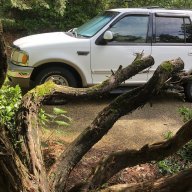

2000 Expedition XLT 5.4L new to me with inherited issues.

Disclaimer: Links on this page pointing to Amazon, eBay and other sites may include affiliate code. If you click them and make a purchase, we may earn a small commission.

omgjedis

New Member
Joined
Dec 22, 2025
Posts
2
Reaction score
2
Location
Westwood ca
Hello, I haven't really introduced myself as I am a pretty fresh owner of this 2000 Expedition, but I got it with and inherited miss and the owner (a pretty trusted coworker) told me he daily drove it before letting it sit for the last year or so. He said his OBDII told him it was the #6 misfiring. I am waiting on a new OBDII scanner, as mine keep getting stolen somehow, but should be here tomorrow. I got all new Motorcraft coils and plugs gapped the plugs to recommended .054, used dialectic grease on all the boots, but while pulling out the old plugs and coils, #6 had what looked like sandy grease. After swapping all the plugs and coils I am still getting a miss. Now there wasn't much I could do about cleaning inside the cylinder without pulling head and I am not at that point until i can do some diagnostics and research. What I have seen, if anyone has seen the same and can help out, is this could be a valve issue? Looks sort of like fine grit sand in grease on the coil and plug.

Should also mention besides new plugs and coils (oh yeh and replacing #6 it was the only non motorcraft coil and was also broken where the harness clips on) it seemed to misfire almost worse with the new plugs and coils. right after replacing let it warm up for a good 20 minutes (it's snowy and cold where I live) and then ran it around at around idle with little revs here and there for about a mile. The misfire seemed more of a typical lob you may feel from a high mileage V8 through this, with the occasional cough here and there. After it was nice and warm I ran it up and down a 3 mile stretch of straight backroad right by me and on the round trip 3 miles back really aired it out and at high rev it felt fine, 1000-2000 was coughing and rough and on coast it was fine. after this round trip i did an oil change and drove it around about half mile with no issue and then drove it about a mile at 25-45 mph with some deep coughs here and there.

Sorry to rant just want to inform best as possible. I used Mobil1 oil and filter for oil, new air filter, techron fuel system cleaner, and in the oil change used the lucas oil additive. The mileage is 254k but seems like it was well taken care of, My coworker got it a few years back and daily drove it until the issues started since he has many other projects. I will get a code check hopefully tomorrow and be better informed, but figured i would maybe get a head start if anyone is familiar with this issue. Thanks!

 

Karrde

New Member
Joined
Dec 27, 2025
Posts
1
Reaction score
1
Location
Iowa
I have not introduced myself around here yet either. I have a 97 and 98 now and a couple of other first gens in the past.

You may have your codes rechecked by now but here are some thoughts. Specific codes would abbreviate the diagnostics and may make some of what I say moot.

The sandy grease you refer to, was it on the exterior portion of the plug and on the coil boot on the in-cylinder portion? An otherwise good cylinder and spark plug could have abnormal buildup in the cylinder on the spark plug if the cylinder is misfiring due to a faulty coil for instance. If the buildup in other the exterior side of the plug and coil boot I would look for a source of intrusion into the spark plug well (eg. coolant from intake manifold crack/gasket, not sure on the 'sand' though).

The fact that number 6 had the misfire (as reported to you anyway) and the only mismatched coil indicates this problem has been attempted to be addressed. If the code check shows cylinder six misfire I would recommend a compression test. Easy enough and a basic harbor freight tester is adequate to the task.

Could the gritty grease be anti-sieze that was applied in the past instead of dielectric grease?

A careful pass back through to check all of the coil and injector connectors are fully seated may also be a good idea.

I recently picked up the 98 and had a random significant misfire(s) that would flash the CEL but oddly would not set a code. I fixed that swapping the full set of coils from my 97. That resolved the issue and I found the 98 had 3 different brands of coils with only two motorcraft. The aftermarket are so unreliable you made a good start with a full motorcraft set. My 97 got the full set of motorcraft coils after that swap.
 

jr1under

Full Access Members
Joined
Feb 8, 2016
Posts
271
Reaction score
189
Location
Aiken, SC
That resolved the issue and I found the 98 had 3 different brands of coils with only two motorcraft. The aftermarket are so unreliable you made a good start with a full motorcraft set.
Not everyone agrees with that assessment but it certainly was the case with my 99 several years ago. I'm not averse to using aftermarket parts but the coils just did not work. It could be that they don't need to be Motorcraft, just be identical, but I'm not planning on testing that out.
 

Jon Hedges

Member
Joined
Jan 22, 2017
Posts
9
Reaction score
5
Location
United States
Similar problem with my 2000 Expy about 10 yrs ago. Turned out to be coolant leak into spark plug tube via cracked OEM intake manifold. Replaced intake manifold with aftermarket Dorman. That fixed it. 470k miles now and still runs great!
 

EngineerMike

Active Member
Joined
Sep 5, 2022
Posts
36
Reaction score
27
Location
ca
IIWMI'd do a microscopic level check of the #6 harness connector at the new coil, unlikely but possible fouling there. More likely what Jon Hedges said
 

Billme

Full Access Members
Joined
Oct 16, 2020
Posts
319
Reaction score
131
Location
Hattiesburg,Ms
I had a problem with no 6 misfire after new coils, but it turned out that the injector was semi restrictive.. I used a still rod, and a small hammer to lightly tap it while the engine was running.. You could hear the difference when it straightened out..Try the easy stuff first
 

BrentDJ

Member
Joined
Jan 8, 2020
Posts
16
Reaction score
12
Location
WA
I've had this problem on my 99 Expys.
It was caused generally by either leaks (see JH comment) or even simply condensation in the vacuum/EGR lines. Generally if you are dealing with something this old, all of these lines need to be replaced wherever you find them. If they are OEM they are more than 25 years old. You may want to assume that they aren't leaking because the fit is snug. But that snug fit is meaningless as applied to 25+ year hose. Deterioration is the natural order of things. Ensure that both your vacuum lines and EGR lines are all new hose. Don't stop at the engine compartment. Follow them all the way to the carbon canister and fuel tank. Many of those parts are obsolete now. So if you have any air leaks on top of your fuel tank you may need to coat the connection area with a sealant that covers any air leaks. But be certain to use a coating/sealant that can also be removed in the future if your fuel pump ever calls it quits. My general advice is this: 25+ year old vehicles are not for the easily discouraged. :)
 

k4vbb

Active Member
Joined
Jun 12, 2025
Posts
31
Reaction score
18
Location
Castle Rock, CO
Watching this.....

The gritty substance bears further explanation, though. Where was this substance found? Was it on the inside of the plug that faces the inside of the cylinder, or was it on the outside of the plug where the boot covers it?

As far as the #6 cylinder misfire goes, it could be one of multiple things. A vacuum leak will result in a random misfire on any one of the 8 cylinders. A steady misfire on the same cylinder points to an issue with that cylinder alone, like a faulty injector, faulty ignition coil (already addressed), coolant ingress, or low compression. MAKE SURE THE CLIP THAT HOLDS THE IGNITION COIL PLUG IS STILL IN PLACE -- these get brittle over time, and if missing, the plug will disconnect itself from the coil.

With the proper tool sets, a diagnosis can be made without disassembly:

The 2000 model year supports what is called a "relative compression test". With a scan tool that is capable of performing this test hooked up, the engine will crank (or you'll crank it with the key) for ~10 seconds. During that time, the scan tool monitors the ignition pulse for each cylinder to find the compression stroke. At the same time, the scanner monitors the amperage draw on the starter. Matching up the two produces a table between each cylinder and the amperage draw on the starter during the compression stroke. The idea behind it is that cylinders with lower compression are easier on the starter and require less amperage. The output on the scan tool will be a graph that shows which cylinders have higher/lower compression. I have yet to see one of these on one of these trucks that wasn't almost flat (flat = good).

Another good test can be performed with a capable scan tool is a "cylinder balance test", or "cylinder contribution test". This test can be performed at idle, or while driving, and will display a graph of the amount that each cylinder contributes to producing overall power. This test is good at showing how much each cylinder contributes, and showing which cylinders are not operating as they should. This helps to narrow down the troubleshooting steps.

The ignition and injector can be tested with an automotive oscilloscope. Basically, the waveform produced by the ignition coil when it fires is analyzed. Lean-running cylinders will have a different shape to them, and a good mechanic with experience doing this will know the difference between a coil that is not functioning as it should, a lean-running cylinder due to injector failure, ect...

Definitely keep us posted, though.
 
Top