Almost all tires found on vehicles from the factory are developed specifically for that vehicle during the vehicle chassis. It's not too common for "carryover" or "off the shelf" tires to be fitted on a vehicle from the factory, but it does happen I would say 10-15% of the time.
DOT Codes do change on both the vehicle and OEM as well as aftermarket, so if you have a 2015 vehicle with OEM tires, there's a decent chance that both the current OEM tires on the 2021 model and the aftermarket may have a DOT change.
You can choose very specific situations, but overall, I go back to the quote I referenced for my reply:
"I would highly doubt that OEM tires would ever show up on an external site. They would 99% of the time be direct order between manufacturers. Just my .02."
I would say 90% of the OEM tires on vehicles found currently in production can be found and ordered as an exactly same (or newest spec on vehicle) tire from Tire Rack, Discount tire, etc...
Am I saying this is the only tire spec available in this size/speed/LI/product line? Not at all. It's common for tire manufacturers to sell seemingly similar tires on paper/sidewall description with different attributes to focus on different performance to tune for other OE use, or for replacement sales.
Take for instance a very popular product, the Michelin Latitude Tour HP:
Michelin Latitude Tour HP (tirerack.com)
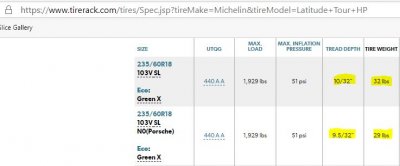
235/60R18 103V has two variants (see attached). One is not specified for an OEM, with a higher Tread Depth, other is OE specific NO (Porsche fitment) at a lower tread depth. You can buy both.
Look down the fitment list of the Tour HP in general from the link - 80% are the OEM fitment from the factory. OEM suppliers are required per their terms and conditions with the OEM's to keep the factory specifications available in the market where their vehicles are sold, or if product changes were made on vehicle, which happens, to make this latest factory spec available in the market. Again, this does not stop tire manufacturers to create a second product to also make available to the customers with adjustments done to cater more to the end consumer (wear, comfort, winter, etc...) as seen on the attachment.
I'm not here to create any conflict - this is coming from someone who has worked in the OE supplier industry for 18 years, 14 on the tire side.
No, if you saw the previous posts, and the one I replied to, i was specifically talking about the tires that are created specifically for OEM use, that, and to you response, Hankook makes tires for Ford that actually use the exact same series and models, but are slightly different to decrease costs. As I said, having worked at one of the largest tire shops out there, we used to do that a lot. We would get someone in that had a road hazard issue on a set of stock tires, and even if we had the same tire in stock, it may have actually had different DOT certs. Sometimes it's things like trad depth may be a little less, composition might be slightly different, in fact, some brands are making tires different right now so that car manufacturers can pass EPA requirements a little easier. But the consumer version of that very same tire may be different.
All I was referring to is those "custom" versions for vehicle manufacturers aren't typically going to show up on aftermarket sites, as they aren't orderable by consumers. And just as a side note, I actually had this exact issue on my last vehicle. Destroyed a stock tire offroad, and the not only was the replacement slightly higher tread depth than the stock tires (and they only had about 2k miles on them), but they were stiffer. Which was noticeable in some conditions.




 As what most people in the thread have already stated, snow performance differences between most AWD/4wd vehicles are really tire differences.