Electrical Short that isn't Blowing a Fuse

Disclaimer: Links on this page pointing to Amazon, eBay and other sites may include affiliate code. If you click them and make a purchase, we may earn a small commission.

OP
OP
T

Tim Skinner

Active Member
Joined
May 17, 2017
Posts
26
Reaction score
0
Location
Elyria. Oh
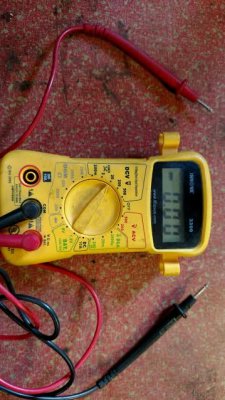
well I checked the circuit as instructed putting the positive lead from the meter on the positive post on the battery and touching the lower post on the solenoid on the firewall, the meter read less than .2v when my helper was holding the key to the start position Here is the meter I'm using with voltage setting
unnamed.jpg

It read .040 on the meter


i
 

stamp11127

Full Access Members
Joined
Mar 10, 2012
Posts
6,207
Reaction score
1,246
Location
Temple, Georgia
That result tells you the amount of resistance in that portion of the circuit is very low, well within spec.

Normally the next step would be to perform the same test but move the black lead to the positive stud on the starter. Most meters don't have leads long enough to do that so you end up making an extended lead with 2 alligator clips and a length of wire.

If you don't want to make one then read the voltage going to the starter. Red lead on the starter stud - black lead on battery negative post if close enough or chassis ground. Attempt to start the engine. You should see the same voltage at the battery and this test when attempting to start. You should see 0 volts all other times. Always perform electrical t/s with a fully charged battery.

Post the results please.
Battery voltage & voltage at the starter
 
Last edited:
OP
OP
T

Tim Skinner

Active Member
Joined
May 17, 2017
Posts
26
Reaction score
0
Location
Elyria. Oh
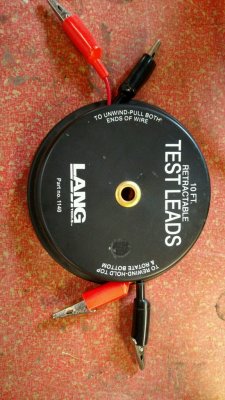
Well with the Battery Having 12.84 v I used these test leads I moved the Black lead from my meter to the positive post on the starter and had my helper hold the key in the start position the result is.01vIMG_20170523_182004250.jpg
 

stamp11127

Full Access Members
Joined
Mar 10, 2012
Posts
6,207
Reaction score
1,246
Location
Temple, Georgia
Red lead on the starter stud (on the starter) - black lead on battery negative post if close enough or chassis ground.

If you left the red lead on the battery positive and the black lead on the positive post on the starter post then that tells you the resistance on the positive side of the circuit is well within spec - as long as the circuit is closed when the ignition switch is turned to start.

It would still be good to know what voltage is going to the starter per the quote above when attempting to start the engine

Once you have that voltage reading check the negative side of the starter circuit. Red lead on clean metal on the starter body, black lead on negative battery post. Attempt to start. Reading should be less than .1v.
 
OP
OP
T

Tim Skinner

Active Member
Joined
May 17, 2017
Posts
26
Reaction score
0
Location
Elyria. Oh
Well I had the black lead on the negative battery post and the red lead on the starter post the reading is 12.84v . When I put red lead on the starter body and the and the black lead on the negative battery post it read .1v
 

stamp11127

Full Access Members
Joined
Mar 10, 2012
Posts
6,207
Reaction score
1,246
Location
Temple, Georgia
Since you have the same voltage at the starter that you have at the battery, there is nothing wrong with the starter circuit. The ground side also checks out with the .1v.

This indicates a problem with the solenoid mounted on the starter if it is still getting hot.

Your meter can handle 10A current for a short period. You may consider seeing how much is being drawn by connecting the meter in series with one of the battery posts and clamp. Only leave it connected long enough to get a reading. If the draw is more than 10A you will probably blow the internal fuse.

Have you double checked the voltage on the small wire to the solenoid mounted on the firewall? You need to verify the readings, should be 0 until the ign switch is in start.
 
Last edited:
OP
OP
T

Tim Skinner

Active Member
Joined
May 17, 2017
Posts
26
Reaction score
0
Location
Elyria. Oh
well I checked to small wire going to the when the switch is off and it's reading 8.47v . it's hot even when the key is not in the vehicle
 

stamp11127

Full Access Members
Joined
Mar 10, 2012
Posts
6,207
Reaction score
1,246
Location
Temple, Georgia
Usual culprit is the ignition switch.

Disconnect one battery cable, leave the small wire that you are reading the 8.47v disconnected at the solenoid and touch the battery clamp to the post. Note if there is a change in the amount of spark - you will have some. See if the solenoid on the starter is still getting warm/hot.
 
OP
OP
T

Tim Skinner

Active Member
Joined
May 17, 2017
Posts
26
Reaction score
0
Location
Elyria. Oh
when I connected the battery to the post leaving the small wire unpluged I get the same amount of spark and the solenoid isn't getting hot - I was thinking of taking the starter out and bench testing it to see if is working or if it burned out. If the the ignition switch shorted out would it cause this type of problem
 

stamp11127

Full Access Members
Joined
Mar 10, 2012
Posts
6,207
Reaction score
1,246
Location
Temple, Georgia
You can test the starter in place. Jump the two big studs on the firewall solenoid with a junk screwdriver. Make sure trans is in park and key out of ignition switch.
Just need to blip the starter initially. If it tries to turn the engine you can run it longer.
 

stamp11127

Full Access Members
Joined
Mar 10, 2012
Posts
6,207
Reaction score
1,246
Location
Temple, Georgia
What we are dealing with doesn't deal with negative voltage so the -.31v is nonsense. Did you try jumping / shorting the two studs?
 
Top