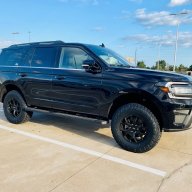

Ignoring the tongue weight (max cargo/payload)?

Disclaimer: Links on this page pointing to Amazon, eBay and other sites may include affiliate code. If you click them and make a purchase, we may earn a small commission.

audiodane

Member
Joined
Jul 24, 2018
Posts
12
Reaction score
1
Location
alabama
Hi folks. Bought a 2014 Expy EL w/ HD Tow Package recently.. Super excited. Been researching for a few months now various campers, and all the math that goes along with it. Want something large enough for the family (three kids plus foster children and/or friends as they are with us), so we're looking for something that sleeps 7-10 folks. That's a big rig. I better do my math right!

I am seeing most folks here talk about the max tongue weight, but not really consider the max payload/cargo limits on the driver door tire label. I'm curious if I'm the one missing something, or most everyone else?

As I see it:

With WDH, I can have a max tongue weight of 890lbs. But regardless, I have a max payload "not to exceed 1433lbs" on my driver door tire label. With driver (200), wife and three kids (475), weekend luggage (200), hitch (50), that max payload drops precipitously to (1433-200-475-200-50=) 508lbs. I no longer have an 890 lb tongue limit. I have a 508 lb tongue limit! With a 10-15% tongue weight ratio, my max loaded trailer weight has dropped to between 3,386 - 5,080 lbs!

If I decide to move the luggage weight from the Expy into the trailer, though, I can reduce that 200lbs by 85% to just ~30lbs of hitch weight. Now, with just driver, humans, and hitch, my tongue limit raises to 708lbs, which brings me back up to a max loaded trailer weight of 4,720 - 7,080 lbs.

This is STILL a far cry from the 890 lbs tongue weight that I see most folks discussing.

So, am I wrong? Or is this something that most folks are overlooking when talking about travel trailers?

cheers,
..dane

ps.- I'm assuming that the tire label specified max cargo rating already accounts for a full tank of gas? If that's an incorrect assumption, then oiy! That tongue weight needs to go WAY back down!
 

Casflynn

Member
Joined
Jul 6, 2017
Posts
21
Reaction score
13
Location
Happy Valley PA
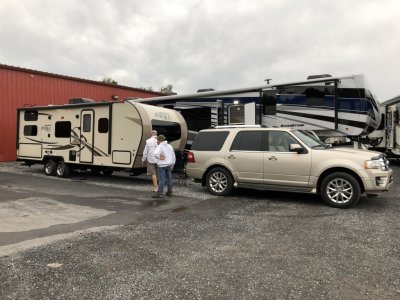
I spend what seemed like months figuring this out. Ignore the door to a certain extend. I can’t stress this enough.... Go weight your rig at a cat scale (get the app, super easy) with you, the kids, full gas (tank is over the rear axle which sucks), and any gear you will have when towing ( which needs to as little as humanly possible). My number was 6400lbs, but more importantly it was 3200 front and 3200 rear, so I had 1100lbs left after me, wife, 2 kids in car seats, dog, full tank. I bought a 6000lb gvw trailer with a dry weight of 4500ish pounds, factory tongue of 660. Real world tongue ( propane, battery’s, Hensley hitch, cargo, etc) was close to 900lbs. So after all that, I’m close to the 7500 gvw of the truck and the rear axle of 4300lbs. Cat scale is your friend. See my post from a few weeks ago on my weights. Good luck

My personal two cents, this mainly applies to non el, 6000lb trailer under 28ft hitch to bumper( gotta watch how these travel companies decode their campers, ie a 28bhs jayco might be 30ft tip to tip)

Happy to help you with this as I have spent months and many late hours trying to dial mine inIMG_0769.JPG


Sent from my iPhone using Tapatalk
 
OP
OP
A

audiodane

Member
Joined
Jul 24, 2018
Posts
12
Reaction score
1
Location
alabama
Hi @Casflynn,

Thanks so much for that feedback. I have registered for CAT and found there is a scale within about 30 minutes of my home. I'll probably go do this tomorrow, as it sounds like this will certainly make calculation MUCH easier.

How did you know that your weight was evenly distributed on your axles? I've never done anything like this before. Are these places designed for folks who "know what they're doing," or are there fairly well-posted instructions? The app makes it sound like I literally just drive onto a plate, open the app and hit the posted number, click "accept" and when it says it's done, put 'er in drive and head home and check my email...

cheers,
..dane
 

Casflynn

Member
Joined
Jul 6, 2017
Posts
21
Reaction score
13
Location
Happy Valley PA
Exactly what you do, app is stupid easy. The scale is simple, there are 3 “plates”, one for each axle. So for a semi there are two plates up front, and a big one for the trailer, just drive onto the front two plates and put the middle of your rig over the line. Once you get there it will make sense, it’s easy. Should be $11.50. It’s also super level, so after the app gets your weight, hop out and measure from the ground to your fenders to get your baseline heights to help adjust your hitch


Sent from my iPhone using Tapatalk
 
OP
OP
A

audiodane

Member
Joined
Jul 24, 2018
Posts
12
Reaction score
1
Location
alabama
Got weighed this morning.. Fun, never done that before ... and yes, totally stupid easy! All family in the car, full tank of gas, 50lb bag of concrete in the back to simulate the hitch (we don't have one yet). Here's what came up with.

Vehicle specs:
  • 2014 Expedition EL
  • 5.4L, w/ HD Tow Package (3.73 axle ratio)
  • Wheelbase 131" (11')
  • Length 221" (18.5')
  • 7540 lbs = GVWR
  • 4250 lbs = RGAWR
  • 15,000 lbs = GCWR
Vehicle weights
  • 3200 lbs = Front axle
  • 3500 lbs = Back axle
  • 6700 lbs = Total actual
(I was surprised that they were all such nice round numbers... do they round??)

So if I understand it correctly..

GVWR - Total actual= 840lbs
RGAWR - back axle = 750lbs
GCWR - Total actual = 8,300lbs

SO, questions:

  1. If I don't use a WDH, I am limited to 750lbs, yes? (granted that may dip the back end too much, this is just for numbers sake)
  2. If I do use a WDH, I can go to 840lbs as long as the individual axles aren't over their respective limits?
  3. This is likely a hotly debated topic- but are these limits already taking safety margins into account? e.g. do I need to derate everything 10-20%, or do manufacturers already perform testing to some degree beyond these limits so that these are valid upper limits?

If I assume the latter (going up to the limits is okay) then with a fully balanced load it looks like I can pull a fully loaded trailer (10-15% tongue weight) between GTWR 5,600lbs - 8,400lbs. (Note: limited to 8,300lbs upper limit due to GCWR.)

If I assume the former (derate the 840lb WDH limit to 670lb), then I'm looking at a GTWR of 4,466lbs - 6,700lbs -- drastically reducing the options available. (Most plans that sleep 6 are in the GTWR range of 7,500lbs.)

Also, @Casflynn, where did you get your spreadsheet from on your other thread?

OK, last question for now.... Length....

I have read from some folks that length matters tremendously while traveling (and of course when navigating back into the campsite); that the longer you are, the more likely you are to sway and loose control and even tip. Others say length really doesn't matter, but that the entire discussion is around and about weight..

We have an Expedition EL.. we're already 18' long. Is pulling something with a total/exterior length longer than 30' a bad idea? Or do I need to stick with something with a total exterior length under 30' with this vehicle? And is this recommendation just based upon empirical personal experience, or some other guidance/rule-of-thumb that I have yet to find?

cheers,
..dane
 

Casflynn

Member
Joined
Jul 6, 2017
Posts
21
Reaction score
13
Location
Happy Valley PA
1) Weight, yes you have 840 pounds “left”. Don’t even think about not using a WDH, too many reasons to list why you have to. SOME of the weight from the tongue will get transferred to the front axle and the trailer axle. I’m over my rear axle weight without WD, under by a few hundred with it. My two cents, 900lbs max tongue weight loaded is your goal, which is going to very hard to gauge as each manufacturer dry weights are different, shoot for a 600 to 700 dry tongue.

2) I know you want to buy a double slide 30 some ft bunkhouse, we all do, but even your wheelbase of 131 is still a foot shorter than a normal half ton truck which is normally around 145. 30ft is long for a 131 wheelbase. Lots of other factors come into play, trailer suspension, your towing experience, type of roads, etc.... I’m a huge point projection hitch guy (Hensley, propride) they just plain work, but each there own

3) I’ll find the link to the spreadsheet and share it


Sent from my iPhone using Tapatalk
 

Casflynn

Member
Joined
Jul 6, 2017
Posts
21
Reaction score
13
Location
Happy Valley PA
And for the record, I’m not in the “ the manufactures numbers are conservative” category. I refuse to go over weights if all possible, especially with an independent rear end and my family in the car. Couple pounds over in a good half ton or 3/4 ton truck? I could live with that, maybe.

I think my expedition and others tow very well for what they are, but they are still a compromise and not a truck in a towing situation

And tires, get good ones, LT or P metric XL rating, learn about pressures (whole other can of worms)

And brakes, good ones, I really like the ford/motor craft severe duty “blue” pads. Ford oem rotors are also high quality compared to aftermarket options.


Sent from my iPhone using Tapatalk
 
OP
OP
A

audiodane

Member
Joined
Jul 24, 2018
Posts
12
Reaction score
1
Location
alabama
re: "manfacturers are conservatives" category .... totally agree. But you are in the camp of "max load is OK" by saying I can use up to that total 840lb (~900lb) limit.. There is another camp that says "derate the max load because max is unsafe." I know there is a lot of debate between those three camps...

thanks for your spreadsheet link! I will start filling it in.

re: length; is there any sort of rule of thumb for length limits based upon wheelbase or whatever else? I can't find any. Just folks saying, like you, "go short." And others saying, "meh, length is just fine" (including the local RV salesperson I spoke with near the CAT station this morning since I was in the area)..

re: tires; we bought our Expy used back in August in prep for a camper (when we quickly realized our Odyssey wasn't quite up to the task of a travel trailer- heh heh heh).. we will be due for tires soon.. I normally use TireRack.com; but if you have links regarding pressures, and the ratings you recommend and why, I would be happy to start learning that stuff too, once we have the camper nailed down..

re: brake pads; awesome- thanks! we are due for those soon also. will likely pair those with the tires and get a full service around thanksgiving..

cheers,
..dane
 

Casflynn

Member
Joined
Jul 6, 2017
Posts
21
Reaction score
13
Location
Happy Valley PA
I wouldnt be too concerned with getting the truck to the max gvw, 7500 lbs, think of it this way, you and 7 buddies hop in that thing to go golfing and your at 7500, I just don’t like going over, especially going over the rear axle weight of 4300, good way to tear things up on an independent rear

Length of trailer is tricky, end of day is all about sway, longer trailer vs shorter wheelbase invites sway. Sway is the trailer making the rear end of your truck move which keeps the sway growing, think of a semi or a single cab dually truck, short wheelbase right, but all the tires keep it planted, you got two tires trying to stop all the lateral motion from the huge sail behind you, once it starts, it’s hard to stop, if you have never seen or experienced it, it ain’t fun, point projection hitch’s stop this, and every friction type sway hitch attempts to stop it. Bottom line, get the best hitch you can afford.

Tires are kind of easy, over inflating p metric types do not increase load capability, but airing them up to 40 or 45 with an xl load tire, takes some of “squirm” out of the tire. LT is a whole new ballgame, match load rating to vehicle, but tires pressures will be something like 40 to 60 some depending on tire, LT tires have a much stiffer sidewall. I have Cooper AT3 4S in an XL rating, no LT tires in my 275/55-20 size that would go over well wife the wife, it’s her daily driver, but the XL tire tows much better than the stock Hankooks.


Sent from my iPhone using Tapatalk
 

Casflynn

Member
Joined
Jul 6, 2017
Posts
21
Reaction score
13
Location
Happy Valley PA
To answer the length question directly, I think max for a short wheelbase base expy(119) is around 26, 30 for an el, and when I say 30, I mean hitch to tail, not box size. A 30 ft trailer ends up being close to 33 or 34 all said and done, watch how each trailer manufacturer decides their models.


Sent from my iPhone using Tapatalk
 

montecarlo31

Full Access Members
Joined
Aug 7, 2013
Posts
439
Reaction score
39
Location
USA
If you are really in a bind to remove weight from the Expedition you can also drop the spare tire. That's 50 plus lbs right there and it hangs over the rear end.
 

rdlangston13

Full Access Members
Joined
Aug 1, 2015
Posts
110
Reaction score
50
Location
Katy, TX
Also remember that with a WDH, tongue weight is not the only weight added to the rear axle. Your real axle will act as a pivot point and some of the front axle weight will transfer to the rear axle, so now you have the tongue weight plus weight from the front axle all being added to the rear.

That being said I’m sure I over the crap out of my expedition. 5 adults, one child, back packs, and a 6900 lbs boat trailer without weight disruption. Yeah, oops.


Sent from my iPhone using Tapatalk
 
OP
OP
A

audiodane

Member
Joined
Jul 24, 2018
Posts
12
Reaction score
1
Location
alabama
Yeah it was an interesting "ah-ha!" moment when I realized moving the luggage from the trunk to the trailer actually improved my margins... because only a fraction of that luggage weight is now on the vehicle.... totally counter-intuitive...
 

mwells

Member
Joined
Feb 4, 2011
Posts
18
Reaction score
7
Location
Tampa Bay, FL
Another point to remember. Over 30 feet will keep you out of some national and state parks. Also over 30 feet can be very difficult to find a gas station and pumps where you can get in and out of easily. Just food for thought.
 

shane_th_ee

Full Access Members
Joined
Aug 31, 2017
Posts
880
Reaction score
676
Location
Seattle
GVWR - Total actual= 840lbs
RGAWR - back axle = 750lbs
GCWR - Total actual = 8,300lbs

SO, questions:

  1. If I don't use a WDH, I am limited to 750lbs, yes? (granted that may dip the back end too much, this is just for numbers sake)
  2. If I do use a WDH, I can go to 840lbs as long as the individual axles aren't over their respective limits?
  3. This is likely a hotly debated topic- but are these limits already taking safety margins into account? e.g. do I need to derate everything 10-20%, or do manufacturers already perform testing to some degree beyond these limits so that these are valid upper limits?

OK, last question for now.... Length....

I have read from some folks that length matters tremendously while traveling (and of course when navigating back into the campsite); that the longer you are, the more likely you are to sway and loose control and even tip. Others say length really doesn't matter, but that the entire discussion is around and about weight..

We have an Expedition EL.. we're already 18' long. Is pulling something with a total/exterior length longer than 30' a bad idea? Or do I need to stick with something with a total exterior length under 30' with this vehicle? And is this recommendation just based upon empirical personal experience, or some other guidance/rule-of-thumb that I have yet to find?

If you don't use a WDH, you'll be limited to max receiver dead weight (mine's 600lbs), not sure what your 2014's is. If you do use a WDH, you may or may not be able to get all the way to 840 as it'll depend on how the weight shifts from the front axle to the rear axle when the trailer is attached and then how effectively the WDH gets the weight off the rear axle and onto the steering and trailer axles. (You might get more than 840, you might get less).

The trick with length and safety is that it's not so much about length over-all as it is about controlling sway. And sway is about weight distribution. The longer your trailer, the higher the percentage of tongue weight you'll want to keep the thing from swaying (look for the u-haul video on you-tube.) So in practice, if you get that really long 8300lb trailer you'll end up wanting to put more than the 10% minimum tongue weight just to keep it from swaying.

And, yes, the max weight ratings for the vehicle do include safety margins. The recommended "20% de-rating for towing capacity" is a rule of thumb because most people don't go weigh their truck before shopping for a trailer. You've gone and done your homework and now you know what your real numbers are and not just what was in the glossy brochure that the nice Ford salesman gave you.

Finally, keep in mind that "dry" weights are next to useless for figuring out tongue weights. Ours is ~4100lbs dry, but we end up with a ~930lb tongue weight on a 23' long trailer because it's got a 60gal fresh tank right behind the front wall and two 6V GC batteries and two 30lb propane tanks, and...
 
OP
OP
A

audiodane

Member
Joined
Jul 24, 2018
Posts
12
Reaction score
1
Location
alabama
Another point to remember. Over 30 feet will keep you out of some national and state parks. Also over 30 feet can be very difficult to find a gas station and pumps where you can get in and out of easily. Just food for thought.

Hmm. Thanks @mwells! I will have a look around at that..

If you don't use a WDH, you'll be limited to max receiver dead weight (mine's 600lbs), not sure what your 2014's is. If you do use a WDH, you may or may not be able to get all the way to 840 as it'll depend on how the weight shifts from the front axle to the rear axle when the trailer is attached and then how effectively the WDH gets the weight off the rear axle and onto the steering and trailer axles. (You might get more than 840, you might get less).

The trick with length and safety is that it's not so much about length over-all as it is about controlling sway. And sway is about weight distribution. The longer your trailer, the higher the percentage of tongue weight you'll want to keep the thing from swaying (look for the u-haul video on you-tube.) So in practice, if you get that really long 8300lb trailer you'll end up wanting to put more than the 10% minimum tongue weight just to keep it from swaying.

And, yes, the max weight ratings for the vehicle do include safety margins. The recommended "20% de-rating for towing capacity" is a rule of thumb because most people don't go weigh their truck before shopping for a trailer. You've gone and done your homework and now you know what your real numbers are and not just what was in the glossy brochure that the nice Ford salesman gave you.

Finally, keep in mind that "dry" weights are next to useless for figuring out tongue weights. Ours is ~4100lbs dry, but we end up with a ~930lb tongue weight on a 23' long trailer because it's got a 60gal fresh tank right behind the front wall and two 6V GC batteries and two 30lb propane tanks, and...

Thanks so much, @shane_th_ee! I wouldn't *not* use a WDH for the type of camper we're looking at; but was just wanting to understand the math..

The length-vs-tongue weight issue is interesting. I will go look up this uhaul youtube for some more information. I've just heard 10-15% tongue weight but no guidance beyond that. And I've never considered the WDH actually pushing weight back onto the trailer. I've only thought about it pushing it to the front steering axle. That is very interesting. I suppose that is why the measurement spreadsheets want to see both with WDH bars attached as well as without -- to better see WHERE all that weight is going...

I'm pleased to hear that I don't need to further derate my numbers by 20%, too. I can understand the derating-by-20% for those not weighing ahead of time. That is indeed a good rule of thumb.

Your ~930lb tongue weight on a 23' trailer is very interesting. But then again, your 60gal tank is larger than most every 23' trailer I've seen. Mind me asking what brand & model you have?

is it easy to see "ahead of [purchsae] time" how the tongue weight will be affected by battery/liquid/LP/etc? They usually just spec their dry weight and their GTWR (and/or cargo capacity).. but I don't think I've seen how much of that default cargo will affect the tongue weight..

cheers,
..dane
 

shane_th_ee

Full Access Members
Joined
Aug 31, 2017
Posts
880
Reaction score
676
Location
Seattle
Hmm. Thanks @mwells! I will have a look around at that..


Thanks so much, @shane_th_ee! I wouldn't *not* use a WDH for the type of camper we're looking at; but was just wanting to understand the math..

The length-vs-tongue weight issue is interesting. I will go look up this uhaul youtube for some more information. I've just heard 10-15% tongue weight but no guidance beyond that. And I've never considered the WDH actually pushing weight back onto the trailer. I've only thought about it pushing it to the front steering axle. That is very interesting. I suppose that is why the measurement spreadsheets want to see both with WDH bars attached as well as without -- to better see WHERE all that weight is going...

I'm pleased to hear that I don't need to further derate my numbers by 20%, too. I can understand the derating-by-20% for those not weighing ahead of time. That is indeed a good rule of thumb.

Your ~930lb tongue weight on a 23' trailer is very interesting. But then again, your 60gal tank is larger than most every 23' trailer I've seen. Mind me asking what brand & model you have?

is it easy to see "ahead of [purchsae] time" how the tongue weight will be affected by battery/liquid/LP/etc? They usually just spec their dry weight and their GTWR (and/or cargo capacity).. but I don't think I've seen how much of that default cargo will affect the tongue weight..

cheers,
..dane
We have a 2013 Outdoors RV Creekside 18CK. It's actually only an 18ft box, and 22'3" tip to tip. It's the shortest trailer I could find which would sleep 6 (it sleeps 7)*. The Outdoors RV brand is known for designing quality, rugged, 4 season trailers suitable for off-grid camping. But they also have a well-served reputation for shockingly high "real world" tongue weights. (They even offer a 4-battery tray option. Just in case I needed another 120-130lbs of tongue weight.)

The easiest way to get an idea of loaded tongue weight is to find an owners forum and ask current owners what their weights are. Short of that, you're left looking at size and number of propane tanks and batteries, water tank size and locations and storage area locations all relative to the axle location. (Rule of thumb, the farther forward something is from the trailer axles, the more it contributes to tongue weight. The farther aft something is from the trailer axles, the more it REDUCES tongue weight. And if it's right over the trailer axles, it doesn't contribute to tongue weight at all.) Of course, if you're only planning on camping with full hookups then you don't really have to worry about weight you'll never carry.

As for why we have two 6V batteries, yes they are better than 2 12V deep cycle batteries. The 12V deep cycle batteries are "marine/RV" batteries and more of a hybrid than a true deep cycle. In the "marine" application, they are still expected to support the high current draw of a starter. Which means the plates, while still thicker than a car battery, are not as thin as a true deep cycle battery. A 6V golf cart battery, however, is a true deep cycle battery and not designed with a starter motor in mind. So the plates are much thicker which gives a longer life and allows you to run them down a bit more without damage.

*We have 4 kids and here in the Pacific Northwest, we like to camp in National Forests and Parks. Those campgrounds we mostly built in the 1930's by the CCC and tend to have rather short pads. So every additional foot of length, is another place you can't go and another site you can't use. Oh, and very few of those campgrounds have any hookups; some have no potable water at all.
 
Top