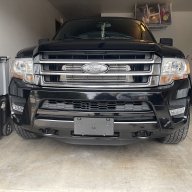
Is an aftermarket intercooler really worth it for towing??

Disclaimer: Links on this page pointing to Amazon, eBay and other sites may include affiliate code. If you click them and make a purchase, we may earn a small commission.

OP
OP
4

42pilot

Member
Joined
Oct 14, 2021
Posts
21
Reaction score
25
Location
Blairsville, GA
The louvers on the IC in are also for fuel economy, in addition to helping warm up quickly as others have stated.
Ford makes these to run in all temps so I would imagine in sub zero temps the system would want them closed to help keep the engine at operating temps. Much like semis in sub zero have their grills almost completed blocked.
You are correct, but the louvers in relation to engine operating temps only apply to radiators and not the IC. I wish I could have sub zero air intake temps all the time.
 

Battleship1

New Member
Joined
Dec 6, 2022
Posts
1
Reaction score
0
Location
Metro Detroit
Not helpful in the conversation because a'all are operating above my level, but... got here because there's a Raptor take-off IC for a reasonable price near me, and was wondering it be a worthwhile addition. Just starting looking into it, but I'd ASSUME it be an upgrade compared to what's stock on the 2017. Any thoughts appreciated. ...and now I want to figure out if the 2017 has these louvers and if I should disable them if I were tinkering in the area....
 

BlackBetty

Full Access Members
Army
Joined
Feb 1, 2021
Posts
433
Reaction score
169
Location
Surprise, AZ
First of all, thanks for the dyno chart. That's an impressive result. When I calculate your HP, I come up with approx 650 HP given your 618 ft lbs of torque at 5500 rpm. Nonetheless, a quick and relatively flat torque curve is far more important than HP.

I don't want to get a tune because, quite frankly, I own this vehicle; its my daily driver; it has to last (have you seen the price of new/used vehicles??!!) and I don't want to wear the engine with increased pressures, etc. In addition, I just don't trust aftermarket tunes. If you look at the software, i.e., the tables and inputs to produce a result, it is complicated. I used to use Link G4 ECUs to tune, and we only used 12-14 tables, for example fuel delivery rate, fuel correction by IAT temperature, manifold pressure, timing, boost, acceleration rate, cold start, hot start and so on. There are probably well over 50 tables in our ECUs. You just need one corner to be cut, or be too aggressive on timing on boost, and so on. For me, I'm ok with the power delivery using 87 octane or 91 towing. Personal opinion.

Since our ECUs learn, installing a new aftermarket IC needs no tuning package to get the benefits.

Thanks again for the chart.

No, I completely understand. I thought long, and hard, before I did the tune. Finally gave in. Even took it off once to take it to the dealer. Thought about leaving it off. After driving it for a few days made my mind up to reinstall it. Drive like a turd in my opinion.

I like your HP math… what’s the formula you used? Those final numbers on the dyno printout are at the wheels. It’s those numbers you multiply by 15-20% to get flywheel numbers, correct? I typically am modest and use 15%. Thanks!!!
 

JasonH

Full Access Members
Joined
Nov 12, 2018
Posts
1,557
Reaction score
895
Location
Houston, TX
Not helpful in the conversation because a'all are operating above my level, but... got here because there's a Raptor take-off IC for a reasonable price near me, and was wondering it be a worthwhile addition. Just starting looking into it, but I'd ASSUME it be an upgrade compared to what's stock on the 2017. Any thoughts appreciated. ...and now I want to figure out if the 2017 has these louvers and if I should disable them if I were tinkering in the area....
No louvers on 2017.
 
OP
OP
4

42pilot

Member
Joined
Oct 14, 2021
Posts
21
Reaction score
25
Location
Blairsville, GA
UPDATE

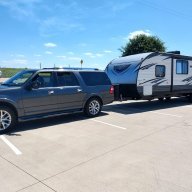
I just got back from an 8,000 mile round trip, from JAX to Wyoming and back. I pulled a 6300lb travel trailer about 5500 miles of the 8,000, that included a lot of miles at elevations over 6,000ft and some up to 9,000 ft. Over the total trip, average mpg was 10.5. For the most part, I stayed at or below 65 mph and of the 5500 miles pulling the trailer, about half that was back roads. This trip, we took as many back roads as possible west of the Mississippi.

So, how did the stock intercooler perform? With the louvers pinned to the open position, and the motor always requiring some amount of boost (I hesitate to mention how much because it was always different due to terrain, headwind or tailwind, traffic and so on), the differential between ambient temp and manifold inlet temp was just too great (sometimes more than 30 degrees continual), especially compared to not pulling a trailer and continually being in some amount of boost. The OEM intercooler just could not shake the continual heat soak. Since I am selling my travel trailer, it's not worth it to me to invest +$900 for a quality IC when the stock IC works just fine for short bursts of power. If I would have kept my trailer, I would definitely upgrade the IC.

I also learned the 3.5L Ecoboost and the Expedition (with tow package) is an impressive combination for pulling small to mid-size travel trailers. The highest mountain passes and passing slower rigs, I never felt like the car was under-powered or lacking. Well done, Ford.

FYI...
 

Calidad

Full Access Members
Joined
Oct 1, 2019
Posts
765
Reaction score
400
Location
California
Great discussion, I just stumbled in after reading about 6.7 Diesel guys mangling their turbos during this cold snap. Apparently the 6.7’s maybe more so the 24’s and newer (intake difference?) are developing ice in the intake tube which is breaking off and being ingested into the turbo.
Ford is telling them to run a grill cover in sub freezing temperatures.

I haven’t heard of any 3.5’s having this issue.

However!!!! I tow heavy and up some big altitude 7400ft so far I’ve only gone 6200-7400ft. Going the other way 100ft to 7400ft I bailed (that failing tstat!!) before the big climb when trans temps hung at 230 even after a 15 min stop for a cool down. I knew something wasn’t right. Didn’t cook anything avoided that…. Had a buddy with a 2500 come take the boat over the pass on that trip that direction your climbing from 100ft over 7400ft. This last spring I borrowed a buddy’s 24 F250 6.8 gasser for the drag over the pass. That thing ran the same temps towing up the pass that it runs empty‍♂️. Boat is 8700 with trailer included.

Crazy thing that 6.8 beast only gets into the almost 500ftlb of torque at 4000rpm!! Tows so different than the 3.5 where 2000-2500rpm is more than plenty to keep 8700lbs running legal speed. This route is 45-55 with a few 30mph turns. Two good grinds where loaded semi’s, trucks RVs etc are doing the 30-35mph grind.

Coming down is no joke, one section its only about a 8 min section I approach it at 25mph with flashers in 2nd gear. Same thing the heavy semi guys do. Its very controlled with maybe 3 brake applications to stay in the 30-32mph zone. Passing lane right at the bottom so no biggie with traffic.
The F250 really didn’t have any better braking than the Expedition both really highly dependent on the trailer brakes.
 

Calidad

Full Access Members
Joined
Oct 1, 2019
Posts
765
Reaction score
400
Location
California
The altitude vs max tow factor is definitely interesting. I crossed three passes between 5500-6000 on my long drag from Seattle to the Bay Area 840 mile run in End of July. We had 104 temps in Roseburg Oregon while climbing Grants Pass had all windows down front and back heaters blasting full blast climbing at 1800-2000 rpm. We literally crossed the top when trans temp hit 140 and engine temp was 238. I would have pulled off to cool down but we literally were looking down hill so just let it cool off as we came down the back side. Dropped to 200 in about 10 minutes on the transmission and the engine temp was below 228 in about 5 minutes.

Siskiyou Pass is a bigger grind right at the CA/OR boarder. We stayed at family’s house then hit that at 5:30 am in 75 degree temperatures trans was 232 when we hit the top engine temp was below 228. I’m pretty sure that faulty thermostat was starting to act up after the Grants Pass given I saw some weird temp spikes on the transmission while on the flats nothing hot just cruising at 55 flat straight and it would just randomly jump from 210 to 218 then after a few minutes drop to 212 etc. Never getting below 210. After replacing it 190-200 flat haul with decent climb not 5000ft at 2500 to see what temps do and trans only spiked to 218 something I wouldn’t have done with the prior tstat given it would have really spiked temps.
 

Calidad

Full Access Members
Joined
Oct 1, 2019
Posts
765
Reaction score
400
Location
California
I wonder if the fan on the intercooler would help keep temps down? 2019 Platinum heavy tow with all the same stuff as the current Tremor but I don’t think it has that extra fan thats part of the H.O version?
 

JasonH

Full Access Members
Joined
Nov 12, 2018
Posts
1,557
Reaction score
895
Location
Houston, TX
I wonder if the fan on the intercooler would help keep temps down? 2019 Platinum heavy tow with all the same stuff as the current Tremor but I don’t think it has that extra fan thats part of the H.O version?
Its boost causing the elevated temps. Have to use the lower gears. Anecdotally, an oil cooler helps because the turbos are really heating up the oil when they're running hard. All that heat gets dumped into the coolant.
 

Calidad

Full Access Members
Joined
Oct 1, 2019
Posts
765
Reaction score
400
Location
California
Oh climbing in 3rd -4th on the big stuff keeping rpms under 2100 seems to really help. Thats easily 35-40mph with the Semi’s doing their grind.
 

Fastcar

Full Access Members
Army
Joined
Dec 14, 2013
Posts
1,115
Reaction score
707
Location
FL
Thank you gentlemen for posting one of the more informative threads I've read. Kudos to you!
 
Top