
Replaced pads and rotors, brake pedal sinking to floor now?!?

Disclaimer: Links on this page pointing to Amazon, eBay and other sites may include affiliate code. If you click them and make a purchase, we may earn a small commission.

07navi

Full Access Members
Joined
Feb 3, 2020
Posts
2,535
Reaction score
598
Location
Mt.Shasta California
Thanks guys! I did go do the break in procedure again and I think it feels a little better (or maybe I just want that to be true...haha) but it's still super easy to push it straight to the floor. Having to hold it for ~30 seconds is more like what I'd expect! I don't think it's a safety issue at this point since the brakes stop fine unless they're super hot, so I'll drive it this week to see if it keeps improving.

Not sure if I already mentioned this, but I thought about putting the old rotors and pads back on the front to test if that was the issue but I already got rid of the pads, unfortunately.

I doubt if that would do anything anyway.
 
OP
OP
U

UniqueTII

Well-Known Member
Joined
Dec 6, 2018
Posts
65
Reaction score
19
Location
Des Moines, IA
The theory would be that the uneven contact patch is causing the pedal to drop as it twists the pad flat, so the old ones wouldn't have that issue. Just a theory!

thumbnail_20200924_221313.jpg

EDIT: This was after the first break-in session.
 

Plati

Well-Known Member
Joined
May 4, 2016
Posts
2,781
Reaction score
1,367
Location
.
The theory would be that the uneven contact patch is causing the pedal to drop as it twists the pad flat, so the old ones wouldn't have that issue. Just a theory!

View attachment 38333

EDIT: This was after the first break-in session.
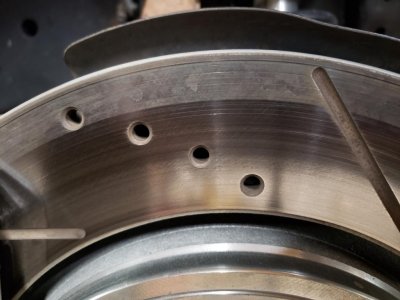
Is that normal that the pad only rides on 3/4 of the rotor diameter?
On mine the pad is sized same as rotor. Looks odd.
 
OP
OP
U

UniqueTII

Well-Known Member
Joined
Dec 6, 2018
Posts
65
Reaction score
19
Location
Des Moines, IA
Is that normal that the pad only rides on 3/4 of the rotor diameter?
On mine the pad is sized same as rotor. Looks odd.

The pad covers 100% of the rotor diameter, so this is definitely not a good contact patch! I swapped the inner and outer on that side before doing my second break-in and it cleaned it right up, so I'm leaning toward a pad issue and not a caliper/bracket issue.
 

07navi

Full Access Members
Joined
Feb 3, 2020
Posts
2,535
Reaction score
598
Location
Mt.Shasta California
You could have the worst pads ever made and they won't cause the pedal to drop to the floor. Cars.com lists the spongy brake pedal on the expys as one of the top drawbacks.
 
OP
OP
U

UniqueTII

Well-Known Member
Joined
Dec 6, 2018
Posts
65
Reaction score
19
Location
Des Moines, IA
You could have the worst pads ever made and they won't cause the pedal to drop to the floor. Cars.com lists the spongy brake pedal on the expys as one of the top drawbacks.

It's clear that my brake pedal behavior (goes right to the floor) doesn't match the expected performance of the vehicle (yours takes firm pressure over time to go to the floor) so there's obviously some sort of problem. There are a limited number of factors that would allow a hydraulic cylinder to move in a closed system, namely movement of other cylinders, bypassing, leaking, air, or hose expansion. It's not my theory, but others have stated that they were getting caliper movement as the non-parallel pad surface was pressed flat onto the rotor which caused the pedal drop. As the pad wore over time the pedal pressure improved. Again, just some experiences of others that I'm interested in testing. Given the volume of fluid needed to move the large caliper pistons, it doesn't take much movement to consume the amount that the master cylinder can displace.

The other factors I've listed have all been addressed to some degree with changing out parts and so many bleeds, but I'm not confident in any part of the braking system at this point. There may even be other factors I'm not thinking of but this is a pretty simple system overall.
 

Yupster Dog

Staff member
Moderator
Joined
Dec 7, 2018
Posts
1,536
Reaction score
1,066
Location
Virginia
It's not my theory, but others have stated that they were getting caliper movement as the non-parallel pad surface was pressed flat onto the rotor which caused the pedal drop. As the pad wore over time the pedal pressure improved. Again, just some experiences of others that I'm interested in testing. Given the volume of fluid needed to move the large caliper pistons, it doesn't take much movement to consume the amount that the master cylinder can displace.

It truly pains me to say this but (cough, cough, choke) @07navi is correct.

You could have the worst pads ever made and they won't cause the pedal to drop to the floor.

If the pad is not close enough to the rotor that is a caliper problem not a pad problem.
 
OP
OP
U

UniqueTII

Well-Known Member
Joined
Dec 6, 2018
Posts
65
Reaction score
19
Location
Des Moines, IA
It truly pains me to say this but (cough, cough, choke) @07navi is correct.


If the pad is not close enough to the rotor that is a caliper problem not a pad problem.

Lol, I welcome any correctness on this ridiculous issue!

Just to clarify, it's not that the pad isn't close enough to the rotor, it's that they're not parallel so the contact patch is uneven (see picture a few posts back). Again, the theory is that the caliper pushes it as flat as possible but that you run out of pedal travel due to the volume differences of the master cylinder piston and caliper pistons. With multiple people saying that their pedal feel improved over time or by repeating the break-in procedure I feel that it's worth entertaining.
 

07navi

Full Access Members
Joined
Feb 3, 2020
Posts
2,535
Reaction score
598
Location
Mt.Shasta California
It's clear that my brake pedal behavior (goes right to the floor) doesn't match the expected performance of the vehicle (yours takes firm pressure over time to go to the floor) so there's obviously some sort of problem. There are a limited number of factors that would allow a hydraulic cylinder to move in a closed system, namely movement of other cylinders, bypassing, leaking, air, or hose expansion. It's not my theory, but others have stated that they were getting caliper movement as the non-parallel pad surface was pressed flat onto the rotor which caused the pedal drop. As the pad wore over time the pedal pressure improved. Again, just some experiences of others that I'm interested in testing. Given the volume of fluid needed to move the large caliper pistons, it doesn't take much movement to consume the amount that the master cylinder can displace.

The other factors I've listed have all been addressed to some degree with changing out parts and so many bleeds, but I'm not confident in any part of the braking system at this point. There may even be other factors I'm not thinking of but this is a pretty simple system overall.
Not buying that theory because the caliper pistons move a long way with very little pedal travel.
 
OP
OP
U

UniqueTII

Well-Known Member
Joined
Dec 6, 2018
Posts
65
Reaction score
19
Location
Des Moines, IA
Not buying that theory because the caliper pistons move a long way with very little pedal travel.

That's fair but I don't have a better theory to act on. "These trucks have crappy brakes" doesn't explain a new condition after 130K miles and a hardware change. The condition didn't change after replacing calipers, lines, master cylinder, and HCU.

I just pulled the front wheels again and the pads seem to be sitting okay with no huge gaps on any edge. I'll try to have someone pump the brakes later so I can see if there's any movement as the pedal falls.
 

Trainmaster

Old School Member
Joined
Jun 17, 2017
Posts
3,620
Reaction score
2,122
Location
Rockaway Beach, NY
I'd throw out the Chinese pads, followed by the Chinese rotors and replace them with domestic stuff. Bet your problem will be solved. But that's me. I've been burned EVERY TIME I've opted for Made-in-China crap.

If I had your problem, the first thing I'd do is put the old stuff back on. That would rule out a problem in the new things: Flexing backing pads, thin pads, thin rotors, flexing rotors and who-knows-what. That would take me back to where I was before I opened the worm can.
 
OP
OP
U

UniqueTII

Well-Known Member
Joined
Dec 6, 2018
Posts
65
Reaction score
19
Location
Des Moines, IA
I'd throw out the Chinese pads, followed by the Chinese rotors and replace them with domestic stuff. Bet your problem will be solved. But that's me. I've been burned EVERY TIME I've opted for Made-in-China crap.

If I had your problem, the first thing I'd do is put the old stuff back on. That would rule out a problem in the new things: Flexing backing pads, thin pads, thin rotors, flexing rotors and who-knows-what. That would take me back to where I was before I opened the worm can.

I'm really regretting throwing the pads away at this point. I have the rotors if I needed to try that and I could grab some other pads.
 

Plati

Well-Known Member
Joined
May 4, 2016
Posts
2,781
Reaction score
1,367
Location
.
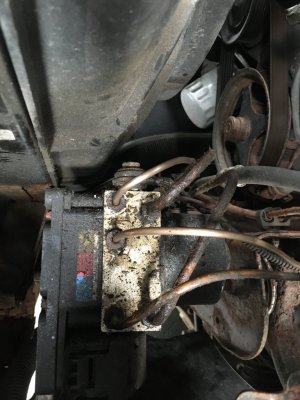
OK ... this is really humorous. I just went out to drive my 2003 to The Depot. Brake pedal goes right to the floor. Pump it couple times, same. Put in reverse ... NO BRAKES or very little. I was able to stop it, just barely after a few feet. Crap on driveway!!! Gotta be brake fluid I would guess. No brakes.

I can drive my 2014EL until I get the 2003 repaired. I'm gonna take the attitude that you helped me out by precipitating a failure in a safe location (driveway) rather than out in traffic where it would SUCK. TFF
:33:
View attachment 38270

Once I look at it, I'll post up what broke
I replaced both front steel brake lines with CuproNickel and also both flexible lines at the same time. Should be solid now. Brakes are still soft as always but work!
IMG_2103.JPG
 

04WHITEEDDIE

Member
Joined
Oct 23, 2019
Posts
10
Reaction score
4
Location
Marietta, Ga.
UniqueTll...did you ever get your issue resolved? After I changed my front pads from stock ford to akobono I had a more soft/mushy brake pedal at standstill, but when driving, the brakes work good. I can even get the ABS to activate on dry road when i slam on brakes at 50mph
 
OP
OP
U

UniqueTII

Well-Known Member
Joined
Dec 6, 2018
Posts
65
Reaction score
19
Location
Des Moines, IA
UniqueTll...did you ever get your issue resolved? After I changed my front pads from stock ford to akobono I had a more soft/mushy brake pedal at standstill, but when driving, the brakes work good. I can even get the ABS to activate on dry road when i slam on brakes at 50mph

I'm in the same boat. The pedal is still mushy and requires a lot more travel than it should (and will drop to the floor when pressed firmly) but the brakes do work so I've just been dealing with it. I will likely try to swap out more components in the future but don't want to deal with it right now.
 

07navi

Full Access Members
Joined
Feb 3, 2020
Posts
2,535
Reaction score
598
Location
Mt.Shasta California
Looks like stock rotors and metallic pads are looking better all the time. Probably the best you can do for these spongy Expies.
 

outdare

Well-Known Member
Joined
Jan 28, 2011
Posts
70
Reaction score
19
Location
Texas
Is there a thickness difference between these brake pads? Would that cause these issues.

Sent from my moto g(7) play using Tapatalk
 
Top