

You are using an out of date browser. It may not display this or other websites correctly.
You should upgrade or use an alternative browser.
You should upgrade or use an alternative browser.
Tire pressures
- Thread starter 16plati
- Start date
Disclaimer: Links on this page pointing to Amazon, eBay and other sites may include affiliate code. If you click them and make a purchase, we may earn a small commission.

JExpedition07
That One Member
I run 40 psi on my Michelins, not sure what max pressure is though. It says 35 PSI on the door jamb as recommended.
powerboatr
Full Access Members
40
38 out back
rears stay at 38 unless we are towing the trailer with max tongue weight
38 out back
rears stay at 38 unless we are towing the trailer with max tongue weight


Max pressure is only for when you are running at or close to max tire capacity.
Sent from my iPhone using Tapatalk Pro
Sent from my iPhone using Tapatalk Pro
MuddySpokes
Full Access Members
On my tires, max is not stated on the sidewall.
When towing, I do start with the rears just under or at MAX COLD when cold.
Even when empty, there is no noticeable difference to taking them down to lower pressures. Am sure there is some scientific test out there that will show a difference of X inches or X feet stopping distance though. YMWV.
Also, am sure that there are plenty of ways that different people manage their tires. So, in this case, am not looking to claim which approach is best and am merely answering the original question
When towing, I do start with the rears just under or at MAX COLD when cold.
Even when empty, there is no noticeable difference to taking them down to lower pressures. Am sure there is some scientific test out there that will show a difference of X inches or X feet stopping distance though. YMWV.
Also, am sure that there are plenty of ways that different people manage their tires. So, in this case, am not looking to claim which approach is best and am merely answering the original question
On my tires, max is not stated on the sidewall.
When towing, I do start with the rears just under or at MAX COLD when cold.
Even when empty, there is no noticeable difference to taking them down to lower pressures. Am sure there is some scientific test out there that will show a difference of X inches or X feet stopping distance though. YMWV.
Also, am sure that there are plenty of ways that different people manage their tires. So, in this case, am not looking to claim which approach is best and am merely answering the original question
Are they mud tires?? Please show a pic of a DOT street tire that does not state max pressure, load range, and traction, tread wear, DOM etc on it.
ALL tires that say 35 max get 35 or at least 34 if I'm in a hurry.
All 44 tires get 42-42.
All 50 tires get 42-45.
Any 55 tires get 44-45 or so.
All 60 get 55-60.
All 80 get at least 72. Since all my E range tires are on big vehicles and carry lots of weight.
I have had tire shops put a brand new E range on and put 35 in it.
That wouldn't even be safe on one of my 14,400 GVWR vehicle!!!
All 44 tires get 42-42.
All 50 tires get 42-45.
Any 55 tires get 44-45 or so.
All 60 get 55-60.
All 80 get at least 72. Since all my E range tires are on big vehicles and carry lots of weight.
I have had tire shops put a brand new E range on and put 35 in it.
That wouldn't even be safe on one of my 14,400 GVWR vehicle!!!
MuddySpokes
Full Access Members
Are they mud tires?? Please show a pic of a DOT street tire that does not state max pressure, load range, and traction, tread wear, DOM etc on it.
Step into the world of LT's. It is common to see MAX COLD which is not MAX.
Dr0idattack
Well-Known Member
Running 80 right now because of some recent towing. But I plan to go to 65 in a bit.

Since this is an enthusiasts community, and many people are running non stock tires, its probably helpful to also state the tire size, construction (P, P-Metric, LT) and load ratings. LT tires, for instance, will often run higher pressures than equivalent size in a P-Metric, to achieve the same load rating. Generally conversion tables can be found on the tire manufacturers websites..
But yes, according to the tire manufacturers anyway, maximum stated cold inflation pressures are for when the tire is expected to carry at or near its maximum stated load capacity, and can and should be decreased to match actual load carried for best results.
Here is an article pulled from Toyo's website as an example..
https://www.toyotires.com/media/2125/application_of_load_inflation_tables_20170203.pdf
Keep in mind this example is for a specific brand and model tire, but it gets the point across..
But yes, according to the tire manufacturers anyway, maximum stated cold inflation pressures are for when the tire is expected to carry at or near its maximum stated load capacity, and can and should be decreased to match actual load carried for best results.
Here is an article pulled from Toyo's website as an example..
https://www.toyotires.com/media/2125/application_of_load_inflation_tables_20170203.pdf
Keep in mind this example is for a specific brand and model tire, but it gets the point across..
Last edited:
Most tires, even LTS do not say maximum cold inflation. They say maximum load XXXX number of pounds at maximum pressure that is printed on the sidewall . Some may add cold for uniformity.Step into the world of LT's. It is common to see MAX COLD which is not MAX.
Even Turf & lawn mower tires have a maximum inflation credit on the sidewall. The first post was that there was no maximum pressure printed on the sidewall. I can't recall ever seeing a tire even on a two-wheel dolly but didn't have maximum inflation printed on the sidewalk.
No tire should ever be inflated past the maximum pressure stated on the sidewall.
It is irrelevant if you're going to haul a heavy load or not. If your load is over the maximum load rated on the sidewall of the tire at the maximum pressure then you need a heavier Rated Tire.
For uniformity we always check tire pressures when cold. This is not to say that a tire inflated to 80 lb cold will not be a few pounds over when it has been driving on the road for several miles.
But you never put 82 or 85 lb in that same Tire when it's cold because you're going to haul more weight. That is not appropriate.
chuck s
Full Access Members
- Joined
- Dec 20, 2006
- Posts
- 1,990
- Reaction score
- 753
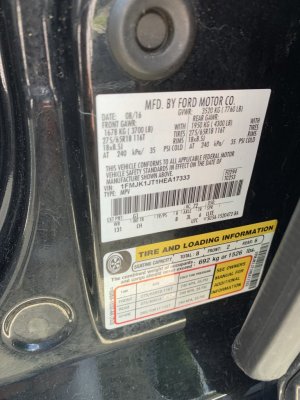
If anyone has an Expedition with factory LT tires I'd be interested in seeing the rear GAWR as listed on the data plate.
My Expedition's Gross Axle Weight Rating (GAWR), the maximum permissible weight on the rear axle, is 4300 pounds. This can be achieved with the recommended cold tire pressure of 35psi in the rear tires. Normal inflation higher than that will just wear out the tread center more quickly (although radials minimize this).
The GAWR doesn't change if I put 40psi in the tires or put harsh riding LT tires on the truck. At 51psi (max cold pressure) the pair of rear tires will support 5512 pounds -- but the axle and suspension won't.
-- Chuck
My Expedition's Gross Axle Weight Rating (GAWR), the maximum permissible weight on the rear axle, is 4300 pounds. This can be achieved with the recommended cold tire pressure of 35psi in the rear tires. Normal inflation higher than that will just wear out the tread center more quickly (although radials minimize this).
The GAWR doesn't change if I put 40psi in the tires or put harsh riding LT tires on the truck. At 51psi (max cold pressure) the pair of rear tires will support 5512 pounds -- but the axle and suspension won't.
-- Chuck
Correct! It also doesn't really matter what the name plate for the manufacturer says. No tire should ever be loaded beyond the maximum load stated on the sidewall and that is at the PSI rated also stated on the sidewalk. You should never inflate a tire over the max pressure listed on the sidewall. If you do and you're trying to overcompensate for extra way you are already breaking safety rules by overloading the tires.If anyone has an Expedition with factory LT tires I'd be interested in seeing the rear GAWR as listed on the data plate.
My Expedition's Gross Axle Weight Rating (GAWR), the maximum permissible weight on the rear axle, is 4300 pounds. This can be achieved with the recommended cold tire pressure of 35psi in the rear tires. Normal inflation higher than that will just wear out the tread center more quickly (although radials minimize this).
The GAWR doesn't change if I put 40psi in the tires or put harsh riding LT tires on the truck. At 51psi (max cold pressure) the pair of rear tires will support 5512 pounds -- but the axle and suspension won't.
-- Chuck
If anyone has an Expedition with factory LT tires I'd be interested in seeing the rear GAWR as listed on the data plate.
My Expedition's Gross Axle Weight Rating (GAWR), the maximum permissible weight on the rear axle, is 4300 pounds. This can be achieved with the recommended cold tire pressure of 35psi in the rear tires. Normal inflation higher than that will just wear out the tread center more quickly (although radials minimize this).
The GAWR doesn't change if I put 40psi in the tires or put harsh riding LT tires on the truck. At 51psi (max cold pressure) the pair of rear tires will support 5512 pounds -- but the axle and suspension won't.
-- Chuck
2010ELExpy4x4
Well-Known Member
LT 285 70 17 load range E run them at 35psi for on road driving, even at that pressure feel the road more than the P tires it came with.
Stock Goodyear wranglers, P275/65/18 I run at max pressure of 50 front and rear during camping season since I'm running at max tongue weight and any additional stiffness in the rear (side to side) is greatly appreciated. If these dang things ever wear out I'll go to a firmer sidewall tire but right now I'm at 47k miles and still at half tread depth....
Ford Platinum EL 2016 model. Tires: 285/45R22 114H. Recommended pressure in the door sticker 38 PSI Cold. Philippines is a warm country with temperature ranging 30-35 C. I just follow the manufacturer's recommended pressure.
We should eally pay more attention to the tire manufacturers ecommendations than the automobile manufacturers recommendation.Ford Platinum EL 2016 model. Tires: 285/45R22 114H. Recommended pressure in the door sticker 38 PSI Cold. Philippines is a warm country with temperature ranging 30-35 C. I just follow the manufacturer's recommended pressure.
It's already been proven that a Vehicle Manufacturer can recommend a pressure that can easily result in dangerous conditions and accidents.
I don't think I've ever heard of a tire manufacturer messing up on their maximum inflated safety pressure. The worst that can happen even if you ran all tires at the absolute maximum pressure is you would have a firmer maybe bumpy ride, you could wear out the center a little faster than the complete width of the tread and you would be able to hold the maximum load with the vehicle without fear of overloading or overheating a tire. So not the worst things in the world.
We should eally pay more attention to the tire manufacturers ecommendations than the automobile manufacturers recommendation.
It's already been proven that a Vehicle Manufacturer can recommend a pressure that can easily result in dangerous conditions and accidents.
I don't think I've ever heard of a tire manufacturer messing up on their maximum inflated safety pressure. The worst that can happen even if you ran all tires at the absolute maximum pressure is you would have a firmer maybe bumpy ride, you could wear out the center a little faster than the complete width of the tread and you would be able to hold the maximum load with the vehicle without fear of overloading or overheating a tire. So not the worst things in the world.
You should NEVER run at maximum pressure, unless you are running at maximum weight. When running at maximum pressure, without the weight, your contact area is decreased. Depending on how under maximum weight you are running it could be a significant difference. Less contact patch means less grip, and longer stopping distances.
Yes, Back in the 90’s Ford got in trouble for running Explorers and Rangers at less pressure than Firestone recommended for their OEM tires. They both paid for it, significantly! They will not make that mistake again.
I run around 38-40 based on what I have observed Tire wear wise and average load we run.
I have pushed it up more when towing, but don’t tow even close to Max regularly. Maybe 4-5K at most. Most of the time is a small metal yard trailer and around 2K loaded.
Sent from my iPhone using Tapatalk Pro
Last edited:
Similar threads
- Replies
- 9
- Views
- 2K

- Replies
- 10
- Views
- 2K

- Replies
- 6
- Views
- 2K
- Replies
- 5
- Views
- 1K


- Replies
- 0
- Views
- 580


Staff online
-
 JUST4FUNAdmin