


weak alternator voltage and 10 burnt fuses... !! ??

Disclaimer: Links on this page pointing to Amazon, eBay and other sites may include affiliate code. If you click them and make a purchase, we may earn a small commission.

mohammed

Member
Joined
Mar 31, 2013
Posts
6
Reaction score
0
Location
Saudi Arabia
Hello,

in my 2012 ford Expedition XLT 4X4, I have a problem that gave me headache and still, my alternator is outputing 13.8 at best, there was corrosion on the battery terminals and after cleaning it the voltage spike up to normal 14.2v for two or 3 starts.. the I figured OK my battery is sucking alternator voltage in with a new the voltage is 14.2v very good, second run the problem is back,

today tested the engine compartment fuse box, and after test all fuses I found 10 fuses not working they are as follows (according to the manual page 287):

*** UPDATE: I rechecked all engine compartment fuses with engine on and off and took some of them off , results is they are working fine
.


I didn't have check engine light !! , Any help is much appreciated.


Thanks
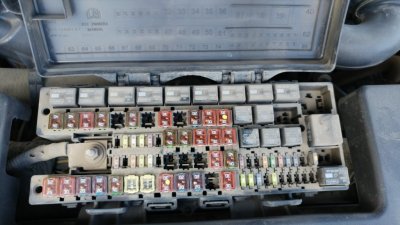
20170808_072030.jpg
 
Last edited:

Bedrck47

Full Access Members
Joined
Jul 4, 2014
Posts
5,639
Reaction score
659
Location
Elizebethtown, PA
it was nice that you took the time to list all of the fuses by number and description.
And ever the page number in the owners manual.

But what would be more helpful would be to know what year expy you have
 
OP
OP
mohammed

mohammed

Member
Joined
Mar 31, 2013
Posts
6
Reaction score
0
Location
Saudi Arabia
its 2012, I expected the forum to display it from my personal info when I first register like other forums.
 

stamp11127

Full Access Members
Joined
Mar 10, 2012
Posts
6,207
Reaction score
1,246
Location
Temple, Georgia
Welcome to the site.

I added your model info to your signature.
I doubt you have blown fuses, looks more like a dust/sand issue with making good connections. A couple cans of contact cleaner sprayed into each set of terminals with the fuses or connectors removed would help. Remove one at a time and spray. You can't run the engine with the pcm fuses and coil fuses blown so how are you able to read the 13.8 voltage?
 

Bedrck47

Full Access Members
Joined
Jul 4, 2014
Posts
5,639
Reaction score
659
Location
Elizebethtown, PA
What is the battery voltage with the engine shut off?

What is voltage at idle? And at 1500 RPM's
 
Last edited:
OP
OP
mohammed

mohammed

Member
Joined
Mar 31, 2013
Posts
6
Reaction score
0
Location
Saudi Arabia
This forum doesn't You need to make a signature line

OK, thanks.

If you have 10 blown fuses then you have a short circuit somewhere.

I just rechecked all fuses in the engine compartment fuse box with engine on and off and took some of them off to check indivisually and they are all fine.

Welcome to the site.

I added your model info to your signature.
I doubt you have blown fuses, looks more like a dust/sand issue with making good connections. A couple cans of contact cleaner sprayed into each set of terminals with the fuses or connectors removed would help. Remove one at a time and spray. You can't run the engine with the pcm fuses and coil fuses blown so how are you able to read the 13.8 voltage?

Thanks man, it is as you said I recheck all fuses and they are fine, as for the battery terminals I changed the battery the asked the seller to clean them for me but I didn't check after him I'll try cleaning them my self and get back with the result.

What is the battery voltage with the engine shut off?

What is voltage at idle? And at 1500 R

I just changed the battery a week ago, the voltage last time I checked was 12.6v.
 

Bedrck47

Full Access Members
Joined
Jul 4, 2014
Posts
5,639
Reaction score
659
Location
Elizebethtown, PA
When you checked the fuses was the engine running or was it off with the key out of the ignition.

Also how did you test the fuses.

Opps I see you corrected about fuses being good or bad.

Your original post didn't make sense If the fuel pump fuse and the coil fuse was bad the engine wouldn't have ran and you wouldn't see 14+ volts from the alt as it wouldn't have been running also
 
OP
OP
mohammed

mohammed

Member
Joined
Mar 31, 2013
Posts
6
Reaction score
0
Location
Saudi Arabia
When you checked the fuses was the engine running or was it off with the key out of the ignition.

Also how did you test the fuses.

Opps I see you corrected about fuses being good or bad.

Your original post didn't make sense If the fuel pump fuse and the coil fuse was bad the engine wouldn't have ran and you wouldn't see 14+ volts from the alt as it wouldn't have been running also

I checked in all cases engine off/on any doubts took the fuses off test continuity, but mostly with a simple fuse tester just like the attached image.

fuse tester.jpg
 

theoldwizard1

Full Access Members
Joined
Jul 29, 2013
Posts
320
Reaction score
81
Location
SE MI
With the engine off, turn your headlights on for about 10-15 minutes. Start the car and check the voltage at the battery with known good DVM. It will be over 14V but will come down to that 13.8V mark after a few minute.

This is how the "smart charging" system works.

Blown fuses are not related to this behavior.
 

stamp11127

Full Access Members
Joined
Mar 10, 2012
Posts
6,207
Reaction score
1,246
Location
Temple, Georgia
You don't have to drain the battery prior to starting. The initial crank load is in the neighborhood of 400+ amps before the engine starts turning. This is enough for the voltage regulator to start charging the battery.

Once running you can put a good load on the electrical system by turning on the ac and high beams. This will put at least a 45amp load on the system in addition to what is already on.

Mohammed, clean the wire plugs and contacts on the alternator with contact cleaner also. Disconnect the negative battery cable at the battery first though. Reconnect when finished.
 
OP
OP
mohammed

mohammed

Member
Joined
Mar 31, 2013
Posts
6
Reaction score
0
Location
Saudi Arabia
With the engine off, turn your headlights on for about 10-15 minutes. Start the car and check the voltage at the battery with known good DVM. It will be over 14V but will come down to that 13.8V mark after a few minute.

This is how the "smart charging" system works.

Blown fuses are not related to this behavior.

OK, I'll try it and get back with results

I didn't know about smart charging, but is it normal even if I notice the instrument panel light some how dim no as I remember them ? is it related ?

the fuses were not blown, I just rechecked them after words when vehicle when engine on and took of some of them and were fine.


You don't have to drain the battery prior to starting. The initial crank load is in the neighborhood of 400+ amps before the engine starts turning. This is enough for the voltage regulator to start charging the battery.

Once running you can put a good load on the electrical system by turning on the ac and high beams. This will put at least a 45amp load on the system in addition to what is already on.

Mohammed, clean the wire plugs and contacts on the alternator with contact cleaner also. Disconnect the negative battery cable at the battery first though. Reconnect when finished.

in all my test scenarios it involved testing the vehicle with A/C on headlight and fog lights, the voltages are as discussed earlier.. so yah its head scratcher.
 

stamp11127

Full Access Members
Joined
Mar 10, 2012
Posts
6,207
Reaction score
1,246
Location
Temple, Georgia
Disconnect the battery and clean the output stud and wire terminal on the alternator and cable. Also clean the connector for the other wire to the alternator and battery posts and terminals using contact cleaner.

Reconnect the battery positive first then negative last.

Start engine and read charging voltage.

Let engine warm up some then place a load on the electrical system by turning on ac with blower motor on high and the high beams. Rev engine to at least 1500 rpms and read charging voltage again.
If not within spec of 13.5 to 14.5 volts, using a volt meter or multimeter read voltage from alternator output stud (+) to negative battery post.

Be careful to avoid shorting the output stud to alternator case with the probe.

Let us know what the voltages are.
 
OP
OP
mohammed

mohammed

Member
Joined
Mar 31, 2013
Posts
6
Reaction score
0
Location
Saudi Arabia
Disconnect the battery and clean the output stud and wire terminal on the alternator and cable. Also clean the connector for the other wire to the alternator and battery posts and terminals using contact cleaner.

Reconnect the battery positive first then negative last.

Start engine and read charging voltage.

Let engine warm up some then place a load on the electrical system by turning on ac with blower motor on high and the high beams. Rev engine to at least 1500 rpms and read charging voltage again.
If not within spec of 13.5 to 14.5 volts, using a volt meter or multimeter read voltage from alternator output stud (+) to negative battery post.

Be careful to avoid shorting the output stud to alternator case with the probe.

Let us know what the voltages are.

I just cleaned off the battery terminals until I exposed the copper and sanded the battery posts,

The starting voltage is 13.6 after engine start
Underload voltage 13.8 v

Reving the engine didn't make any noticable difference

I also checked the voltage from the alternator, I didn't notice any voltage drop from to the battery.

Does it mean any thing, is it smart charge as "theoldwizard1" said ?
 

stamp11127

Full Access Members
Joined
Mar 10, 2012
Posts
6,207
Reaction score
1,246
Location
Temple, Georgia
The charging voltage is within spec but on the low side.

The next step would be to electrically drain the battery a good amount. You can do this as stated in an earlier post by turning the head lights on and monitoring the battery voltage until it drops to 12.2 volts.

With the meter still attached to the battery start the engine and increase rpms to 1500. Note the charging voltage with the meter. It should be above 14 volts but drop as the battery charges back up.

If it is still low then you need to determine why.
 
Top