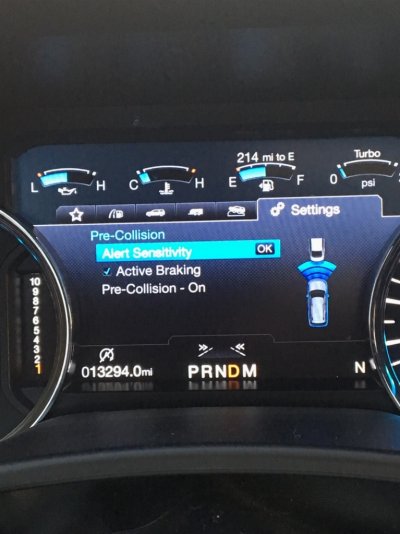
Met with a "field engineer" today. On a test drive, I had to floor the accelerator while heading toward the back of a slow moving semi trailer, and getting uncomfortably close, to trigger the light and tone which verified that the ACA system does work. I described it as marginal; but the engineer pointed out, "that's all that Ford guarantees--a working system not necessarily a perfect system." Not what I would have preferred to hear. He further explained that, from an engineering standpoint, the performance standards for this vehicle are unique to the Expedition/Navigator line and differ totally from any other Ford vehicle with ACA. So, if you are used to driving another Ford with ACA, don't expect your Expedition/Navigator to act the same as that other vehicle. Even at maximum sensitivity, encountering most driving situations that you as the driver would "expect" to trigger a light and tone alert probably won't, all because the engineering team had different ideas on what conditions should trigger a warning. Further still, he acknowledged that it makes no difference in ACA operation whether you have a normal wheelbase or max, 4X2 or 4X4, seven or eight people in the vehicle or one, packed for a trip or not, towing a trailer or not; the ACA operates based on a single set of criteria established for the Expedition/Navigator line. Why? Maybe costs?
Shades of the A/C in my 2010 F-150 causing me to dread Phoenix summers even more. Just when the evaporator temperature reached the point where the cabin air "could" be adequately cooled, the computer would kick the compressor off. Why? Mileage, at the expense of passenger comfort.
However, in the big scheme of things, a perfect ACA ranks much lower to me than: comfortable seats, awesome power, visibility, good looks, road presence, outstanding A/C, and the overall interior layout with so many useful features. Knowing the ACA works and hoping never to need it will have to suffice.