proper inflation?

Disclaimer: Links on this page pointing to Amazon, eBay and other sites may include affiliate code. If you click them and make a purchase, we may earn a small commission.

Plati

Well-Known Member
Joined
May 4, 2016
Posts
2,781
Reaction score
1,367
Location
.
2014EL
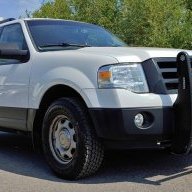
New tires, installed a week ago. … light truck 10 ply rated tires
Cleaned up the wheels today and measured pressure. Good to verify still same after a week.
Running 44 psi @ 38 degrees F. I think they "look" properly inflated … any opinions?
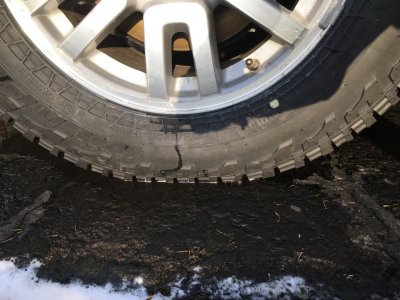
IMG_1545.JPG
 

07navi

Full Access Members
Joined
Feb 3, 2020
Posts
2,535
Reaction score
598
Location
Mt.Shasta California
2014EL
New tires, installed a week ago. … light truck 10 ply rated tires
Cleaned up the wheels today and measured pressure. Good to verify still same after a week.
Running 44 psi @ 38 degrees F. I think they "look" properly inflated … any opinions?
View attachment 34603
2014EL
New tires, installed a week ago. … light truck 10 ply rated tires
Cleaned up the wheels today and measured pressure. Good to verify still same after a week.
Running 44 psi @ 38 degrees F. I think they "look" properly inflated … any opinions?
View attachment 34603
You could run at 35 cold and raise a bunch for towing. E rated tires are 80 psi max, D rated are 65 max, and C are 50 max. All those tires are at their strongest at the max pressure but by no means do you have to run them there. I would recommend C or D rated for these trucks. My Excursion handles the best with E rated at 60 psi but it weighs 8,000 pounds.
 

762mm

Full Access Members
Joined
Aug 28, 2019
Posts
639
Reaction score
390
Location
Quebec, Canada
I run mine at 35 PSI max. My previous Ford I'd run at about 32 PSI for 16 years.

The more pressure you put in tires, the harder it will be on suspension components. Whatever fuel you'll save by running high pressure will be pissed away every time you'll have to do a ball joint, strut or wheel bearing prematurely.

Now, I'm not too familiar with the skinny tires on large mags (never had them, never will), but I believe these will require higher pressures by default, as not to damage the rim on every pothole. These types of wheels really do a number on the suspension components, though... especially on a big & heavy truck.
 

07navi

Full Access Members
Joined
Feb 3, 2020
Posts
2,535
Reaction score
598
Location
Mt.Shasta California
I'm kinda' stuck between the looks of the 20" chrome wheels and the benefits of the small wheel/large tire. The excursion I came from ran large E rated tires and a 16" wheel with a straight front axle and f-250 frame at 8,000 pounds but this new to me 2007 Navigator still rides smoother even with the 20" wheels, and one size larger tires. I thought it was going to have rear air bags but they were either optional or the previous owner converted over to springs. That's still a mystery to me since I never met the owner (consignment car).
 

Black

Full Access Members
Joined
Mar 26, 2018
Posts
1,376
Reaction score
640
Location
Kentucky
When I bumped up my tire size and went to E rated tires I tested out a few pressures.

Offroad shop that mounted the tires suggested 50psi and that was too much. I then tried 40 psi and it was much to squishy on the twisty country roads, I have settled on 45psi on road and for the trails around here 35psi.

Had them on for almost a year and about 10k mikes with a rotation every 5k and they are wearing evenly.
 

762mm

Full Access Members
Joined
Aug 28, 2019
Posts
639
Reaction score
390
Location
Quebec, Canada
I'm kinda' stuck between the looks of the 20" chrome wheels and the benefits of the small wheel/large tire. The excursion I came from ran large E rated tires and a 16" wheel with a straight front axle and f-250 frame at 8,000 pounds but this new to me 2007 Navigator still rides smoother even with the 20" wheels, and one size larger tires. I thought it was going to have rear air bags but they were either optional or the previous owner converted over to springs. That's still a mystery to me since I never met the owner (consignment car).

Stay away from air bags in suspension. Every Ford owner I've met who had them ended up either fixing the thing, converting it to spring (preferred solution) or trading in the vehicle. For whatever reason, they have a lot of problems. The air bags can fail and leak or the compressor fails. Both are big money to fix and are guaranteed to develop problems as they age. You can also damage the system if you jack up the vehicle and forget to manually turn off the compressor (there's an actual procedure for that).


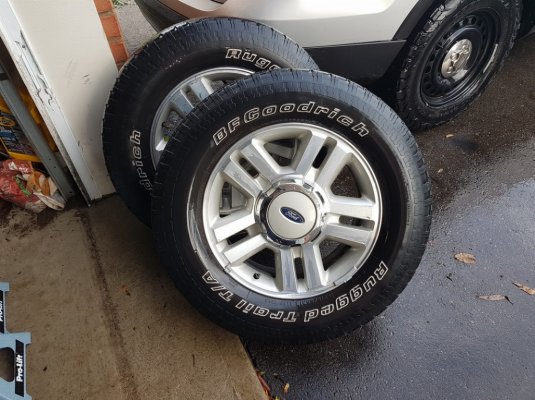
As for tires, the bigger the tire, the better it is for your suspension. I bought a set of OEM F150 mags that run the stock 16" tires for $200 off a local farmer, through kijiji... it came with the mags, tires (worn) and center caps. The F150 was a 2004, but the bolt pattern and center hub dimensions are the same.

Here they are after clean up. I really like the old school look :

F150Mags.jpg
 

07navi

Full Access Members
Joined
Feb 3, 2020
Posts
2,535
Reaction score
598
Location
Mt.Shasta California
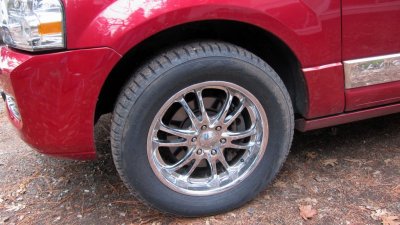
The expy, navi, and the f-100 share the same bolt pattern and offset. I found these chrome 20" Boss brand winter wheels off an older expy on craigslist a week before buying the navi for $60 total with centers andwhl2.jpg lug nuts.
 

TobyU

Full Access Members
Joined
Apr 5, 2013
Posts
2,479
Reaction score
873
Location
Ohio
Not co
I run mine at 35 PSI max. My previous Ford I'd run at about 32 PSI for 16 years.

The more pressure you put in tires, the harder it will be on suspension components. Whatever fuel you'll save by running high pressure will be pissed away every time you'll have to do a ball joint, strut or wheel bearing prematurely.

Now, I'm not too familiar with the skinny tires on large mags (never had them, never will), but I believe these will require higher pressures by default, as not to damage the rim on every pothole. These types of wheels really do a number on the suspension components, though... especially on a big & heavy truck.


Not completely true for front end parts. Low tires give more turning resistance especially at slow speeds and parking lots. Low tires put more strain on inner and outer tie rod end and idler and pitman arms and steering racks too.
 

TobyU

Full Access Members
Joined
Apr 5, 2013
Posts
2,479
Reaction score
873
Location
Ohio
Here we go again.

Most of the time if you put the placard or 35 psi in a E range tire it WILL look low....BECAUSE IT IS!
It was not made to put on a standard load vehicle and have 35 psi in it.
The manufacturer recommendation ONLY considers the original size and load range NOT a D or E.

People keep spouting the OEM pressure as correct but it IS NOT if not the OEM spec tire!


Often 44-45 will look ok and get you by but I find at least 58-50 in an E tire but most ride best at 60-70.
I put at least 60 in all E range tires. If they are on a vehicle that carries heavy loads then they get at least 72...80 if the vehicle is loaded to capacity often.

IF you are not loading it down then the best way is the chalk method.
You have to draw a line across the tread and drive to see what inflation give you the mose even wear across. This will give you the best contact patch which will be best balance between wear and traction.
NOW IF you are carrying heavy loads, the ability of the tires to carry the weight and not blow out or separate and tear belts is more important than the contact patch or wear....SO more air.
 
OP
OP
P

Plati

Well-Known Member
Joined
May 4, 2016
Posts
2,781
Reaction score
1,367
Location
.
When I first went to E tires … based on discussion and advice on this Forum … I did a bit of research and found some documentation (cross reference table) from something like "The American Tires Manufacturer Association" or something like that. I was able to look up my original P tire (maybe weight also) and cross reference it to the E tire and it specified a new pressure to run. That was about 45 psi I think. So all things being the same, just going from P to E I needed to run at the higher pressure. That's one way to do it. Its all buried in this Forum somewhere, maybe I can find it.

This was part of it I think
https://www.expeditionforum.com/threads/tire-pressure-sensor.34019/#post-281108

I've run LT tires on my 2003 @45 for a couple years and they are wearing about right so far.

Its interesting nobody commented on that pic I posted , how it looks.
 
Last edited:

07navi

Full Access Members
Joined
Feb 3, 2020
Posts
2,535
Reaction score
598
Location
Mt.Shasta California
Here we go again.

Most of the time if you put the placard or 35 psi in a E range tire it WILL look low....BECAUSE IT IS!
It was not made to put on a standard load vehicle and have 35 psi in it.
The manufacturer recommendation ONLY considers the original size and load range NOT a D or E.

People keep spouting the OEM pressure as correct but it IS NOT if not the OEM spec tire!


Often 44-45 will look ok and get you by but I find at least 58-50 in an E tire but most ride best at 60-70.
I put at least 60 in all E range tires. If they are on a vehicle that carries heavy loads then they get at least 72...80 if the vehicle is loaded to capacity often.

IF you are not loading it down then the best way is the chalk method.
You have to draw a line across the tread and drive to see what inflation give you the mose even wear across. This will give you the best contact patch which will be best balance between wear and traction.
NOW IF you are carrying heavy loads, the ability of the tires to carry the weight and not blow out or separate and tear belts is more important than the contact patch or wear....SO more air.
I agree with all that and most people don't realize the E rated tires are at their strongest at their max rated psi. C rated are probably best for these Expys in here and they hold 50 psi max. Much better than a flimsy passenger p rated tire.
 

TobyU

Full Access Members
Joined
Apr 5, 2013
Posts
2,479
Reaction score
873
Location
Ohio
I agree with all that and most people don't realize the E rated tires are at their strongest at their max rated psi. C rated are probably best for these Expys in here and they hold 50 psi max. Much better than a flimsy passenger p rated tire.
Yes or at least an extra load pick up style tire.
 

762mm

Full Access Members
Joined
Aug 28, 2019
Posts
639
Reaction score
390
Location
Quebec, Canada
Not co


Not completely true for front end parts. Low tires give more turning resistance especially at slow speeds and parking lots. Low tires put more strain on inner and outer tie rod end and idler and pitman arms and steering racks too.


True. This is why I never turn my wheels when the truck is not moving, as the resistance of a static wheel destroys steering components ten-fold.

"Never", unless it's some sort of a situation where I absolutely need to... of course.


Aa for correct pressures, they should be printed on the door sticker. To be honest, I don't remember what mine says. I got by looks and experience, so my 35 PSI might indeed be kind of low for a heavier truck (I'm still used to what I'd put in my old Explorer, lol).
 

TobyU

Full Access Members
Joined
Apr 5, 2013
Posts
2,479
Reaction score
873
Location
Ohio
True. This is why I never turn my wheels when the truck is not moving, as the resistance of a static wheel destroys steering components ten-fold.

"Never", unless it's some sort of a situation where I absolutely need to... of course.


Aa for correct pressures, they should be printed on the door sticker. To be honest, I don't remember what mine says. I got by looks and experience, so my 35 PSI might indeed be kind of low for a heavier truck (I'm still used to what I'd put in my old Explorer, lol).
Yes but those pressures put inside the door are only correct if you have the same load range tires that came with the vehicle from the factory. Anytime you change load range those pressures are no longer applicable.
 
Top