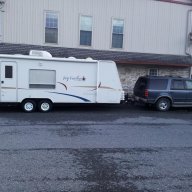
Trouble with towing. Need advice

Disclaimer: Links on this page pointing to Amazon, eBay and other sites may include affiliate code. If you click them and make a purchase, we may earn a small commission.

chuck s

Full Access Members
Joined
Dec 20, 2006
Posts
1,990
Reaction score
753
Location
Chesterfield, VA (that's south of Richmond, y'all)
That's a common misconception (sounds so kinder than "flat wrong). :)

Level is a symptom of proper weight distribution but just 'cuz it's level doesn't mean it's right.

Both suspensions must compress equally on the tow vehicle. That's the goal -- weight distribution not leveling. Makes no difference if the truck and trailer are level if the suspension on the truck isn't taking the weight. Get the truck right, then make the trailer level by adjusting the ball height. Since this will probably change other settings do it again and fine tune it. I've never seen it done right in less than a couple of hours.

-- Chuck
 

Tim Fuller

Full Access Members
Joined
Nov 29, 2017
Posts
53
Reaction score
26
Location
Upstate NY
We made a similar switch last year. 1500lb pop up to a 6100lb hybrid TT. Tongue weight going from about 150 to about 610 lbs produced a noticeable bounce for sure. I'm inclined to say it's normal, just different. Definitely check actual numbers and adjust if needed though
 

cekkk

Full Access Members
Joined
Aug 31, 2011
Posts
177
Reaction score
47
Location
SoCal
Bouncy, as in front axle? Measure from ground to top of front wheel well both unhitched and with trailer attached. I like measurement to be within a quarter inch of unhitched.

We towed 5000 pounds with an '04 regular length Expedition several hundred miles several times, and it had similar miles in it..
 

CaptOchs

Full Access Members
Joined
Jan 27, 2018
Posts
143
Reaction score
50
Location
Rochester NY
Your bars need likely need adjusting. My old bars were chain link and if it was off by one link that was enough to make it bouncy and add sway. Your RV service ctr should have hooked you up letting you take possession of the trailer. If they didn't do it right you ought to take it back.

Where were you driving? Expressway? Last year I had terrible bouncing when I hit this concrete section of the expressway. I swore I lost a bracket or bar so I pulled over. Everything was tight so I continued on. It went away when the road went back to asphalt. I looked it up when I got home and it was some kind of harmonic oscillation effect due to the concrete.
 

2016 Expy EL

Member
Joined
May 3, 2017
Posts
5
Reaction score
1
Location
Az
Hello there everyone. We recently upgraded from a pop up camper to a travel trailer in the late fall. Today I was able to take it on the road again and the drive was a bit unpleasant. I can’t really complain about power or sway with the trailer but there was something i did not like. The ride felt very bouncy, so I maxed out the psi on the tires and it did help but there is still too much bounce. I suspect worn out shocks. Any ideas?
 

2016 Expy EL

Member
Joined
May 3, 2017
Posts
5
Reaction score
1
Location
Az
Hello there everyone. We recently upgraded from a pop up camper to a travel trailer in the late fall. Today I was able to take it on the road again and the drive was a bit unpleasant. I can’t really complain about power or sway with the trailer but there was something i did not like. The ride felt very bouncy, so I maxed out the psi on the tires and it did help but there is still too much bounce. I suspect worn out shocks. Any ideas?
 

theoldwizard1

Full Access Members
Joined
Jul 29, 2013
Posts
320
Reaction score
81
Location
SE MI
What kind of tires do you have on your Expedition ? Some came with "P" rated tires (passenger car). When you buy new tires, switch to "LT" (light truck).
 

2016 Expy EL

Member
Joined
May 3, 2017
Posts
5
Reaction score
1
Location
Az
E rated tires 10 ply would give you a better more stable ride also the Mechanical Leveling Shocks the offered in the Limited and Platinum Expeditions would help.
 

Fordalways

Full Access Members
Joined
May 10, 2010
Posts
61
Reaction score
28
Location
North Central Texas
I have to assume the dealer set up your hitch with an empty trailer. They should have demonstrated to you how to make the adjustments, but there are likely YouTube videos on this. Once you start packing, it is amazing how easy it is to toss in a 1,000 pounds or more in it. Weight distribution makes a difference. A travel trailer should present 10-15% of the gross weight on the ball. This is necessary for stability. Without this weight on the front end the trailer might seesaw on its axles possibly contributing to the bounce you’re feeling. Without scale weights it’s just a guessing game.

Start as others suggested by parking on a flat surface and switch off the auto leveling if you have it. Measure the height of your front and rear wheel wells then lower the coupler and lift the jack allowing the full weight to rest on the ball noting how much the rear square and how much the front might rise. Attach you spring bars using the jack to assist if necessary, then lift the jack again. If properly adjusted, the front and rear measurements should show a roughly equal drop from the initial measurements; a little more on the rear is acceptable. Once you have this right, adjust the ball height to get the trailer level front to rear. You may or may not have to readjust your spring bars. The Expy and trailer will look reasonably level once you step back and look at it. Once all is set, you can now switch your auto leveling back on.

When you go to the scales, go with the trailer packed as you would for a road trip, junk in the trunk and your passengers, full tank of gas, etc. Consider your travel: If you only go to RV parks with full hookups, you may routinely travel with relatively empty holding and fw tanks. If boondocking, you may go with full fw and return with full holding. Just consider that you may routinely be traveling with some water in the tanks.

When you get weighed, you will get a printout showing the individual weights for your front, rear and trailer axles and a total. You can typically get reweighs within 24 hours for a buck or 2. You’ll want to pull out of the way, unhitch and get just the Expy weighed (with same passengers). You now have real numbers to work with. You can verify that the GAWR for the front, rear and trailer aren’t exceeded nor the GCVWR. And you can see how much is on your front and rear axles with and without the trailer.

For math simplicity let’s assume your 6800 lb trailer is loaded with 1200 lbs of gear, groceries, water, etc. and now weighs 8000 lbs and has a tongue weight of 900 lbs (11% TW). The WD hitch should distribute 300 lbs each to the front, rear and trailer axles. If you end up with 250 on the front and 350 on the rear, that’s not necessarily bad as long as you’re not overloading the rear and your low beams aren’t scanning the trees.

If you find that the weight distribution is still way out, you may need to refine the adjustments and go over the scales once more. Once you’ve got this set, you shouldn’t have to do it again until you trade the Expy or the trailer or for some reason change out the hitch.

As previously suggested, replacing stock P-metric tires with LT may be beneficial also.

Concrete expressways can be problematic and most noticeable with a trailer.

http://www.thedieselstop.com/forums/f32/freeway-hop-42513/

There are numerous factors that determine whether it is a soft porposeing motion or a teeth jarring event. Freeway hop is a well known phenomena and opens lots of discussion about speed, wheelbase, trailer length, suspension mods, etc. in over 30 years of dealing with this, the only thing that has softened, but not eliminated it is an AirSafe hitch. Getting your tongue weight right for your trailer and properly adjusting your WD hitch is the most you can do.

 

SailorKane

Member
Joined
Dec 5, 2013
Posts
14
Reaction score
0
Location
Florida
I did the same thing some time ago, at about the same mileage. I had a 24' TT, so your 29 is probably at the max you could tow. I had Different brand WDH (Reese, IMO the best WDH on the market). Went to a scale, weighed the truck alone first. Then weighed each axle of the truck and tow without the WDH doing its weight distributing. Then set it the WDH up and weighed it again. It was better, but still not right. I adjusted the hitch, increasing the tension, until it was right. I suggest you do the same. Sounds like you may have too much weight on the tongue, increasing the pressure on your back tires and suspension, and the WDH not doing enough. But you will know once you weigh it. Cat scales at a local Loves or Flying J is like $10. Whole process is a couple hours. Be sensitive to trucks needing to weigh during the process.
 

MrTommy

Well-Known Member
Joined
Nov 30, 2017
Posts
71
Reaction score
34
Location
Carson City, NV
Cat scales at a local Loves or Flying J is like $10. Whole process is a couple hours. Be sensitive to trucks needing to weigh during the process.

Agree. As a retired trucker I can attest to getting a bit 'upset' at RV'ers taking what I thought was too much time fooling around on the scale while I needed to weight before I could even start my trip.
 

Fordalways

Full Access Members
Joined
May 10, 2010
Posts
61
Reaction score
28
Location
North Central Texas
Agree. As a retired trucker I can attest to getting a bit 'upset' at RV'ers taking what I thought was too much time fooling around on the scale while I needed to weight before I could even start my trip.

Point well taken. Those folks get paid for driving, not waiting; and I had also suggested in my earlier post to get weighed and move to a spot away from the trucks. Everything we buy it handled by a trucker at some point.

The call button and intercom is usually higher than I can reach from an Expy seat, so I send the wife in with her cell phone before I pull onto the scales and we communicate with the scale operator that way and that makes it easy to pull on, get confirmation and pull off and get out of the way. I've gone mid-afternoon when the scales aren't busy. Only if no one is in line when you get your rig weight, disconnect the spring bars and get a 2nd weight while on the scales before going back around with the solo Expy. Subtracting the solo weight from the F/R axle weights with the spring bars disconnected should give you the tongue weight. The TW plus the trailer axle reading without the spring bars will be your GVW for the trailer. Then you can determine if your TW is 10-15% of your trailer GVW. If not, you will need to figure out how to move the heavier stuff you store in your trailer fore or aft accordingly. Your spouse in the scale office won't significantly alter your scale weights. But it would be good if you moved to the driver's position (stand by the driver's door) when getting the unsprung weight so that your position doesn't color the tongue weight calculations. These scales typically have a 20 lb resolution. That is, the scale readings increment in 20s. Assuming you weigh 200, it makes a difference on which scale section you're standing on.

Once you get all this dialed in, if you still experience a lot of bounce other than concrete highways, shocks may be the next thing to look at.
 
OP
OP
Quique309

Quique309

Active Member
Joined
Sep 1, 2015
Posts
25
Reaction score
3
Location
Illinois
Hello everyone. I was finally able to take it to the cat scale. I did measure from the ground to the top of the wheel wells and I realized that my Expedition is a little squatted before having any weight on it. The measurements for the Expedition empty are Front Driver: 36 1/8”. Front Pass. 36 1/4”. Rear Driver: 35 3/4”. Rear Pass: 35 7/8”.
Then I hooked up the camper with Only the hitchball (no weight distribution) and my measurements were these. FD: 36 7/8”. FP: 36 7/8”. RD: 33 7/8”. RP: 34 1/8”.
Then I hooked it up with the weight distribution and these were the results. FD: 36 1/4”. FP: 36 1/2”. RD: 35” RP: 34 3/4”.
At the scale the weights were as following. Steer axle: 3100. Drive axle: 4020. Trailer axles: 6400. For a Gross Combined Weight of 13,520. The Expedition weight axles together were 7120. Then I weighed the Expedition alone and the Front axle: 3160 and the Rear Axle was 3260 for a total of 6420. From my understanding there needs to be more weight distributed to the front axle on the Expedition. Judging by the rear shocks being lower than the front I would assume the the shocks are not good right? Sorry for taking so long to get all the information.
 

chuck s

Full Access Members
Joined
Dec 20, 2006
Posts
1,990
Reaction score
753
Location
Chesterfield, VA (that's south of Richmond, y'all)
You want both suspensions to compress equally. Not sure what FD etc mean in your message. All ya need is to note the amount of compression and since you can't vary it side to side just measure the fender lip height at the front and real loaded and unloaded. If one depresses 1/4" and the other 1" you need to transfer more weight to the 1/4" measured axle.

I'd avoid any WDH using chain links. I've run the same Equalizer (brand) WDH on my former '02 Explorer and '07 Expedition and now on my '17 Expedition. Just takes a coat of paint every couple of years.

Email me and I'll send photos of how it's setup. This will put you very close if not right on as my Roo 23SS hybrid weighs about 6000 pounds.

-- Chuck
 

Bedrck47

Full Access Members
Joined
Jul 4, 2014
Posts
5,639
Reaction score
659
Location
Elizebethtown, PA
Chuck I think FD means Front Drivers side and FP is Front Passenger side R is Rear D&P same as the front D&P
 
OP
OP
Quique309

Quique309

Active Member
Joined
Sep 1, 2015
Posts
25
Reaction score
3
Location
Illinois
Well anfter having the Expedition inspected, I was told one of the rear shocks was leaking and that the rest were worn out. I will be installing Rancho quicklifts first then adjusting the bars to to distribute more weight to the front axle. I will let you guys know how that goes.
 
Top