2010-->2008 seat swap

Disclaimer: Links on this page pointing to Amazon, eBay and other sites may include affiliate code. If you click them and make a purchase, we may earn a small commission.

Adieu

Full Access Members
Joined
Dec 22, 2016
Posts
3,717
Reaction score
798
Location
SoCal
Look at the pic of the white connector. I spliced a red wire into the green wire on the white connector to give it power.

Red spliced to where though?

Seems there is a more elegant way than trailing a wire from the cigarette lighter socket, Im guessing?


Schematic reads plain enough....unfortunately it is NOT a diagram of the connector pinouts, just a circuit....
 
OP
OP
E

ebasista

Member
Joined
Jun 16, 2016
Posts
19
Reaction score
1
Location
Bowling Green KY
I ran a separate wire for power since I also installed a center console

The ********* connector that your seat plugs into the exped is C311 pin 16 is Grey/Red (it is not on all connectors) and has power as well according to the schematic.

I find it funny that you are asking for help and when someone tries you act like a dick
 

10Limited EL

Member
Joined
Dec 12, 2017
Posts
5
Reaction score
0
Location
Tennessee
What about a swapped for a 2007 into a 2010....mine are worn out and thought about just replacing them all together... Seat for seat just different year model
 

star-art

Full Access Members
Joined
Aug 23, 2010
Posts
539
Reaction score
156
Location
Pacific Northwest
2010 heated/cooled seats are totally different than earlier models. Actually, I believe this started in 2009. Also, you can't retrofit memory seats into a truck that doesn't already have them (it may be theoretically possible, but I've yet to see anyone actually do it). As for the seats themselves, they should be the same -- same track design, same bolt pattern, etc. But, the wiring may be totally different.

Important things to note:

1) The passenger seat has an OCS computer. You should keep this intact and transfer it (in its entirety, including the sensor pad that covers the bottom of the seat) over to your new seat. In fact, for safety you should keep your existing passenger seat wiring harness and transfer it to the new seat. While the new seat may have the same OCS, if there are any differences or if it malfunctions for any reason your passenger airbag may fail to deploy in an accident.

2) Airbag connectors should be the same. Make sure the airbags are properly connected during installation and the airbag warning light stays OFF.

3) If your truck *doesn't* have memory seats and the new driver's seat comes with memory, keep your existing driver's seat wire harness and seat motors.

4) If your truck has manual recliners and the new seats have power recliners, you'll need to modify your existing seat wire harness for the power recline and use the switch and plastic trim panel that comes with the new power seat.

5) If your truck doesn't have heated/cooled seats and the new seats are heated/cooled, leave all the wiring and components for that system disconnected. It won't work in your truck because it's controlled by a computer module that has to be initialized and connected to the vehicle network in order to function. I'm not aware of anyone who has ever gotten this to work as a retrofit.

Also, if your 2010 has heated/cooled seats and the 2007 donor truck also had heated/cooled seats, the older style is not compatible and those components won't swap over. Starting in 2009 they went with a Thermo Electric Device (TED) that handles both heat and cool functions but requires computer control. Earlier models merely circulated air via fans for cooling. You would need to keep the seat foam, TED unit, and wire harness of your 2010.
 
Last edited:

JExpedition07

That One Member
Joined
Mar 30, 2017
Posts
6,530
Reaction score
3,140
Location
New York
2010 heated/cooled seats are totally different than earlier models. Actually, I believe this started in 2009. Also, you can't retrofit memory seats into a truck that doesn't already have them (it may be theoretically possible, but I've yet to see anyone actually do it). As for the seats themselves, they should be the same -- same track design, same bolt pattern, etc. But, the wiring may be totally different.

Important things to note:

1) The passenger seat has an OCS computer. You should keep this intact and transfer it (in its entirety, including the sensor pad that covers the bottom of the seat) over to your new seat. In fact, for safety you should keep your existing passenger seat wiring harness and transfer it to the new seat. While the new seat may have the same OCS, if there are any differences or if it malfunctions for any reason your passenger airbag may fail to deploy in an accident.

2) Airbag connectors should be the same. Make sure the airbags are properly connected during installation and the airbag warning light stays OFF.

3) If your truck *doesn't* have memory seats and the new driver's seat comes with memory, keep your existing driver's seat wire harness and seat motors.

4) If your truck has manual recliners and the new seats have power recliners, you'll need to modify your existing seat wire harness for the power recline and use the switch and plastic trim panel that comes with the new power seat.

5) If your truck doesn't have heated/cooled seats and the new seats are heated/cooled, leave all the wiring and components for that system disconnected. It won't work in your truck because it's controlled by a computer module that has to be initialized and connected to the vehicle network in order to function. I'm not aware of anyone who has ever gotten this to work as a retrofit.

Also, if your 2007 has heated/cooled seats and the 2010 donor truck also had heated/cooled seats, the newer style is not compatible and those components won't swap over. Starting in 2009 they went with a Thermo Electric Device (TED) that handles both heat and cool functions but requires computer control. Earlier models merely circulated air via fans for cooling.

Sounds like he has a 2010 and is looking at a 2007 interior in better shape to put in his 2010 by his username.
 

Adieu

Full Access Members
Joined
Dec 22, 2016
Posts
3,717
Reaction score
798
Location
SoCal
2010 heated/cooled seats are totally different than earlier models. Actually, I believe this started in 2009. Also, you can't retrofit memory seats into a truck that doesn't already have them (it may be theoretically possible, but I've yet to see anyone actually do it). As for the seats themselves, they should be the same -- same track design, same bolt pattern, etc. But, the wiring may be totally different.

Important things to note:

1) The passenger seat has an OCS computer. You should keep this intact and transfer it (in its entirety, including the sensor pad that covers the bottom of the seat) over to your new seat. In fact, for safety you should keep your existing passenger seat wiring harness and transfer it to the new seat. While the new seat may have the same OCS, if there are any differences or if it malfunctions for any reason your passenger airbag may fail to deploy in an accident.

2) Airbag connectors should be the same. Make sure the airbags are properly connected during installation and the airbag warning light stays OFF.

3) If your truck *doesn't* have memory seats and the new driver's seat comes with memory, keep your existing driver's seat wire harness and seat motors.

4) If your truck has manual recliners and the new seats have power recliners, you'll need to modify your existing seat wire harness for the power recline and use the switch and plastic trim panel that comes with the new power seat.

5) If your truck doesn't have heated/cooled seats and the new seats are heated/cooled, leave all the wiring and components for that system disconnected. It won't work in your truck because it's controlled by a computer module that has to be initialized and connected to the vehicle network in order to function. I'm not aware of anyone who has ever gotten this to work as a retrofit.

Also, if your 2010 has heated/cooled seats and the 2007 donor truck also had heated/cooled seats, the older style is not compatible and those components won't swap over. Starting in 2009 they went with a Thermo Electric Device (TED) that handles both heat and cool functions but requires computer control. Earlier models merely circulated air via fans for cooling. You would need to keep the seat foam, TED unit, and wire harness of your 2010.

Memory modules can be wired out by connecting buttons directly to motors


I did that and it even worked for a while.... shook loose a ground or something somewhere though so currently theyre stuck again
 

star-art

Full Access Members
Joined
Aug 23, 2010
Posts
539
Reaction score
156
Location
Pacific Northwest
Yes, that works as well. Memory seats have "encoders" on each motor that input to the Driver's Seat Module (DSM). The seat switch also inputs to the DSM and the motors are then directly controlled by the DSM. You can "run a bypass" by connecting the seat switch directly to the motors while leaving the encoders disconnected. This requires some careful study and a good understanding of the wiring diagrams.
 

10Limited EL

Member
Joined
Dec 12, 2017
Posts
5
Reaction score
0
Location
Tennessee
Ok great info but didn't think of all the technical wiring configuration.i figured since it was a power, heated, cooled, memory that the year model didn't matter as long as it was the same type of seat. So my question is there a year range that would be a simple swap seat for seat or just a 10 model.

Thnx
 

star-art

Full Access Members
Joined
Aug 23, 2010
Posts
539
Reaction score
156
Location
Pacific Northwest
I'm guessing that your 2010 EL Limited came equipped with 10-way power, heated and cooled seats with memory function as standard equipment. Any 2009-2017 Expedition, Expedition EL, Navigator, or Navigator L with 10-way power, heated and cooled seats with memory function should swap into your truck. From 2009-2014, only Limited and King Ranch Expeditions had these options (they were standard on Navigator). Starting in 2015, however, even some XLT trucks came with these seats. Also, a new top-of-the-line Platinum model appeared and it has these seats as standard equipment.

Keep in mind, to avoid any programming issues you should probably retain your existing DSM (under the driver's seat) and Climate Control Seat Module (CCSM, under the passenger seat). These modules are programmed specifically for your truck. Also, remember what I said about retaining your existing OCS module for the passenger seat. And, of course, the fact you have side impact airbags mounted in the front seats. All the wiring for these systems is safety critical.

Even though it seems like a lot of trouble, the safest route for your passenger seat might be to take it out, remove the seat back, take off the seat covers, remove the seat back foam, but keep the seat bottom foam (unless it's shot) and then swap over only the seat back foam and seat covers from the new passenger seat. This will avoid altering any of your existing wiring and airbag safety systems.

 

Adieu

Full Access Members
Joined
Dec 22, 2016
Posts
3,717
Reaction score
798
Location
SoCal
Ok great info but didn't think of all the technical wiring configuration.i figured since it was a power, heated, cooled, memory that the year model didn't matter as long as it was the same type of seat. So my question is there a year range that would be a simple swap seat for seat or just a 10 model.

Thnx

You could also just swap the leather
 

star-art

Full Access Members
Joined
Aug 23, 2010
Posts
539
Reaction score
156
Location
Pacific Northwest
That's really the best option in order to maintain the safety systems on your truck. It's actually more work, believe it or not, because you have to take both sets of seats apart. There are airbags to deal with, buried inside the foam, and an OCS system in the passenger seat. Caution is required when working around the airbags (you need to "de-power" the SRS system). Plus, hog rings can be a royal PITA. It can be very helpful if you have an assistant to make the job go more smoothly.

If you also need to swap seat foam because yours is shot, feel free to swap the foam pads on the driver's side. On the passenger seat, because of the OCS system it's best to leave the bottom foam alone. (You can swap the seat back foam no problem.) If you need to also swap the passenger seat bottom foam pad, you must very carefully deal with the OCS in order to make sure it will still function properly.
 

Adieu

Full Access Members
Joined
Dec 22, 2016
Posts
3,717
Reaction score
798
Location
SoCal
That's really the best option in order to maintain the safety systems on your truck. It's actually more work, believe it or not, because you have to take both sets of seats apart. There are airbags to deal with, buried inside the foam, and an OCS system in the passenger seat. Caution is required when working around the airbags (you need to "de-power" the SRS system). Plus, hog rings can be a royal PITA. It can be very helpful if you have an assistant to make the job go more smoothly.

If you also need to swap seat foam because yours is shot, feel free to swap the foam pads on the driver's side. On the passenger seat, because of the OCS system it's best to leave the bottom foam alone. (You can swap the seat back foam no problem.) If you need to also swap the passenger seat bottom foam pad, you must very carefully deal with the OCS in order to make sure it will still function properly.

I have a new set of leather skins laying around but just cant seem to get over dreading the job and get to actually doing it...

How rough is it?
 

star-art

Full Access Members
Joined
Aug 23, 2010
Posts
539
Reaction score
156
Location
Pacific Northwest
To be honest, I haven't done it (yet) with these seats. Last year, however, I rebuilt a set of front seats from a Town Car. It was a LOT more work than previous seats I'd worked on because Ford fully integrated the wire harness into the seat frame and track.

My advice is to take it slow and don't try to get it all done in a day (or a weekend). Take lots of pictures as you go to document how it all goes together. Also, be VERY careful as many plastic parts snap together. These parts are often designed to snap in once and then never come out again. Plastic parts get brittle with age and they will often break rather than come apart. You'll need a special pry bar tool designed to remove door panels. This will help get at snap-in fasteners that hold the wire harness and other components to the frame.

Once you finally get access to remove the seat covers, you'll find they are held strongly to the foam with thick metal rings called "hog" rings. They mold heavy wires called "listing rods" into the seat foam. The covers attach to these with hog rings. Working with these things can be a PITA. Sometimes access can be a challenge. You'll need a special set of pliers designed for the job (you can order them online and they often come with new hog rings).

While taking the seat apart, wear gloves as there can be sharp edges that will cut your fingers (not to mention the pointed ends of the hog rings that can really bite!). It often takes a good bit of strength to get the seat covers off. It can also be a fight to get them back on because they need to be stretched to fit. It's very helpful to have an assistant to help you wrestle with it.

BTW, if you try to work with your 2nd Row seats, be aware there is a special procedure for getting them in and out of the truck. Refer to the Factory Service Manual for instructions. Failure to follow proper procedure can result in breakage of the seat frame or mechanism. The 2nd Row seat frames are NOT serviceable. If anything gets damaged, you have to replace the entire seat frame! I had to do this on my truck when I first got it as one seat was already broken. (Fortunately for me it was still under warranty at the time.)
 

Adieu

Full Access Members
Joined
Dec 22, 2016
Posts
3,717
Reaction score
798
Location
SoCal
To be honest, I haven't done it (yet) with these seats. Last year, however, I rebuilt a set of front seats from a Town Car. It was a LOT more work than previous seats I'd worked on because Ford fully integrated the wire harness into the seat frame and track.

My advice is to take it slow and don't try to get it all done in a day (or a weekend). Take lots of pictures as you go to document how it all goes together. Also, be VERY careful as many plastic parts snap together. These parts are often designed to snap in once and then never come out again. Plastic parts get brittle with age and they will often break rather than come apart. You'll need a special pry bar tool designed to remove door panels. This will help get at snap-in fasteners that hold the wire harness and other components to the frame.

Once you finally get access to remove the seat covers, you'll find they are held strongly to the foam with thick metal rings called "hog" rings. They mold heavy wires called "listing rods" into the seat foam. The covers attach to these with hog rings. Working with these things can be a PITA. Sometimes access can be a challenge. You'll need a special set of pliers designed for the job (you can order them online and they often come with new hog rings).

While taking the seat apart, wear gloves as there can be sharp edges that will cut your fingers (not to mention the pointed ends of the hog rings that can really bite!). It often takes a good bit of strength to get the seat covers off. It can also be a fight to get them back on because they need to be stretched to fit. It's very helpful to have an assistant to help you wrestle with it.

BTW, if you try to work with your 2nd Row seats, be aware there is a special procedure for getting them in and out of the truck. Refer to the Factory Service Manual for instructions. Failure to follow proper procedure can result in breakage of the seat frame or mechanism. The 2nd Row seat frames are NOT serviceable. If anything gets damaged, you have to replace the entire seat frame! I had to do this on my truck when I first got it as one seat was already broken. (Fortunately for me it was still under warranty at the time.)

2nd row, not third row?


Huh... i got two sets and they all seemed to work.... oh except maybe the middle seat, was that why it wouldnt fold? (Not sure might have just been doing it wrong, didnt stay in the truck long enough to find out)
 

star-art

Full Access Members
Joined
Aug 23, 2010
Posts
539
Reaction score
156
Location
Pacific Northwest
To be clear, I meant the 2nd row OUTBOARD seats require a special procedure to remove them from the truck without damage. There is a "shipping pin" that's supposed to be locked in place prior to removal. I will admit even the Factory Service Manual is not super clear on how that works exactly.

The 2nd row middle seat frame *is* serviceable and can be taken apart. The middle seat in my truck, however, doesn't want to fold down. After wrestling with it, I discovered I have to get in front of it, press down and back on the front of the lower cushion with my knee and then pull on the release lever. If I don't do that, the lever moves freely but the seat will not budge.
 

Plati

Well-Known Member
Joined
May 4, 2016
Posts
2,781
Reaction score
1,367
Location
.
To be clear, I meant the 2nd row OUTBOARD seats require a special procedure to remove them from the truck without damage. There is a "shipping pin" that's supposed to be locked in place prior to removal. I will admit even the Factory Service Manual is not super clear on how that works exactly.....
Question about this. I removed the entire second row from my 2014 EL (as well as 3rd row 2/3 seat). Then I customized the interior for camping. Someday if I sell the truck will have to reinstall. It was a bit of a puzzle getting the 2nd row outboard seats out (until I figured out the trick) and took notes for reinstall. The following are my (not very good) notes. Is this what you are referring to above? Thanks. Would hate to "damage" especially if trying to sell. Anything you can add to this may save me a lot of hassle & expense.

Notes: Removed pass side first, usual method. Front bolts first … but had to stick a screwdriver in “latch” thing in back (white plastic) to get to unlatch. Then seat popped up & out. Going back in I would place & “latch" rear part first then bolt down front.
 
Last edited:

star-art

Full Access Members
Joined
Aug 23, 2010
Posts
539
Reaction score
156
Location
Pacific Northwest
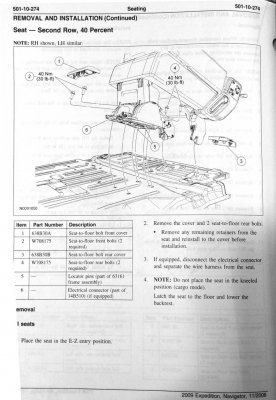
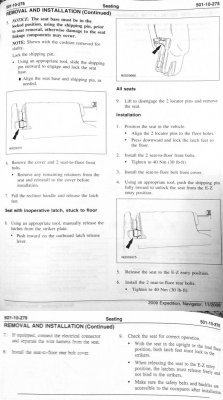
Here are the instructions from the FSM for 2009 vehicles. I would guess these apply to all 2007-2014 models and likely also to 2015-17 vehicles as well:

2ndRowOtbSeatRemoval1.jpg

2ndRowOtbSeatRemoval2.jpg
 

star-art

Full Access Members
Joined
Aug 23, 2010
Posts
539
Reaction score
156
Location
Pacific Northwest
I can tell you that when I first got my 2009 I bought a set of seats from a Navigator hoping to swap them into my truck. At least one of the 2nd row seats had a loose/disconnected "connecting rod" attached to the rear feet. One of my 2nd row outboard seats was also broken in this manner when I bought the truck and it required replacing the entire seat frame under warranty. They had to remove the seat, then strip off the foam/seat covers and move them over to the new frame prior to reinstalling the seat. That sounds like a lot of work! It seemed ridiculous because the rod in question is attached at each end with a bolt, so you'd think you could just replace that. . .

When I was shopping for my truck, I almost made a deal on a 2010 that also had a broken 2nd row seat like this So, it would seem this is not that uncommon.
 
Last edited:
Top