Catch Can!

Disclaimer: Links on this page pointing to Amazon, eBay and other sites may include affiliate code. If you click them and make a purchase, we may earn a small commission.

OP
OP
LokiWolf

LokiWolf

Staff member
Moderator
Joined
Apr 2, 2016
Posts
3,971
Reaction score
2,837
Location
Richmond VA

Yes, UPR makes Catch cans. Theirs are dual. Not aware of a kit specifically for the Expy. Lines and mounting points are a little different than 150. A kit for an EB 2014 F150 would probably fit. But mount might need to be adjusted.

RXP makes a dual kit directly for the Expy. It is probably the best out there, and will catch everything, but it is $450, with many plastic parts. You can upgrade, but it is even MORE then.

http://teamrxp.com/products/rx-dual-valve-catch-can-ford-expedition-2015-2016-2017-35-ecoboost

JLT is an excellent kit for the money, just needs to be emptied regularly.


Sent from my iPhone using Tapatalk Pro
 

Broncoholic

Full Access Members
Joined
Jan 15, 2019
Posts
178
Reaction score
122
Location
Space Coast, FL
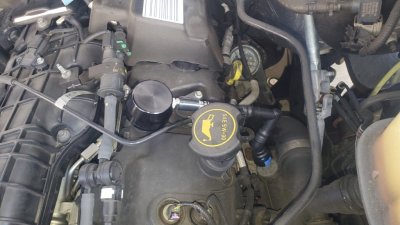
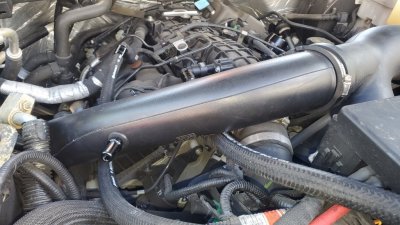
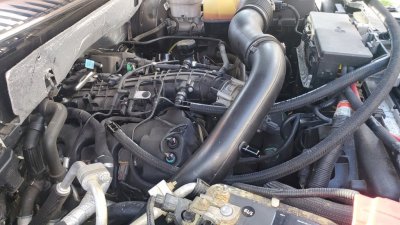
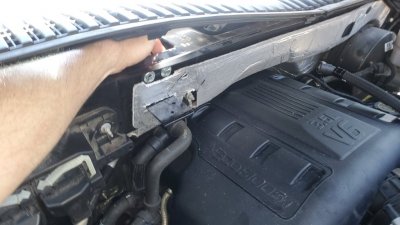
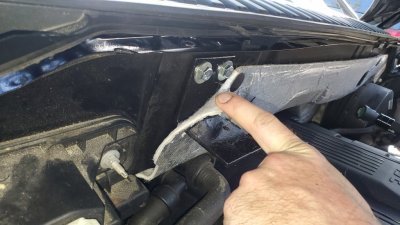
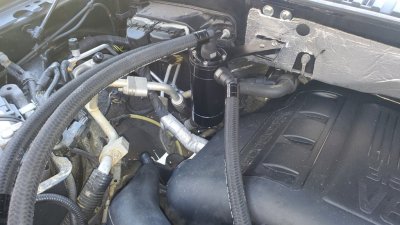
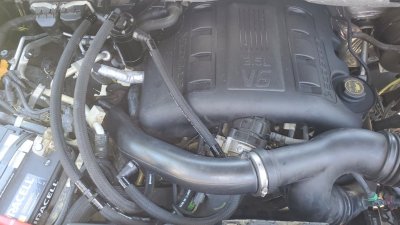
Complete. It took about 5 hours start to finish, primarily because I had to figure out where to mount the can and then fab a bracket. The instructions for the F-150 say to mount it at the driver's side radiator mount/fan shroud, that wasn't happening on the Expedition. I fab'd a bracket from some 3"×3"×1/4" steel angle and mounted it to the firewall with 5/16" fasteners. A bit overkill probably, but it's what I had in the garage along with some primer and black gloss. I was able to get access through the cowl intake to fasten with lock washers and nuts.

Also, the instruction say to drill the hole for the WOT line 21.5" down the inlet tube. That measurement wasn't consistent with the position in their photo and I would've had a helluva time getting the line on, so I placed it about 13.5".

Enjoy the pics and let me know if there's any questions.
20200315_110758.jpg 20200315_110948.jpg 20200315_111014.jpg 20200315_123432.jpg 20200315_123607.jpg
 

1970Maverick

Full Access Members
Joined
Aug 11, 2019
Posts
254
Reaction score
114
Location
orlando, fl

Broncoholic

Full Access Members
Joined
Jan 15, 2019
Posts
178
Reaction score
122
Location
Space Coast, FL
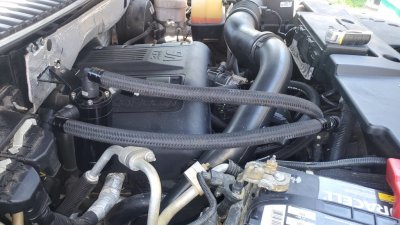
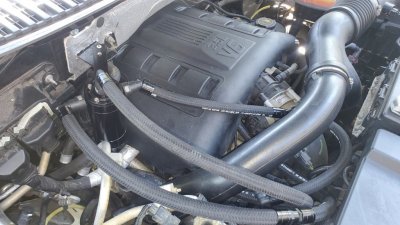
The first post in the thread below has a good description of how the ECSS (electronic clean side separator) works. The ECSS is a stand alone unit that isn't connected to the catch can. It's in my first pic by the oil fill cap.
https://www.f150ecoboost.net/thread...y™-dual-valve-catch-can-with-upr-ecss™.76398/

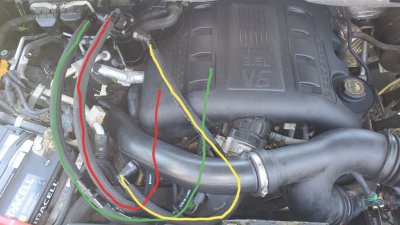
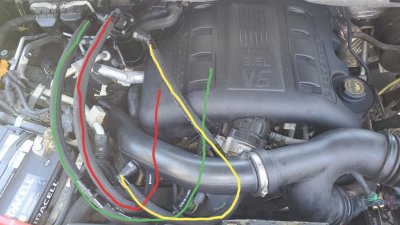
As for the hoses:
The red is the dirty hose and connects to the PCV.
The green provides vacuum from the intake during idle and cruise without boost.
The yellow provides vacuum/venting during boost/WOT.

20200315_215838.jpg
 

Broncoholic

Full Access Members
Joined
Jan 15, 2019
Posts
178
Reaction score
122
Location
Space Coast, FL
I'm sure it's placebo, but we did about 100 miles running around this afternoon and I swear it was idling smoother. Again, I'm sure it's placebo, but I'll continue to pay attention.
 

Plati

Well-Known Member
Joined
May 4, 2016
Posts
2,781
Reaction score
1,367
Location
.
Whenever I wash my Expy, the engine runs a LOT better.

I bought new cleats in High School. Greatly improved my baseball skills, run faster could throw farther hit better!
 

1970Maverick

Full Access Members
Joined
Aug 11, 2019
Posts
254
Reaction score
114
Location
orlando, fl
Now that I'm a little more educated can you all tell me what is inside the specific brand/model of the catch can you have? is there a baffle, filter, strainer or just an empty can?
 

Boostedbus

Full Access Members
Joined
Mar 1, 2018
Posts
747
Reaction score
465
Location
Maryland
Now that I'm a little more educated can you all tell me what is inside the specific brand/model of the catch can you have? is there a baffle, filter, strainer or just an empty can?
My Team RXP can is supposed to be filled with some sort of media. This can is a sealed can with only a petcock drain in the bottom. I assume it’s some sort of metal shavings like steel wool or something because when I got it I shook it and nothing rattled. Whatever it is it sure does a good job of separating the oil from the water. I’ve never gotten any water mix with oil when I drain it. Just straight oil and maybe some gas diluted oil.
 

Broncoholic

Full Access Members
Joined
Jan 15, 2019
Posts
178
Reaction score
122
Location
Space Coast, FL
Now that I'm a little more educated can you all tell me what is inside the specific brand/model of the catch can you have? is there a baffle, filter, strainer or just an empty can?
I don't know. The UPR website says it's a "Multi-Stage Multi-Chamber internal design". I don't plan on opening it.

I bought a hose barb and hose today to add to the drain **** this weekend and do the first drain. After the first 100 mile trip, it's seen little driving due to COVID-19. I still think the idle is smoother.
 

Greg Coleman

Active Member
Joined
May 9, 2019
Posts
37
Reaction score
16
Location
Southeast Michigan
Going through this train wreck of a thread has been pretty excruciating. There is a lot of bad information here, and enough good to sort of make the read worth it. For some anyway. Couple of points:

- The PCV system has a "dirty" side and a "clean" side. The dirty side pulls the vapors out of the crankcase and introduces them into the intake tract to be burned. The clean side allows clean air to be pulled into the crankcase to provide some flow through the system. Putting a catch can on the clean side doesn't really get you anything. NONE of that has ANYTHING to do with DI, Turbos, or VVT. Although, the engineering and design work of the PCV systems on ANY boosted engine is more complicated than an NA engine.

- The 7.3L Godzilla engine is intended to replace the 6.8L V10 and the 6.2L V8's. There is no point in having TWO completely different engines for the F250 to F750 range. 6.2 was "OK" for the Super Duty 250-350, and marginal for the 450-550 trucks. Up until 2015, that was the top of the line. When Ford went back into the Medium truck market, the 6.8 went into the 650 and 750. Not cost effective. The 7.3 replaces BOTH. It was all about COST while getting economies of scale. This is ONLY about available GAS engines. NOT the 6.7 diesel.

- For the record, I have a JLT kit on my '16, and a Saleen separator on my '88 Stang with a 331 stroker. It doesn't have Di, Eco, or Boost!!! I'm going to put one on my wife's '19 Stang GT in the next couple weeks. It doesn't go out in winter!

 

JExpedition07

That One Member
Joined
Mar 30, 2017
Posts
6,530
Reaction score
3,140
Location
New York
Going through this train wreck of a thread has been pretty excruciating. There is a lot of bad information here, and enough good to sort of make the read worth it. For some anyway. Couple of points:

- The PCV system has a "dirty" side and a "clean" side. The dirty side pulls the vapors out of the crankcase and introduces them into the intake tract to be burned. The clean side allows clean air to be pulled into the crankcase to provide some flow through the system. Putting a catch can on the clean side doesn't really get you anything. NONE of that has ANYTHING to do with DI, Turbos, or VVT. Although, the engineering and design work of the PCV systems on ANY boosted engine is more complicated than an NA engine.

- The 7.3L Godzilla engine is intended to replace the 6.8L V10 and the 6.2L V8's. There is no point in having TWO completely different engines for the F250 to F750 range. 6.2 was "OK" for the Super Duty 250-350, and marginal for the 450-550 trucks. Up until 2015, that was the top of the line. When Ford went back into the Medium truck market, the 6.8 went into the 650 and 750. Not cost effective. The 7.3 replaces BOTH. It was all about COST while getting economies of scale. This is ONLY about available GAS engines. NOT the 6.7 diesel.

- For the record, I have a JLT kit on my '16, and a Saleen separator on my '88 Stang with a 331 stroker. It doesn't have Di, Eco, or Boost!!! I'm going to put one on my wife's '19 Stang GT in the next couple weeks. It doesn't go out in winter!


Not totally correct. The 6.2L Boss engine isn’t going anywhere nor does the 7.3 replace it. The 7.3 Liter is the new premium gasoline option and the 6.2 is the standard engine.
 
Last edited:

1970Maverick

Full Access Members
Joined
Aug 11, 2019
Posts
254
Reaction score
114
Location
orlando, fl
Now that I‘m more educated (or confused) after reading this thread, I have more questions.

1) If the purpose of the catch can is to “slow" the flow of dirty air from the PCV to the intake, would it make sense to use a smaller ID hose between the can and intake to reduce the air volume so the dirty air has a longer time in the can to accumulate?

2) What happens to the crank case pressure when you’re on boost if there is no intake vacuum, will the crank case pressure force air into the intake or does the turbo pressure overcome the crank case pressure?

3) Has anyone ever measured the crank case pressure “off" and "on" boost?
 

Broncoholic

Full Access Members
Joined
Jan 15, 2019
Posts
178
Reaction score
122
Location
Space Coast, FL
Now that I‘m more educated (or confused) after reading this thread, I have more questions.

2) What happens to the crank case pressure when you’re on boost if there is no intake vacuum, will the crank case pressure force air into the intake or does the turbo pressure overcome the crank case pressure?
That's an advantage of the UPR dual valve. The yellow line in my pic allows crank case pressure (from red line) to vent to the intake tube while a 1-way check valve is closed in the green line under boost. Under idle/no-boost cruise, the green line supplies vacuum while a 1-way check valve in the yellow line is closed. 20200315_215838.jpg
 

1970Maverick

Full Access Members
Joined
Aug 11, 2019
Posts
254
Reaction score
114
Location
orlando, fl
Has anyone tried cleaning the intake valves by doing an injector cleaning fluid drip into the intake? A long time ago I had a 1978 porsche 944 and as part of the tune-up my mechanic would open the hood, hang a bottle of injector cleaner and allow it to drip into the intake while the car idled for 15-20 minutes. The porsche was NOT direct injection but the treatment was supposed to help clean the intake and port injectors nozzles .
Do you think something like this would help clean EB valves?
 

Boostedbus

Full Access Members
Joined
Mar 1, 2018
Posts
747
Reaction score
465
Location
Maryland
Now that I‘m more educated (or confused) after reading this thread, I have more questions.

1) If the purpose of the catch can is to “slow" the flow of dirty air from the PCV to the intake, would it make sense to use a smaller ID hose between the can and intake to reduce the air volume so the dirty air has a longer time in the can to accumulate?

2) What happens to the crank case pressure when you’re on boost if there is no intake vacuum, will the crank case pressure force air into the intake or does the turbo pressure overcome the crank case pressure?

3) Has anyone ever measured the crank case pressure “off" and "on" boost?
My Team RXP system not only taps into intake manifold vacuum but also has a hose that you tap into both turbo inlet pipes. The turbo inlet pipes provide the vacuum when the turbos spool up and pull air through them thus supplying vacuum under boost. That’s the biggest difference between my system and the JLT can which doesn’t provide vacuum under boost plus the JLT doesn’t separate the oil from the water.
 
Top