
For Those Who Don't Think a Catch Can is Needed on Gen 4 s...

Disclaimer: Links on this page pointing to Amazon, eBay and other sites may include affiliate code. If you click them and make a purchase, we may earn a small commission.

chaffdb

Well-Known Member
Joined
Feb 3, 2022
Posts
60
Reaction score
33
Location
Hattiesburg, MS
Our '22 has about 900 miles on it, and I am going to do the first oil change and install a catch can system this weekend at around 1000 miles on the odometer. I know it's not necessary, but I have run catch cans on other vehicles in the past and have read enough and seen enough, including in this thread, to believe in the benefit.

I have also read the JLT catches the majority of the stuff on the dirty side and they are the only one listed as fitting a '22. I decided to at least look into the dual side setups though and reached out to UPR and RXP to ask a few questions, including whether they knew if their setups would fit a '22 or if they had that in the works. RXP's voicemail requested contact by sending a message through their website. I did so on 9/19 or 9/20, but unfortunately, despite regularly checking my spam folder, I don't believe I ever received a response. UPR, however, took my call and said they had installed one of their "Plug n Play Dual Valve with CSCC" kits for a '21-22 F150 on a '22 Expedition. They advised it doesn't require drilling and could be returned to stock if ever desired. It wasn't cheap, is admittedly probably overkill, and may not be "as good" as a full upgraded RXP setup, but the time they spent on the phone answering my questions and the features presented convinced me to give them my business. They gave me a little price break, too, for what it's worth. It's got braided hose, billet hose ends, hose connectors that are similar to factory but with dual push buttons, and is fully serviceable. I didn't go with the Mega can based on their advice, but I did go with the "Pro Series" check valves, the drain line/valve for the can, and the one-way valve cover breather. UPR advised the latter wasn't necessary in my application but would provide a fail-safe in the case of excessive crank case pressure. I have no connection to UPR or anything against the other two. I'll take some photos and post after my install, especially if there are any issues. I realize this kit is not listed as fitting my ride, but they said they had done it and it worked no problem, so we'll see.
 
Last edited:

m3olsen

Full Access Members
Joined
Jun 8, 2018
Posts
263
Reaction score
94
Location
CNY
@chaffdb , this is the second time today I've come across a thread from you that I'm investigating doing myself. I will be very curious to hear how this goes for you. Thanks for posting.
 

LokiWolf

Staff member
Moderator
Joined
Apr 2, 2016
Posts
3,971
Reaction score
2,837
Location
Richmond VA
Let's correct a few things. Port injection does not solve the deposit issue, but it does decrease it. The port injectors are not spraying fuel all the time, like they are on an engine that just has port injectors. Is a catch can required on a new 2nd gen 3.5TT, nope, want to go that extra step to keeping your intake clean, then it is the way to go. It is a simple install, and a simple empty. I empty mine at every oil change, or before if I am under the hood for other reasons.
 

LokiWolf

Staff member
Moderator
Joined
Apr 2, 2016
Posts
3,971
Reaction score
2,837
Location
Richmond VA
IMO catch cans are not needed on Gen 4's and results using them could be misleading.
If your catch can is full what is the oil % that is the big number. Gas in the PVC gets reburned no issue for the engine.
In high climate areas the nature of the metal catch can will collect condensation. Without it condensation would be burned in the engine which is no big deal either. So just because there is gas in the catch can over a long period of time does not mean it prevented any sludge from going in the engine. Unless you can derive the exact oil content its impossible to know the value.
Also if it was a lot of oil in the PVC then these engines would be running low on oil every month.

Also what is the impact towards warranty and altering the emission systems. Some states its illegal to mod the emission system.
A few ounces of oil less in the oil pan won't show over a even an extended change interval on the stick, but a few ounces of oil deposited in the intake can create A LOT of deposits. Your oil can be easily changed, and is regularly, cleaning your intake on the other hand can be a pain, and possibly damaging if not done correctly.
 

LazSlate

Full Access Members
Joined
May 7, 2022
Posts
416
Reaction score
245
Location
Arizona
A few ounces of oil less in the oil pan won't show over a even an extended change interval on the stick, but a few ounces of oil deposited in the intake can create A LOT of deposits. Your oil can be easily changed, and is regularly, cleaning your intake on the other hand can be a pain, and possibly damaging if not done correctly.

IMO I do not think people will see any benefits in the short term. The intakes were usually never the issue it was always the valves which have all the high temps. Ford changed the injectors to clean these each cycle. Most people get cheap Catch Cans and only do the one side on the passenger so in reality its not really doing much at all. Just collecting 99% water and gas and a very tiny amount of oil. If one was to go down the catch can route it should be high quality tanks with baffles and installed on both sides. I am not against the catch can concept just most of the time its not really needed or the implementation is sub standard to do any good.
 

LokiWolf

Staff member
Moderator
Joined
Apr 2, 2016
Posts
3,971
Reaction score
2,837
Location
Richmond VA
IMO I do not think people will see any benefits in the short term. The intakes were usually never the issue it was always the valves which have all the high temps. Ford changed the injectors to clean these each cycle. Most people get cheap Catch Cans and only do the one side on the passenger so in reality its not really doing much at all. Just collecting 99% water and gas and a very tiny amount of oil. If one was to go down the catch can route it should be high quality tanks with baffles and installed on both sides. I am not against the catch can concept just most of the time its not really needed or the implementation is sub standard to do any good.
So, How many Ecoboosts have you had experience with and had a Catch Can on? I have put one on all of the ones in my signature.

Also, I put those "cheap" cans you speak of, J&L(JLT) to be specific. Dual setups are better, for sure. It has been well documented the majority is collected on one side. Want to catch it all, do a dual setup. Want to catch the majority for about a 1/4 of the price, do a good single setup like J&L.

Catch cans have NEVER been about the short term. Always been about the long term. All of my empties have definitely had oil in them. I would estimate out of the 2 ounces I get every time, half is oil. If you let it sit, it will separate.

In addition, when I said intake, I meant intake manifold not the air intake, my bad on not clarifying.
 
Last edited:

chaffdb

Well-Known Member
Joined
Feb 3, 2022
Posts
60
Reaction score
33
Location
Hattiesburg, MS
Catch cans have NEVER been about the short term. Always been about the long term. All of my empties have definitely had oil in them. I would estimate out of the 2 ounces I get every time, half is oil. If you let it sit, it will separate.
This is my thinking. As long as it's solid and reliable, we plan on keeping this vehicle long term and getting a lot of use out of it. I have had a tendency to keep vehicles too long on several occasions, and might this one if we still really like it as time goes by. This thread is making me consider doing an oil analysis of what comes out of my catch can down the road. I am a fan of getting an analysis of the motor oil every other oil change or every few changes at least to see how things are going. Again probably overkill, but such is my nature I guess. Might be worth the $30 just to see what all is in there. I'll post it here if I do, but I'm putting the cart ahead of the horse since it hasn't even been installed yet.

Going back to an older gen motor without the port injection I know, but my nephew has a '13 F150 4X4 with the Ecoboost that had just under 100k miles when he got it a couple years ago. It's never gotten great fuel mileage or had power that was all that impressive. After reading on here and elsewhere, I suggested he try some of the CRC GDI IVD Intake Valve and Turbo Cleaner that Loki recommended on here somewhere. He has ordered it and plans to try it soon. If it makes an improvement I think he'll be installing a JLT setup on it.
 

LokiWolf

Staff member
Moderator
Joined
Apr 2, 2016
Posts
3,971
Reaction score
2,837
Location
Richmond VA
This is my thinking. As long as it's solid and reliable, we plan on keeping this vehicle long term and getting a lot of use out of it. I have had a tendency to keep vehicles too long on several occasions, and might this one if we still really like it as time goes by. This thread is making me consider doing an oil analysis of what comes out of my catch can down the road. I am a fan of getting an analysis of the motor oil every other oil change or every few changes at least to see how things are going. Again probably overkill, but such is my nature I guess. Might be worth the $30 just to see what all is in there. I'll post it here if I do, but I'm putting the cart ahead of the horse since it hasn't even been installed yet.

Going back to an older gen motor without the port injection I know, but my nephew has a '13 F150 4X4 with the Ecoboost that had just under 100k miles when he got it a couple years ago. It's never gotten great fuel mileage or had power that was all that impressive. After reading on here and elsewhere, I suggested he try some of the CRC GDI IVD Intake Valve and Turbo Cleaner that Loki recommended on here somewhere. He has ordered it and plans to try it soon. If it makes an improvement I think he'll be installing a JLT setup on it.
It will definitely help. Have used it on several older Eco's with good results. All I can say is FOLLOW the instructions to the T. Also, if it is bad, doing it 2 times about 500 miles apart can help too. Good luck, and drop me a line if you have any questions. I don't get on here as much as I used to, but I see the direct messages quicker.
 

chaffdb

Well-Known Member
Joined
Feb 3, 2022
Posts
60
Reaction score
33
Location
Hattiesburg, MS
Ok, I said I was going to do the first oil change and install a catch can system last weekend on our '22, and I did....but the parts in my kit didn't match the directions. I said I would be honest, and here it is. UPR messed up. I emailed them Monday and sent some photos and questions. They complimented the photos and said they'd like to use them on their site with my permission, but they admitted they made a mistake and sent me the the Clean Side Separator (CSS) used in their '15-'21 Expedition kits instead of the Clean Side Catch Can (CSCC) that is part of their latest "Plug n Play Dual Valve" kit for '21-'22 F-150's and '22 Expeditions. They apologized for sending the wrong part and got a CSCC kit in the mail to me. It came in yesterday and I got it put on. First oil change was also done and I sent the oil out for analysis. I'll post that when it comes back. As for UPR, I'm impressed with their customer service. Everyone can and does make mistakes on occasion, and correcting them tells a lot about a company. No complaints here.

As for now, for anyone wanting to install a UPR kit on a '22, I hope this helps. This is my experience as a shade tree mechanic. I usually limit myself to fluid and filter changes, brakes and rotors, and installing aftermarket parts. This was not difficult at all, but more details on the ins and outs of that for me below. This is going to be pic heavy and in several separate posts.

Part 1:

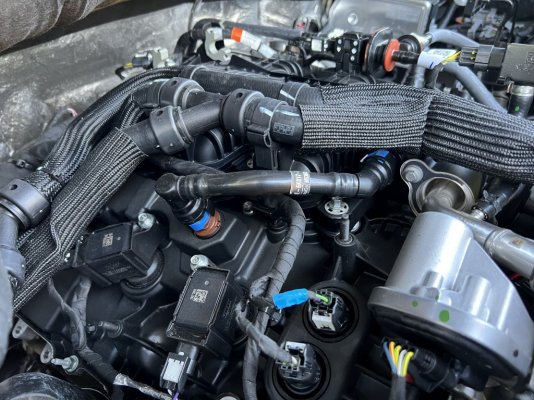
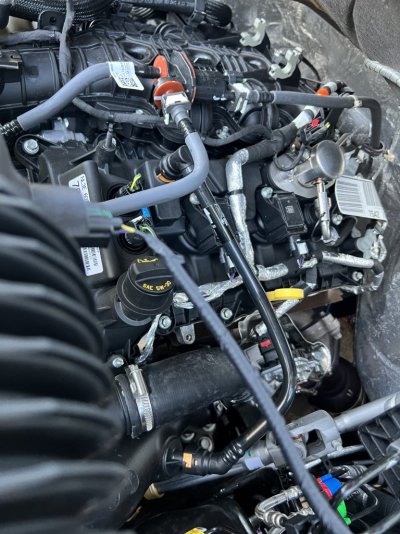
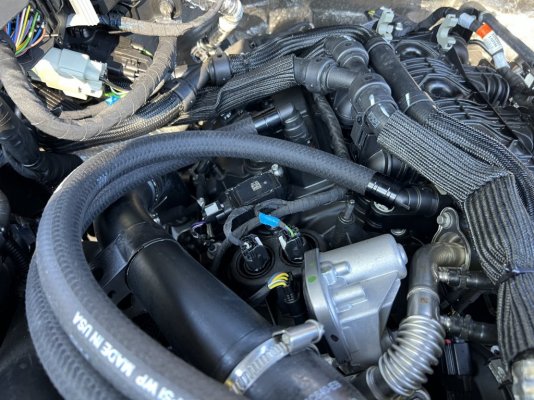
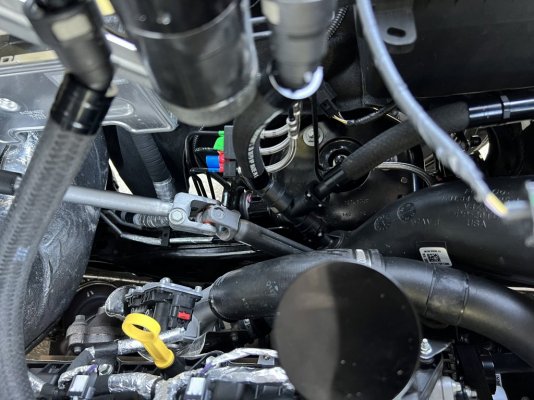
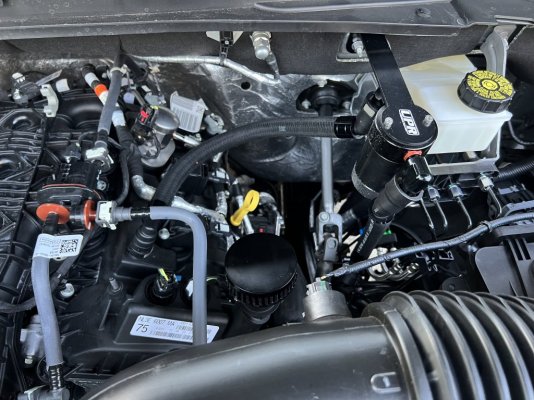
First, here are the two lines that will be removed/replaced. The short line with brown/blue release buttons on the connectors in the first photo is the passenger or "dirty" side PCV tube from engine to intake. In the second photo, the longer line in the center of the photo with similar shaped connectors but with orange instead of the blue/brown is the driver side "clean" CCV line going from engine to turbo intake.

Photo Oct 02, 7 24 44 AM.jpgPhoto Oct 02, 7 24 34 AM.jpg

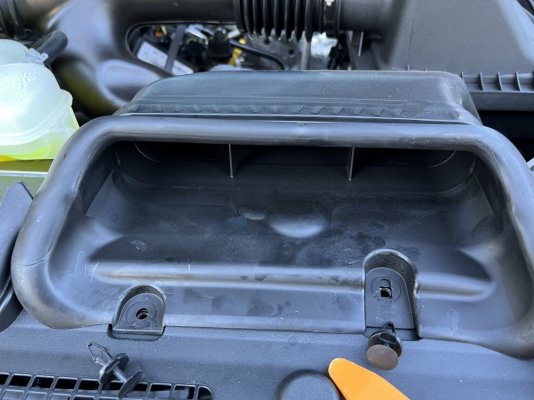
The first step is to remove the cold air intake. The two plastic connectors are pretty easy. A flat screwdriver would work, but I had a plastic trim removal tool (orange in photo) that worked well.
Photo Oct 02, 7 32 45 AM.jpg

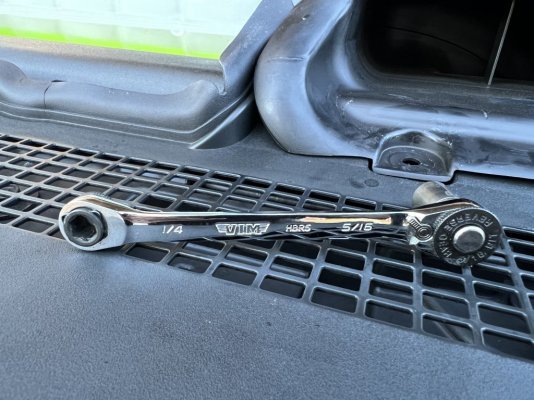
The single bolt looks easy, but space is somewhat limited. My hands aren't huge, but they are probably above average size, and I couldn't find my 1/4" ratchet for some reason. A 3/8" drive ratchet might work eventually but would have taken me forever. Maybe one with finer ratcheting clicks than mine might work better. Anyway, this little tool (VIM Tools HBR5), while not necessary, worked great. I picked it up a few years ago based on a recommendation on the ADVRider forum for a motorcycle tool kit, and it has come in handy on more than one occasion. It's a little expensive for what it is, but it seems well made.
Photo Oct 02, 7 38 32 AM.jpg
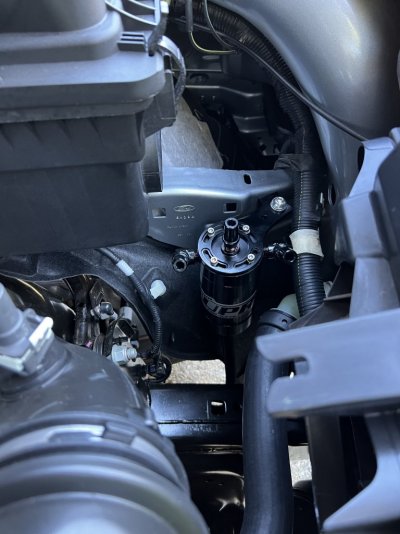
After removing the cold air intake, it's time to mount the larger catch can directly below where it was. UPR utilizes a hole already present. Tightening the nut with lock washer behind the bracket (bottom center of photo below, although nut and lock washer are not visible) is another place where space is at a premium. 1/4" ratchet would have come in handy, but I was able to get it done with a fairly coarse 3/8". This is the 3" can and not the 4" "Mega."

Photo Oct 02, 8 47 53 AM.jpg
 
Last edited:

chaffdb

Well-Known Member
Joined
Feb 3, 2022
Posts
60
Reaction score
33
Location
Hattiesburg, MS
Part 2:

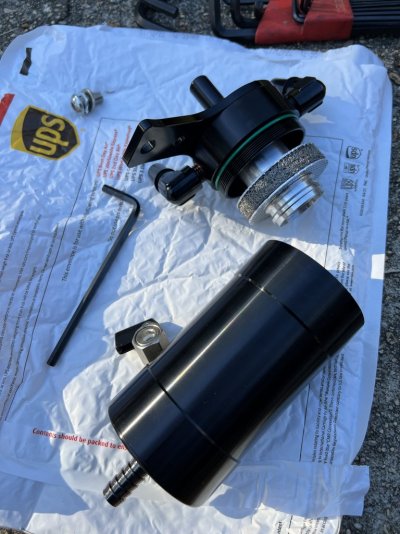
Here is what the inside of the can looks like, and another of it mounted. I went with the remote valve so it can be drained without opening the hood. Drain valve is zip tied to the frame behind the bumper.
Photo Oct 02, 8 36 15 AM.jpgPhoto Oct 02, 8 48 00 AM.jpg
Next you remove the factory PCV tube on passenger side from photo 1 above. This is easily done with the factory connectors, and you can put this part aside in case you ever want to go back to stock. The you route the two provided hoses to the Catch Can, paying attention to which one as the check valve, which way it is pointed, and which fittings you are connecting to. This part is all very easy, and if you were just doing the "dirty" side, you'd basically be done.
Photo Oct 02, 9 07 26 AM.jpg
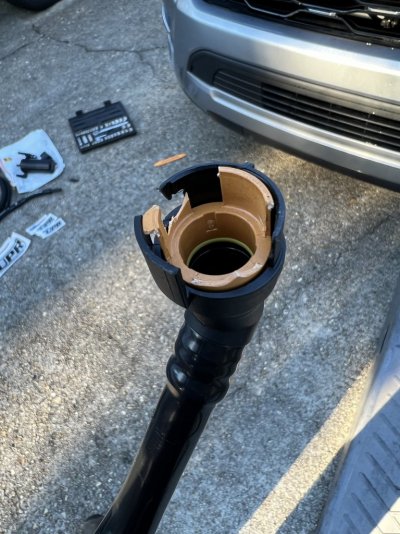
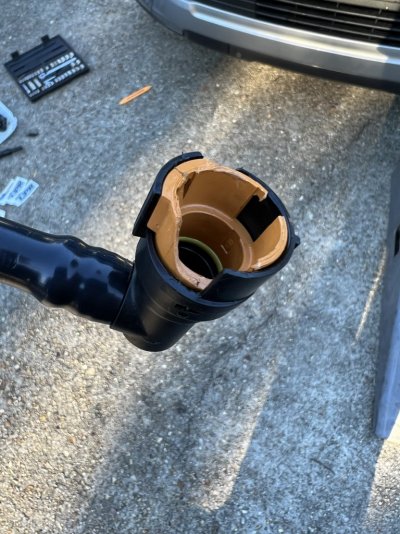
For the driver/clean/CCV side, Ford decided to use a different connector, the ones in orange in the second photo. According to UPR, there is no tool from Ford to remove this fitting. They suggest using a 90 degree pick or hook to remove it and admit you will likely break the connectors when removing. They provide photos and dedicated several pages to this step. They also provide replacement quick release ends for the factory hose in case you ever want to go back to "near" stock. It would function as stock, but without these ends, it will be obvious the hose has been removed and the ends replaced if anyone looks closely. I had a cheap 90 degree pick from Harbor Freight that worked exactly as UPR suggested. This was one of the harder steps but really not terrible, and I did break both connectors getting them off.
Photo Oct 02, 7 55 27 AM.jpgPhoto Oct 02, 7 55 33 AM.jpg
They suggest a heat gun or lighter to warm the factory tube to replace the fittings. I used a heat gun and it made quick work of it, and then you can put the factory hose away for safe keeping. (Ok, I had to use it for a few days until the CSCC came in, but generally you shouldn't.)
 

rvmode

Well-Known Member
Joined
Feb 11, 2022
Posts
45
Reaction score
24
Location
So FLA
Part 2:

Here is what the inside of the can looks like, and another of it mounted. I went with the remote valve so it can be drained without opening the hood. Drain valve is zip tied to the frame behind the bumper.
View attachment 75255View attachment 75254
Next you remove the factory PCV tube on passenger side from photo 1 above. This is easily done with the factory connectors, and you can put this part aside in case you ever want to go back to stock. The you route the two provided hoses to the Catch Can, paying attention to which one as the check valve, which way it is pointed, and which fittings you are connecting to. This part is all very easy, and if you were just doing the "dirty" side, you'd basically be done.
View attachment 75256
For the driver/clean/CCV side, Ford decided to use a different connector, the ones in orange in the second photo. According to UPR, there is no tool from Ford to remove this fitting. They suggest using a 90 degree pick or hook to remove it and admit you will likely break the connectors when removing. They provide photos and dedicated several pages to this step. They also provide replacement quick release ends for the factory hose in case you ever want to go back to "near" stock. It would function as stock, but without these ends, it will be obvious the hose has been removed and the ends replaced if anyone looks closely. I had a cheap 90 degree pick from Harbor Freight that worked exactly as UPR suggested. This was one of the harder steps but really not terrible, and I did break both connectors getting them off.
View attachment 75257View attachment 75258
They suggest a heat gun or lighter to warm the factory tube to replace the fittings. I used a heat gun and it made quick work of it, and then you can put the factory hose away for safe keeping. (Ok, I had to use it for a few days until the CSCC came in, but generally you shouldn't.)
Great post/pics. I contemplated the catch can but have passed so far. What oil did you use?

Just did the break in oil change at 1,300 miles. Still surprised the factory fill is not fully synthetic. Used the Ford Pass points so my only oil option was the Motorcraft Full Synthetic.
 

chaffdb

Well-Known Member
Joined
Feb 3, 2022
Posts
60
Reaction score
33
Location
Hattiesburg, MS
Part 3:

After removing the CCV tube, you install the 3-way Plug N Play Wide Open Throttle adapter on the turbo inlet and connect one leg to the Catch Can. They just push on and click. I really like the connectors UPR is using. Pretty easy to remove and seem secure and quality. Center of the photo here, and this was taken after all hoses were run to it:
Photo Oct 06, 5 59 28 PM.jpg
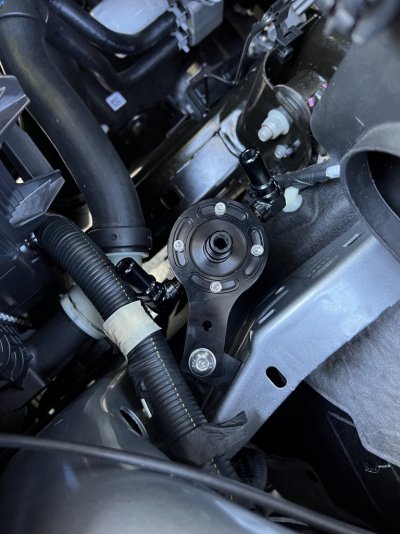
Then you mount the Clean Side Catch Can on the ABS brake controller bracket and run the lines as directed to the engine and to the turbo inlet 3-way.
Photo Oct 06, 6 04 48 PM.jpg
Go back through and check all connections, reinstall the cold air intake (the metal fastener takes a few minutes, the push pins seconds as you'd expect), and enjoy all the extra power and quicker throttle response! I'm kidding, of course. Just seeing who is still reading by this point. We didn't notice any different in the way it drove or sounds or anything like that, nor did we expect to, and no problems with check engine lights or anything unexpected thus far. Oh, I did install the "Billet One-Way Crankcase Breather" which just replaces the oil fill cap. See last photo. As I believe I mentioned, UPR said it wasn't necessary in a stock or near stock application but would provide a fail-safe in the case of excessive crank case pressure. It's got a one-way valve inside it and supposed to be good in areas of cold and freezing weather (we have very little of that) and is best for "maximum engine seal life." I'll come back and post about contents of the Catch Cans at some point, and I'll probably have an analysis done of the can contents just to see what is in there and what percentage is fuel/oil etc just because I'm curious.

It took me around an hour and a half, total, maybe an hour forty-five, but I took a short phone call, was taking photos, was interrupted by my kids briefly once, and I'm probably slower than others. I'll be happy to try to answer questions if I can be of any help, and I take criticism fairly well as long as it's reasonably constructive. Hope this helps someone!
 

chaffdb

Well-Known Member
Joined
Feb 3, 2022
Posts
60
Reaction score
33
Location
Hattiesburg, MS
Great post/pics. I contemplated the catch can but have passed so far. What oil did you use?

Just did the break in oil change at 1,300 miles. Still surprised the factory fill is not fully synthetic. Used the Ford Pass points so my only oil option was the Motorcraft Full Synthetic.
Thanks. I think I'm sold on the catch can concept, but I'm not certain on the single or dual side yet. We'll see how much stuff I get out of the clean side can along the way before I can really have an opinion on that.

I just used the Motorcraft Synthetic Blend and Motorcraft FL-500S filter and did it myself. I found what I thought was a pretty good deal and bought enough of the MC Blend for the first 3 changes along with filters, but then I found I could get the MC Full Synthetic for basically the same price elsewhere and was pretty bummed. Oh well. These first few changes will all be somewhat early, although not nearly as short of interval as the first one. I haven't settled on what interval I'll change at or what oil I'll use long term yet. It's also getting a little cooler now and it will be driven fairly easily for a while, for what that is worth.

I was shooting for 1k miles for the first one and ended up changing it at 990 with 29 hours (and 93% oil life) showing. A friend and others said I was crazy for changing so early. I even had someone suggest the initial fill "might" have special ingredients in it to help the parts "harden and wear in better." Maybe it does, but that's news to me! Glad to see I'm not the only one that believes in a break-in change. The drained oil was fairly dark, especially for that few miles, and I am willing to be the wear metals in the analysis are much higher than they will be a change or two down the road.

I do find it interesting that it comes from the factory with a different oil filter. Mine had a FoMoCo AA5E 6714 EA on it. The last two letters appear to have changed over the years, but this has been a common practice for a while. The FoMoCo has slightly more capacity and a little bit thicker case, from what I have read, but I don't know that it offers any real advantage. Just interesting.
 
Last edited:

rd618

Full Access Members
Joined
Nov 1, 2021
Posts
745
Reaction score
389
Location
new york
Thanks. I think I'm sold on the catch can concept, but I'm not certain on the single or dual side yet. We'll see how much stuff I get out of the clean side can along the way before I can really have an opinion on that.

I just used the Motorcraft Synthetic Blend and Motorcraft FL-500S filter and did it myself. I found what I thought was a pretty good deal and bought enough of the MC Blend for the first 3 changes along with filters, but then I found I could get the MC Full Synthetic for basically the same price elsewhere and was pretty bummed. Oh well. These first few changes will all be somewhat early, although not nearly as short of interval as the first one. I haven't settled on what interval I'll change at or what oil I'll use long term yet. It's also getting a little cooler now and it will be driven fairly easily for a while, for what that is worth.

I was shooting for 1k miles for the first one and ended up changing it at 990 with 29 hours (and 93% oil life) showing. A friend and others said I was crazy for changing so early. I even had someone suggest the initial fill "might" have special ingredients in it to help the parts "harden and wear in better." Maybe it does, but that's news to me! Glad to see I'm not the only one that believes in a break-in change. The drained oil was fairly dark, especially for that few miles, and I am willing to be the wear metals in the analysis are much higher than they will be a change or two down the road.

I do find it interesting that it comes from the factory with a different oil filter. Mine had a FoMoCo AA5E 6714 EA on it. The last two letters appear to have changed over the years, but this has been a common practice for a while. The FoMoCo has slightly more capacity and a little bit thicker case, from what I have read, but I don't know that it offers any real advantage. Just interesting.

I just did my break in oil change at ~1550 miles. This time I sent a sample for oil analysis, guys at blackstone are amazing.
Early results. It should be on everyone’s list to change oil within first 5k miles. Lots of iron, copper, and silicone in my analysis. Normal for break-in, But not great additives to run with for first 10k miles. Also. Ford factory uses a slightly out of spec viscosity from 5w-30, lower than normal.
 

chaffdb

Well-Known Member
Joined
Feb 3, 2022
Posts
60
Reaction score
33
Location
Hattiesburg, MS
I just did my break in oil change at ~1550 miles. This time I sent a sample for oil analysis, guys at blackstone are amazing.
Early results. It should be on everyone’s list to change oil within first 5k miles. Lots of iron, copper, and silicone in my analysis. Normal for break-in, But not great additives to run with for first 10k miles. Also. Ford factory uses a slightly out of spec viscosity from 5w-30, lower than normal.
Yes, I'm in good/similar company here. lol. I'd like to compare results when mine come back. I'm a little surprised I haven't seen them yet. I've always used Blackstone and been happy. The only real negatives I have ever read is that their price is a little high and they don't "properly" measure for fuel in the sample, since they only do a flash point and "estimate" the fuel percentage off that, or something of that sort. For comparison purposes, I actually pulled 2 samples back to back. One went to Blackstone and the other to Oil Analyzers (kits purchased through Amsoil). Both went out a week ago, and I figure I should have results any time now. I've seen some other reports of slightly lower viscosity in the factory fill.
 

BlackBetty

Full Access Members
Army
Joined
Feb 1, 2021
Posts
433
Reaction score
171
Location
Surprise, AZ
There are two PCV locations on these engines. One at the intake manifold and one at the intake manifold. If running with boost, it will dump ahead of the turbo. If not boosting, it will dump at the intake manifold. Single catch can systems typically only work with the system connected to the intake manifold.
Thanks for bringing this up as I have a question about the PCV, and CCV, sides.

I have a Full Race Oil catch can. It previously worked very well collecting blow-by. I’ve since upgraded to the Full Race intercooler, and TurboSmart BOV kit. Well, ever since that upgrade I’ve not had anything drain from the Full Race catch can. Did notice the BOV was pretty nasty (disassembled for thorough cleaning), so figured it was pulling/ dumping what the catch can was dumping. Also, checked my MAP sensor; it’s still not getting saturated with nastiness, so that checked good.

What I would like to know is if I were to uninstall the catch can (mentioned earlier it’s not collecting anything) and reinstall the OEM lines would it still run clean at the manifold? Would my MAP sensor remain clean if I were remove the PCV block-off plate and reconnect the passenger side PCV back to the manifold.

I ask for two reasons…
1. The catch can isn’t catching anything to drain since the installation of the BOV.
2. I would really like to reinstall my engine cover. Want to get it painted.

However, if the PCV will throw that crap back in the manifold still (sounds like it will as I read earlier this will happen when no boost is present) I will consider getting a passenger side catch can to prevent it from happening. I actually have a JLT can some where in the garage. Need to look for it when I get home.

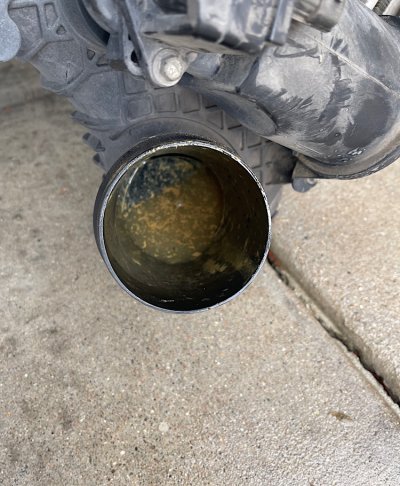
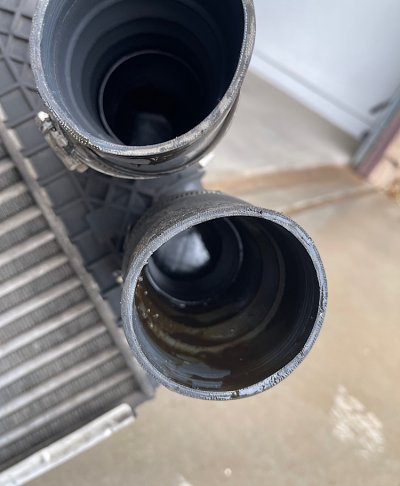
For the catch can naysayers I can attest to the need for them as I had horrible issues with hesitation, and acceleration issues. Found out my MAP sensor was coated in blow-by crap. Cleaned it. Performance regained. Within 1-2wks it was saturated again. Did more research which lead me to tap my intercooler. It started to drip a mix of oil and water. This drip turned into a steady flow with some acceleration.

You know what… having typed out my entire experience, and thinking about how the system works as I described my issue might’ve just helped me answer my own question. I know what I need to do.

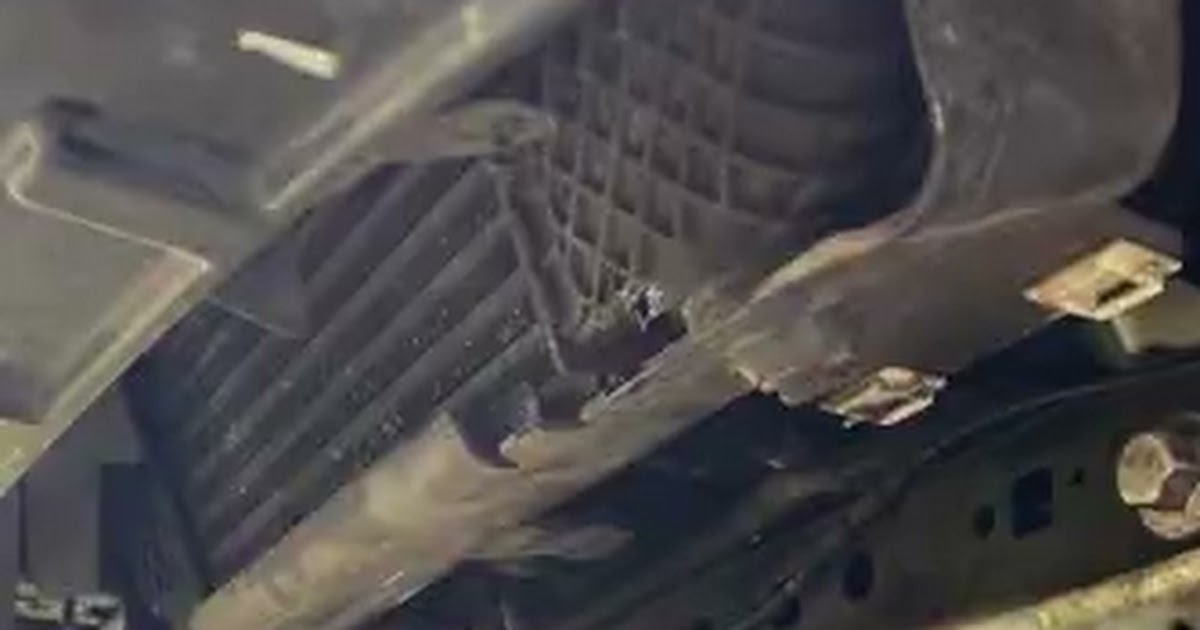
Take a look at a few of my pics. You’ll see why there’s a need. Here is a link to Google Photo’s to see a video of the contamination leaking out of the intercooler. At this point I was thinking about the Full Race replacement, so why not tap a small hole to see what, if anything, I should be worried about. Here’s what I saw… look at the ground beneath the truck. That’s how much leaked out before I decided to race the motor a bit…


Attachments

  • C4EDE64B-D828-47A3-A0A0-98B23CD8B0FE.jpeg
    C4EDE64B-D828-47A3-A0A0-98B23CD8B0FE.jpeg
    268.7 KB · Views: 24
  • 983CB00D-FDA3-4D22-A3F2-4522AD45FD7D.jpeg
    983CB00D-FDA3-4D22-A3F2-4522AD45FD7D.jpeg
    140.6 KB · Views: 23

BlackBetty

Full Access Members
Army
Joined
Feb 1, 2021
Posts
433
Reaction score
171
Location
Surprise, AZ
What you’re seeing inside the old intercooler isn’t the entire story. Some of the fluid leaked out due to manipulation for the purpose of removing. By the time I thought it be a good idea to get evidence what you see is what was left. Plenty enough to give a good idea to what’s going on.

With that evidence provided it’s easy to see how my sensors were coated in gunk. Once I cleaned them it was entirely different story. As mentioned earlier that did last long.
 

Andy B

Full Access Members
Joined
Aug 25, 2016
Posts
325
Reaction score
154
Location
Redding, CT
JLT is easy, and won’t break the bank!


Sent from my iPhone using Tapatalk Pro

Do you have a link (or recommendation) on where to buy one for a 2023 SPP?

Also, what is the consensus on if dealers use this to void the warranty?

(I don't have my 2023 yet, still driving my 2010, so catach cans are new to me even though i've been on this forum for years)
 

Members online

Forum statistics

Threads
57,016
Posts
535,899
Members
54,714
Latest member
Budman55
Top