

JLT Oil Seperator

Disclaimer: Links on this page pointing to Amazon, eBay and other sites may include affiliate code. If you click them and make a purchase, we may earn a small commission.

Sgt Darkness

Full Access Members
Joined
Oct 24, 2018
Posts
359
Reaction score
98
Location
East Tennessee
Like IBV 150 stated so eloquently, any vehicle can benefit from a catch can. If you don't care a rats patoot, then don't. But when your 5-7 year old twin turbo melts down early, don't come here ********. Remember pcv valves and clean oils will take you just so far. And damage like age, sneaks up on you. Did you guys/girls at 20, ever dream you'd have back, knee or colon problems at 60? Of course not. Your engine is 20 years old right now, diet and exercise for it are critical, just like us. If you knew 40 years ago in 1979, something that would keep you healthy in 2019, and was easy to do, your damn Skippy you'd do it. Why fight logic, getting sludge out works. It works with us, it works with cars/SUVs.


Sent from my N9131 using Tapatalk

Wow.....we r showing our age now....I was raised on the idea that any Pennsylvania grade oil (Pennsoil, QuakerState, Standard Oil, and a few others created sludge in any vehicle engine...I was also taught how to “Pepsi” an engine and how mothballs work well in providing u with a bunch of extra power also. I was raised on Castrol 20W50, 10W40 and later on 5W30. Castrol never let any of my engines down. Also, how u can repair the main crank bearings with a matchbook....sorry to get off topic but when I heard “sludge” it turned on a part of my brain not used in years....

 

Machete

My Rig. 2000 EB 4x4 5.4L
Joined
Jul 18, 2012
Posts
843
Reaction score
355
Location
Illinois
Thank
Just for clarity, the 3.5TT EB in the Expy does not have VVT or VGT Turbos. They are single geometry Wastegated Turbos.


Sent from my iPhone using Tapatalk Pro

The eco boost does indeed use variable valve train also referred to as variable cam timing. This design is at the root of the cam phaser problems and all the related components in the VVT.
 

LokiWolf

Staff member
Moderator
Joined
Apr 2, 2016
Posts
3,971
Reaction score
2,834
Location
Richmond VA
Thank

The eco boost does indeed use variable valve train also referred to as variable cam timing. This design is at the root of the cam phaser problems and all the related components in the VVT.

When I see VVT, I think Variable Vane Turbo, or Variable Geometry Turbo(VGT)...


Sent from my iPhone using Tapatalk Pro
 

lbv150

Full Access Members
Joined
Mar 12, 2011
Posts
606
Reaction score
284
Location
Northeast
Thank

The eco boost does indeed use variable valve train also referred to as variable cam timing. This design is at the root of the cam phaser problems and all the related components in the VVT.

It's called VCT....and the 5.4 with them suck.
 

Machete

My Rig. 2000 EB 4x4 5.4L
Joined
Jul 18, 2012
Posts
843
Reaction score
355
Location
Illinois
It's called VCT....and the 5.4 with them suck.

Yup. Ford screwed up. I wouldn’t purchase a VVT engine. This is why I still drive my trusty 2v 5.4. It just runs so reliably and tows everything I need easily.
 

Boostedbus

Full Access Members
Joined
Mar 1, 2018
Posts
747
Reaction score
465
Location
Maryland
Hey I’m just a somewhat old timer on here and although it seems I’ve worked on every carbed engine ever made was just wondering, “where does the oil go that isn’t caught in a catch can?” I suppose into the oil cooler for the turbos?? Thanks, oh yea, this is the first turbo I’ve ever owned.......
Yeah it gets vented straight back to the intake to get burned along with the fresh air piped in. I think most American cars got pvc systems around 1968.... pretty sure my buddies old stock 67 283 Chevelle had a breather / blowby tube in the front when we pulled it and stuffed a 327 Mill in the old girl.The old breather tube systems just vented crankcase vapors to the atmosphere. Since then engines have been burning the vented crankcase vapors through vacuuming them back into the intake to the combustion chambers. Carburetors and port fuel injection have been able to keep the valves clean by gasoline washing over them. With direct injection the fuel is shot directly into the combustion chamber so the valves are closed when this happens and the fuel never gets to wash the valve faces. The dirty/oily air piped in over the hot valves now gets cooked on the intake valves. The dirty/oily air also migrates into the innercooler. A catch can helps to slow down and or possibly eliminate this from happening. All the waste oil/water that we dump from our cans would have otherwise been burned or coated/gathered in intakes and innercoolers.
 

chuck s

Full Access Members
Joined
Dec 20, 2006
Posts
1,990
Reaction score
753
Location
Chesterfield, VA (that's south of Richmond, y'all)
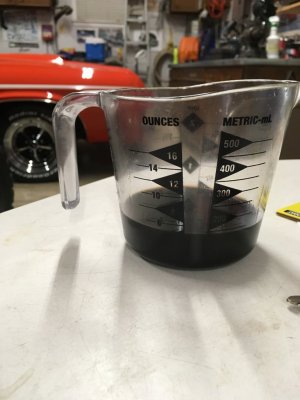
My very limited trials show 3oz/1000 miles of this vapor get converted to liquid and trapped in the catch can. It's effectively sludge when trapped in the can but was nothing more than vapor when it went in so it's not accurate to compare the two directly.

I do not know the effectiveness of the catch can. Sure it's catching that 3oz of oily chocolate milk looking liquid every 1000 mines but is it precipitating 90% of the oil vapor? Is is precipitating 10%? How effective is this process only running off one bank of a Vee engine?

Just looking at the liquid drained out of the can (photos previously) I'd rather not be running this thru the engine.

-- Chuck
 

HawkX66

Semper Fi!
Joined
Aug 28, 2018
Posts
643
Reaction score
318
Location
VA/MA
My very limited trials show 3oz/1000 miles of this vapor get converted to liquid and trapped in the catch can. It's effectively sludge when trapped in the can but was nothing more than vapor when it went in so it's not accurate to compare the two directly.

I do not know the effectiveness of the catch can. Sure it's catching that 3oz of oily chocolate milk looking liquid every 1000 mines but is it precipitating 90% of the oil vapor? Is is precipitating 10%? How effective is this process only running off one bank of a Vee engine?

Just looking at the liquid drained out of the can (photos previously) I'd rather not be running this thru the engine.

-- Chuck
You're on to some good points. What it's catching for the most part isn't a big deal IMO for most well running motors though it is definitely debatable with direct injection and the intercooler. 3 oz of mostly moisture collection with enough oil to make it cloudy by the looks of it. The catch can is not just running off one bank though. If I'm not mistaken, it's like PCV which is venting the whole system. The exit for the whole system is only on one side.
 

1955moose

Full Access Members
Joined
Nov 23, 2014
Posts
6,004
Reaction score
1,351
Chuck brought up a good point. The catch can's only pulling from one side of motor. Can you run a T line, or a second pcv valve for other side, to pull from all 8. And by doing that, would it remove more sludge for the can?

Sent from my N9131 using Tapatalk
 

chuck s

Full Access Members
Joined
Dec 20, 2006
Posts
1,990
Reaction score
753
Location
Chesterfield, VA (that's south of Richmond, y'all)
There is a PCV valve and hose running out of each valve cover. Interestingly enough, it has been observed the passenger side PCV systems seems to shoulder the load of venting the crankcase, and thus most aftermarket oil separator kits only provide provisions for the passenger side.
(Americantrucks.com)

Also I note the Ford Performance catch can for the Coyote V8 also only hooks to the passenger side. Looks like it holds more than 3 ounces.

https://www.americantrucks.com/ford...senger-side-11-17-50l-1117-gt-boss-gt350.html

-- Chuck
 

mquick5

Full Access Members
Joined
Aug 27, 2018
Posts
589
Reaction score
154
Location
Buckeye Country
I received my new bracket Monday, and installed it Tuesday. The hardest part was putting the cover back on top of the motor. Although not in the directions, I used red Loctite, to attach the to M4 screws to the can. Everything about this kit seems heavy duty except for the 2 attaching tiny screws. In fact if I read it right the hoses are rated at 3,000 lb! That's some serious Overkill there.

Sent from my SM-G930T using Tapatalk
 

lbv150

Full Access Members
Joined
Mar 12, 2011
Posts
606
Reaction score
284
Location
Northeast
Another way to look at it is the engine will be more efficient with a can. It will be ingesting clean air and fuel only. No un burnt by products from the crankcase which does nothing for performance.
 

1955moose

Full Access Members
Joined
Nov 23, 2014
Posts
6,004
Reaction score
1,351
You know what amazes me is all the years I rode motorcycles back in the late 60's early 70's, when cars/trucks used draft tubes before pcv valves, that I never slipped and fell. Back then the majority of cars running around were from the 50's, and 60,s. Pcv valves didn't start till around 1961, later for a lot of manufacturers. The draft tubes released a bit of oil straight down on the roadway. Even staying out of the middle of the road through a turn, basically cars, and trucks were literally painting the roadways with oil.

Sent from my N9131 using Tapatalk
 

Boostedbus

Full Access Members
Joined
Mar 1, 2018
Posts
747
Reaction score
465
Location
Maryland
My Can has been catching mainly oil and not much noticeable moisture. I’m not sure exactly why. It is being cold started in my garage mostly, and possibly the media in the can that filters/separates the oil from the water vapor is different than that of the JLT cans. It’s never been milky coming out. 44CD7E94-24B6-4D58-9CA4-4943CD8180C5.jpeg
 

chuck s

Full Access Members
Joined
Dec 20, 2006
Posts
1,990
Reaction score
753
Location
Chesterfield, VA (that's south of Richmond, y'all)
Looks more like chocolate milk or dark hot chocolate, not oil on my truck.

img_3909-1-jpg.29007


img_3741-1-jpg.29004


Top was last week, bottom 1000 miles before that.

-- Chuck
 

1955moose

Full Access Members
Joined
Nov 23, 2014
Posts
6,004
Reaction score
1,351
No moisture is a good thing right?

Sent from my N9131 using Tapatalk
 

lbv150

Full Access Members
Joined
Mar 12, 2011
Posts
606
Reaction score
284
Location
Northeast
In the warmer weather mine is just oil, in the winter it is a mix with water...
 

Boostedbus

Full Access Members
Joined
Mar 1, 2018
Posts
747
Reaction score
465
Location
Maryland
No moisture is a good thing right?

Sent from my N9131 using Tapatalk
The only possible problem I see with the cans that don’t separate the oil and the water vapors is that they could freeze overnight when left not drained. My RXP Can just has a ball valve drain on the bottom of the can and doesn’t unscrew apart. I was told by the manufacturer that it has some kind of steel media inside the can. I’m guessing it’s something like steel wool that somehow wicks the oil out of the vapors and let’s the water vapor through to be burned off. I’ve never even seen a hint of water come out of mine yet..... emulsified in the oil or even straight water. Straight unmixed water would be the first to trickle out of the drain when I open it because of it being heavier than oil, but not a drop.
 
Top