Tire pressures

Disclaimer: Links on this page pointing to Amazon, eBay and other sites may include affiliate code. If you click them and make a purchase, we may earn a small commission.
plumcolr

Full Access Members
Joined
Mar 11, 2015
Posts
164
Reaction score
69
Location
freehold nj
2017 stock wrangler fortitudes, 275/65-17. Previous owner ran them soft but not enough to trigger the TPMS. Middle has excellent tread, both sides all tires not good, tread pretty much gone. I am running 40psi to try to compensate. I suspect they were in the 32-35 psi range.
 

TobyU

Full Access Members
Joined
Apr 5, 2013
Posts
2,479
Reaction score
873
Location
Ohio
You should NEVER run at maximum pressure, unless you are running at maximum weight. When running at maximum pressure, without the weight, your contact area is decreased. Depending on how under maximum weight you are running it could be a significant difference. Less contact patch means less grip, and longer stopping distances.

Yes, Back in the 90’s Ford got in trouble for running Explorers and Rangers at less pressure than Firestone recommended for their OEM tires. They both paid for it, significantly! They will not make that mistake again.

I run around 38-40 based on what I have observed Tire wear wise and average load we run.

I have pushed it up more when towing, but don’t tow even close to Max regularly. Maybe 4-5K at most. Most of the time is a small metal yard trailer and around 2K loaded.


Sent from my iPhone using Tapatalk Pro

As long as the tire doesn't say maximum inflation 35 psi then you are good.

Not nearly as much reduction in contact area from being at max as dangers of being too low.
As I mentioned you can get some center wear which means it is contacting harder in the middle and less on the outer sides but it takes 1000's of miles to show this.
Same as being underinflated can wear out steering components faster but it takes years.
Being only at 28-30 as some do can quickly esp after cold temps end up at 18-24 psi and crate a dangerous sidewall flex, vehicle leaning, tire popping bead, overheating at speeds...situation.
I never run at max unless it is a high weight carrying vehicle and it is used to haul weight.
All of these I have had load range E tires and all spec at 80 PSI max.
I always go to 70-72 even if no heavy loads. These tires bulge a lot and look too low at anything under 60 PSI.
 

Munkiebunz3

Full Access Members
Joined
Sep 20, 2018
Posts
261
Reaction score
95
Location
Soviet Monica, Kommiefornia
Get some chalk, run a line across the tire in 2 places, drive straight for 50-100 feet, get out and inspect.
If chalk is gone in the center and lots on the edge, reduce the pressure.
If chalk is gone on the sides but lots in center, add air.
If chalk is equally faded, you good.
If chalk is all gone, reapply and drive shorter distance.

With my standard load I'm running 47psi.
 

chuck s

Full Access Members
Joined
Dec 20, 2006
Posts
1,990
Reaction score
753
Location
Chesterfield, VA (that's south of Richmond, y'all)
I see folks thinking they get more carrying capacity by high tire pressure. Ain't so according to the sticker. Maximum axle weight ratings is achieved with 35 psi on my tires according to both mandatory placards. Doesn't get any higher with more pressure although the tires may run cooler and the rear end squirm less when towing. The P-metric tires themselves can support 2756 pounds each or 11,024 pounds at their max pressure (50psi) but the suspension is limites the truck to 7500 pounds GVW. (The two axles actually add up to a bit more than that.)

-- Chuck

IMG_5214[1].JPG
 

TobyU

Full Access Members
Joined
Apr 5, 2013
Posts
2,479
Reaction score
873
Location
Ohio
The placard has little to do with the tires maximum load and it only applies to the original or exact spec replacement tires. Many people change tires and sizes.
You could overload a vehicle or axle and even break springs etc and be under the load limit of tires at certain pressures. this is part of the reason the factory puts a placard and loading sticker on vehicle.
But when talking about just the tires...what it printed on the tire is king but applies only to the tire.
If I put load range E 225/75-16 on a truck that came with standard load tires and called for 32-35 psi...I would NEVER put 35 psi in them. They even look low and bulge too much in sidewall. They have a max inflation of 80 psi. I don't put 80 either as they usually ride too harsh at 80. I put 55-72 depending on vehicle and they work great this way.
 

LokiWolf

Staff member
Moderator
Joined
Apr 2, 2016
Posts
3,971
Reaction score
2,837
Location
Richmond VA
As long as the tire doesn't say maximum inflation 35 psi then you are good.

Not nearly as much reduction in contact area from being at max as dangers of being too low.
As I mentioned you can get some center wear which means it is contacting harder in the middle and less on the outer sides but it takes 1000's of miles to show this.
Same as being underinflated can wear out steering components faster but it takes years.
Being only at 28-30 as some do can quickly esp after cold temps end up at 18-24 psi and crate a dangerous sidewall flex, vehicle leaning, tire popping bead, overheating at speeds...situation.
I never run at max unless it is a high weight carrying vehicle and it is used to haul weight.
All of these I have had load range E tires and all spec at 80 PSI max.
I always go to 70-72 even if no heavy loads. These tires bulge a lot and look too low at anything under 60 PSI.

You should really try the Chalk trick or the wet spot trick on concrete with your Tires at 70-72 unloaded. I think you will be very unpleasantly surprised, that your contact patch is significantly decreased.

Generally a little under actually increases Contact patch, but decreases directional control and increases heat. Also increases tire edge wear. Just like drag cars that decrease pressure, or jeeps off road. Contact patch and the ability of the tire to conform to the road, increases traction, but there is a point where it becomes too soft, and lateral control is decreased and the added friction, increases heat to an unsafe level.

MANY years working on road race cars and late model circle track cars. Lots of adjustment for temp, both ambient and track.

There have been many studies with numbers and actual data to support what I am saying. Most were done using 20% under, recommended, and 20% over. The over had the worst stopping distance, under had the best. Again there are other negatives I mentioned above.


Sent from my iPhone using Tapatalk Pro
 

TobyU

Full Access Members
Joined
Apr 5, 2013
Posts
2,479
Reaction score
873
Location
Ohio
You should really try the Chalk trick or the wet spot trick on concrete with your Tires at 70-72 unloaded. I think you will be very unpleasantly surprised, that your contact patch is significantly decreased.

Generally a little under actually increases Contact patch, but decreases directional control and increases heat. Also increases tire edge wear. Just like drag cars that decrease pressure, or jeeps off road. Contact patch and the ability of the tire to conform to the road, increases traction, but there is a point where it becomes too soft, and lateral control is decreased and the added friction, increases heat to an unsafe level.

MANY years working on road race cars and late model circle track cars. Lots of adjustment for temp, both ambient and track.

There have been many studies with numbers and actual data to support what I am saying. Most were done using 20% under, recommended, and 20% over. The over had the worst stopping distance, under had the best. Again there are other negatives I mentioned above.


Sent from my iPhone using Tapatalk Pro


I have done the chalk trick and I love it. What you're saying is very accurate on like a standard Expedition like the 2001 that we have but that just has standard SUV tires no load range E. My load range E vehicles are 36 - 40 ft long suv limos that way almost 10,000 pounds empty and E550 party buses that way a little less empty but carry a huge load and a lot of people.
Not sure what you mean by recommended but I don't put a lot of faith in what the manufacturer recommends however I will say I have seen loading placards on limos from the high quality reputable coachbuilders that specifically say what size tire and load range the vehicle is supposed to have and what it's supposed to be aired to.
This would of course supersede any recommendation for the vehicle and its original form before it was stretched.
I'm not going to put load range D or E tires on a vehicle unless it needs it to carry a lot of weight but if I'm going to have them on the vehicle I'm not going to run them at 32-35 psi.
 

LokiWolf

Staff member
Moderator
Joined
Apr 2, 2016
Posts
3,971
Reaction score
2,837
Location
Richmond VA
I have done the chalk trick and I love it. What you're saying is very accurate on like a standard Expedition like the 2001 that we have but that just has standard SUV tires no load range E. My load range E vehicles are 36 - 40 ft long suv limos that way almost 10,000 pounds empty and E550 party buses that way a little less empty but carry a huge load and a lot of people.
Not sure what you mean by recommended but I don't put a lot of faith in what the manufacturer recommends however I will say I have seen loading placards on limos from the high quality reputable coachbuilders that specifically say what size tire and load range the vehicle is supposed to have and what it's supposed to be aired to.
This would of course supersede any recommendation for the vehicle and its original form before it was stretched.
I'm not going to put load range D or E tires on a vehicle unless it needs it to carry a lot of weight but if I'm going to have them on the vehicle I'm not going to run them at 32-35 psi.

So your comments above were pressures in tires on Limo’s? Why didn’t you mention that? We are talking about Expeditions, not Limo’s or Party Busses. Why were you talking those pressures with no reference point?

My statement still stands and is fact, and based on actual Data. Running tires slightly below the recommended vehicle manufacturer pressure with the stock size tires, and will give you better braking performance, but might have other negative like lateral control or tire temp and wear on outer edge. Pressures on the higher side decreases contact patch, and significantly increase stopping distances and very negatively effect lateral grip.

The part to take away is to find that sweet spot. Some where around the recommended pressure that gives you a good contact patch, and doesn’t lead to squishy handling or bad wear. Using the visible shape of the tire and sidewall is an absolute pointless endeavor unless the tire is VERY low. Using things like the chalk trick and the wet spot trick on pavement/concrete to understand the contact patch. Also paying attention to wear over time can tell you A LOT!


Sent from my iPhone using Tapatalk Pro
 

JExpedition07

That One Member
Joined
Mar 30, 2017
Posts
6,530
Reaction score
3,140
Location
New York
I see folks thinking they get more carrying capacity by high tire pressure. Ain't so according to the sticker. Maximum axle weight ratings is achieved with 35 psi on my tires according to both mandatory placards. Doesn't get any higher with more pressure although the tires may run cooler and the rear end squirm less when towing. The P-metric tires themselves can support 2756 pounds each or 11,024 pounds at their max pressure (50psi) but the suspension is limites the truck to 7500 pounds GVW. (The two axles actually add up to a bit more than that.)

-- Chuck

View attachment 31477
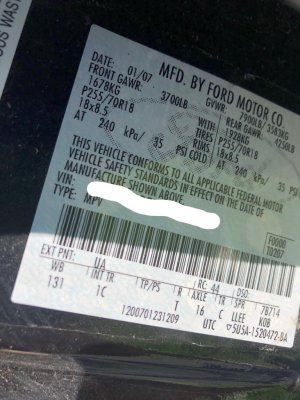
Interesting the math is odd on my 2007 as well, GVWR is listed at 7,900 but the axles add up to 7,950.

E349BB1E-3B31-4D97-85CB-E714D38C352D.jpeg
 

Boose

2017 Platinum EL
Joined
Mar 18, 2014
Posts
319
Reaction score
101
Location
NJ
Factory Pirellis on the 22's run them at 36 cold.
 

TobyU

Full Access Members
Joined
Apr 5, 2013
Posts
2,479
Reaction score
873
Location
Ohio
So your comments above were pressures in tires on Limo’s? Why didn’t you mention that? We are talking about Expeditions, not Limo’s or Party Busses. Why were you talking those pressures with no reference point?

My statement still stands and is fact, and based on actual Data. Running tires slightly below the recommended vehicle manufacturer pressure with the stock size tires, and will give you better braking performance, but might have other negative like lateral control or tire temp and wear on outer edge. Pressures on the higher side decreases contact patch, and significantly increase stopping distances and very negatively effect lateral grip.

The part to take away is to find that sweet spot. Some where around the recommended pressure that gives you a good contact patch, and doesn’t lead to squishy handling or bad wear. Using the visible shape of the tire and sidewall is an absolute pointless endeavor unless the tire is VERY low. Using things like the chalk trick and the wet spot trick on pavement/concrete to understand the contact patch. Also paying attention to wear over time can tell you A LOT!


Sent from my iPhone using Tapatalk Pro

No need to get defensive, I've already said you are correct and agree with your statements from the last post. I wasn't sure if by recommended you meant the maximum inflation pressure on the tire from the manufacturer or the one on the vehicles placard. I think from this last post you are meaning that they run better if you pass below the maximum printed on the sidewall which I completely agree with. That's also why I earlier said that I typically run them at 70-72 from what they have printed on the side wall. Unless you are loading a tire to its capacity it rides way too hard at at and as you mentioned the traction can suffer.

We are talking about tire pressures so whether it's on an expedition, a Lamborghini, or an airplane it's still relevant to the thread because it's about tire pressures.

"I never run at max unless it is a high weight carrying vehicle and it is used to haul weight.
All of these I have had load range E tires and all spec at 80 PSI max."

This was in my first post about it and I did specify I was talking about load range e tires carrying lots of weight. The fact that it's a limo or a moving truck makes little difference as the tires and the bus chassis is exactly the same for a box truck.

A lot of people that end up asking about tire pressures do so because they are Towing. This is also not a towing forum and most people tow with pickup trucks and not Expeditions and SUVs. At least people that tow a lot of weight.

When we have open conversation and people share their opinions and experiences even if they are off-topic, we learn learn more and get more information to base our own conclusions from.

The chalk method has always been about the best real-world way to test. I've done this many times and I've also use the actual in parking lot circumference test when matching up used tires that are worn with new tires that may be a different size. I remember on our Expedition once I had a couple of good used tires but only a little over half tread and had some brand-new yokohama's on the rear. I believe the new ones were 255 16 and the old ones were 265 so they were a closer match and circumference than if I were have put used to 255 on the front.
I've also use the online tire comparison sites to check circumference quite a few times also but nothing is as accurate is actually doing it yourself with chalk and a tape measure.

Now what I would like to know and maybe since you done a lot of car racing you might have a trick for this... Is how to find out if a tire is going to have increased edgware from being out of alignment without waiting until it's already starting to show?? I assume you could lay the chalk on heavily and drive and see if you're getting increased wear on the chalk on the edge 2 inches inside or out of the tire.
Just not sure if you could should keep this in a straight line or do any turning of the wheel whatsoever. I assume going in a straight line might give you some and pot as to if it's going to wear and an edge quicker.
 

psfsvt

New Member
Joined
Mar 2, 2017
Posts
2
Reaction score
1
Location
Shawnee, KS
For what it's worth, 275/65/18 E Range K02s; been running at 45psi for the last 40k miles. Tire wear is nice and even, and no issues of any kind at that pressure. 2014 EL 4x4. Got E Range because I'm on gravel and in fields a lot and E Range wear better for that and don't seem to get punctures as easily.
 

TobyU

Full Access Members
Joined
Apr 5, 2013
Posts
2,479
Reaction score
873
Location
Ohio
For what it's worth, 275/65/18 E Range K02s; been running at 45psi for the last 40k miles. Tire wear is nice and even, and no issues of any kind at that pressure. 2014 EL 4x4. Got E Range because I'm on gravel and in fields a lot and E Range wear better for that and don't seem to get punctures as easily.
I'm not sure if all E range wear better but they probably do. A lot of it might be brand dependent also. The best to wearing tires I've ever had in my life were Michelin LTX M&S load range E and BFGoodrich commercial T/A load E.
 

John D

Active Member
Joined
Mar 7, 2018
Posts
26
Reaction score
13
Location
Memphis
I run 40psi in 18" michelin primacy XC on 2016 EL. No additional load. At highway speeds with 35psi, I feel like the sidewall flexes too much and the truck sways more than I like when changing lanes.
 

TobyU

Full Access Members
Joined
Apr 5, 2013
Posts
2,479
Reaction score
873
Location
Ohio
I run 40psi in 18" michelin primacy XC on 2016 EL. No additional load. At highway speeds with 35psi, I feel like the sidewall flexes too much and the truck sways more than I like when changing lanes.
I'm assuming that since it's a Michelin tire and you didn't specify that it was a increased load range of D or E that the maximum inflation pressure on the side of the tire says 44 psi. If so then I find that 40-42 tends to be the best pressure to run them at on a standard vehicle hauling no heavy loads.
 
Top