
The ecoboost engine does have some nice enhancements over traditional engines. The power is produces for it's size is certainty impressive. I hate to admit it because I too favor the v8, but the turbo charged smaller displacement engines are more efficient in most ways. I wonder how progress is going on the cvvt (constantly variable valve train) development. That's really going to be another major jump for engines and efficiency/power.


You are using an out of date browser. It may not display this or other websites correctly.
You should upgrade or use an alternative browser.
You should upgrade or use an alternative browser.
Official Photos & Info: 2015 Expedition
- Thread starter LocDoc
- Start date
Disclaimer: Links on this page pointing to Amazon, eBay and other sites may include affiliate code. If you click them and make a purchase, we may earn a small commission.
The ecoboost engine does have some nice enhancements over traditional engines. The power is produces for it's size is certainty impressive. I hate to admit it because I too favor the v8, but the turbo charged smaller displacement engines are more efficient in most ways. I wonder how progress is going on the cvvt (constantly variable valve train) development. That's really going to be another major jump for engines and efficiency/power.
To answer your question about the valve-train, the 3.5 EcoBoost V-6 uses twin independent-variable camshaft timing (Ti-VCT) and a dual over head cam (DOHC) setup with 24-valves, 4-valves per cylinder with 2 intake and 2 exhaust valves per cylinder.
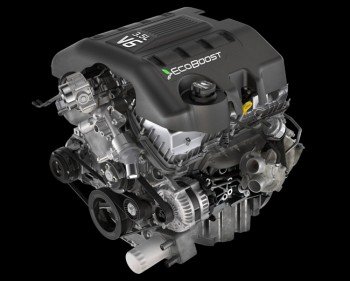
Intelligent Ti-VCT is employed to control the timing of the 12 intake and 12 exhaust valves. Ti-VCT accomplishes this by adjusting both intake camshaft phasing to continuously adjust the intake vales, and exhaust camshaft phasing to continuously adjust the exhaust valves.
The Ti-VCT system operates by applying hydraulic pressure in a sealed Ti-VCT unit (there are two of them) to move the rotor vane (which is bolted to the corresponding camshaft) from an advance position, to a retard position, or vice versa.
Fuel is injected into the cylinder chambers by direct injectors mounted to the underside of the chamber head and protrude into the distal edge of the compression chamber.
All this allows the pumped-up V-6 to breathe freely, and make the most out of every drop of fuel spent during combustion. But that still doesn’t scratch the surface of the advanced V-6 which also uses air-to-air intercooled twin-turbochargers which can work comfortably with operating temperatures up to 954 degrees Celsius or about 1,750 degrees Fahrenheit.
Last edited:

MoHawk
Full Access Members
^^ Captain Google over here. LOL
I'm talking more about a truly variable valve system. I read about it a few years back that it was in R&D I think by Mercedes. I'm sure the Ti-VCT does really well, but for best efficiency it would need to be completely variable. I don't even know if something like that could be engineered because of the forces, power requirements, and precision needed at high RPMs and there would be many other issues like how the system would function if it lost power.
Ford's Ti-VCT system is very much continuously variable. All modern valve timing systems are. The machtronic control unit never stops adjusting cam phasing. Valve timing is continuously adjusted based on engine speed, engine load, electronic throttle control, and other sensory feedback. Ti-VCT can continuously vary valve timing wildly across the entire rpm range, and even perform crazy "hat-tricks" like retarding the system by as much as 20 degrees.
Very similar to Ford’s Ti-VCT is BMW’s Double VANOS continuously variable valve timing system which (just like Ti-VCT) also continuously varies valve timing by adjusting the intake and exhaust camshafts.
Now, continuously variable valve lift (CVVL) is a different story and serves a different purpose. Ford has been toying with its own CVVL system.
BMW was the first to really put that technology to production use, and calls it "Valvetronic". Valvetronic continuously varies valve lift, but not valve timing.
BMW uses both Valvetronic and Double VANOS together, to give a continuously "steplessly variable" valvetrain system.
Below is a PDF highlighting VCT and CVVL which together make a fully variable valvetrain, its a good read, but might put some to sleep...
" http://www.nt.ntnu.no/users/skoge/p...rs/0794_FrB14_4.pdf?origin=publication_detail "
Very similar to Ford’s Ti-VCT is BMW’s Double VANOS continuously variable valve timing system which (just like Ti-VCT) also continuously varies valve timing by adjusting the intake and exhaust camshafts.
Now, continuously variable valve lift (CVVL) is a different story and serves a different purpose. Ford has been toying with its own CVVL system.
BMW was the first to really put that technology to production use, and calls it "Valvetronic". Valvetronic continuously varies valve lift, but not valve timing.
BMW uses both Valvetronic and Double VANOS together, to give a continuously "steplessly variable" valvetrain system.
Below is a PDF highlighting VCT and CVVL which together make a fully variable valvetrain, its a good read, but might put some to sleep...
" http://www.nt.ntnu.no/users/skoge/p...rs/0794_FrB14_4.pdf?origin=publication_detail "
Last edited:

There's been a lot of posts about the engine of the new Expy, but I see another concern (from Automotive News press release): "The 2015 Expedition's electronic suspension has a continuously controlled damping system that receives 46 inputs from the body, steering and brakes to constantly adjust the vehicle's ride to road conditions.
The Expedition is the first Ford brand vehicle to offer the damping system in the United States. Previously only Lincoln vehicles had it."
Will this be standard or an option? Seems like the electric wizardry will make the "next-Gen" (or Refreshed Expy) much harder to lift than any of the previous generations.
The Expedition is the first Ford brand vehicle to offer the damping system in the United States. Previously only Lincoln vehicles had it."
Will this be standard or an option? Seems like the electric wizardry will make the "next-Gen" (or Refreshed Expy) much harder to lift than any of the previous generations.

sgtowing
Supporting Members
There's been a lot of posts about the engine of the new Expy, but I see another concern (from Automotive News press release): "The 2015 Expedition's electronic suspension has a continuously controlled damping system that receives 46 inputs from the body, steering and brakes to constantly adjust the vehicle's ride to road conditions.
The Expedition is the first Ford brand vehicle to offer the damping system in the United States. Previously only Lincoln vehicles had it."
Will this be standard or an option? Seems like the electric wizardry will make the "next-Gen" (or Refreshed Expy) much harder to lift than any of the previous generations.
I would think it would be an option like the air ride was. It will be virtually impossible to lift.
The third generation 2015 Expedition (U324 standard wheelbase) and Expedition EL (U354 long-wheelbase) will still be offered with a standard steel coil spring setup. Its carried over from 2014.
Also available will be a adaptive "Nivomat" hydraulic self-leveling suspension, also carried over from 2014 models. It replaced the adaptive air ride pneumatic self-leveling suspension. The last year model for air ride was 2013.
The CCD system will be standard on Platinum editions.
Also available will be a adaptive "Nivomat" hydraulic self-leveling suspension, also carried over from 2014 models. It replaced the adaptive air ride pneumatic self-leveling suspension. The last year model for air ride was 2013.
The CCD system will be standard on Platinum editions.
This 2015 mid-life cycle update for the third generation (U324 and U354) is just a holdover until the all-new fourth generation arrives.
Ford has confirmed in three years the Expedition will transition to an all-aluminium body (like the F-150), based on the new aluminium F-150’s architecture. It’s been under development for some time now. Development of the aluminium F-150 itself started back in 2009. That’s 6 (six) years of development.
Also, an Expedition Hybrid version with parallel electric rear-drive in the works, and will require a new platform. The current Expedition’s T1 platform (chassis) which first appeared for 2007, isn’t really setup for that.
The forth generation Expedition is due to arrive around 2016 or 2017 calendar year, either for the 2017 or 2018 model year. Give or take a year.
So I went out to eat last night and saw an explorer and the mistook it for an expedition because of how similar the roof rack looked. Then I realized what the next generation Expedition may look like or at least be based off. Here it is:
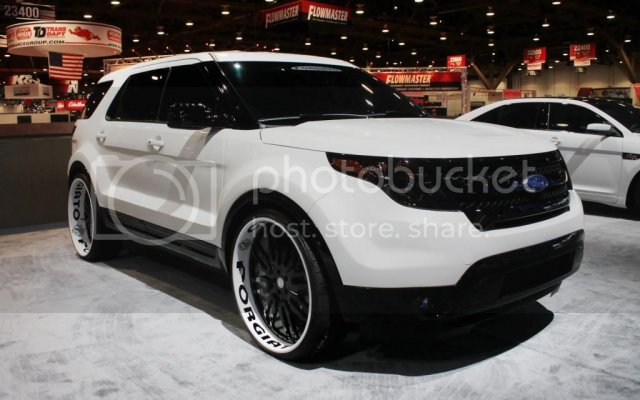
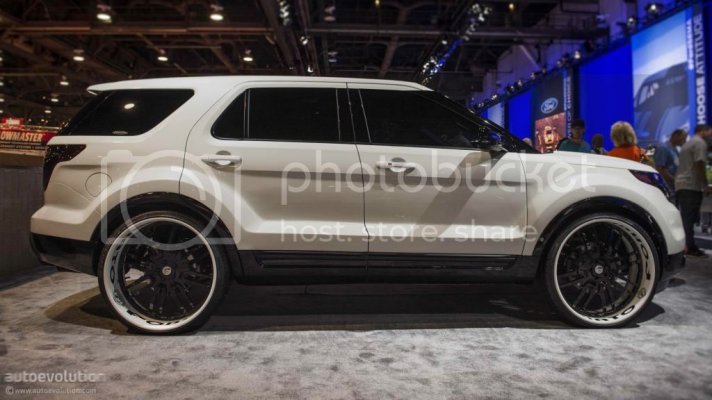
I can only imagine Ford is going to use the explorer for it base design on the exterior. I just hope they make it unique enough unlike the second gen. To me the second gen was a letdown (and now I own one
 ) because it seemed to be just a larger clone of the explorer.
Last edited:
I found an upgrade kit for the ecoboost F150 3.5L over at the Steeda website. I would think this is substantially the same powertrain that will be in the new Expy.
Steeda claims with a CAI and tune, you can get another 65 hp and 120 ft/lb torque. That would put the V6 at 430 hp and 540 ft/lb, up in 6.2L territory and much more that the 5.4L.
Bring on the boost!
Steeda claims with a CAI and tune, you can get another 65 hp and 120 ft/lb torque. That would put the V6 at 430 hp and 540 ft/lb, up in 6.2L territory and much more that the 5.4L.
Bring on the boost!
Mangina
Full Access Members
I found an upgrade kit for the ecoboost F150 3.5L over at the Steeda website. I would think this is substantially the same powertrain that will be in the new Expy.
Steeda claims with a CAI and tune, you can get another 65 hp and 120 ft/lb torque. That would put the V6 at 430 hp and 540 ft/lb, up in 6.2L territory and much more that the 5.4L.
Bring on the boost!
+1. I don't think the pro V8 crowd has any idea how easy and CHEAP it is to make extra power in these turbo motors.
ExpeditionUser
Well-Known Member
Nice truck!! I hope they put the 5.0 in it.
The eXpedition
Full Access Members
Does anyone knows if the 2015 will be having Rear Locking differential?
Sent from my GT-I9500 using Tapatalk
Sent from my GT-I9500 using Tapatalk
The eXpedition
Full Access Members
Just FYI, this facelift/mechanical update is expected to last for three model years (2015, 2016, and 2017), with the all-new aluminium Expedition arriving sometime in 2017 for the 2018 model year.
That’s about the same timeframe Ford expects the 3.0 liter 24-valve DOHC Commonrail Direct Injection "Lion" V-6 twin-turbo diesel to be ready.
Ooh man I like this comment
Sent from my GT-I9500 using Tapatalk
Expyman02
Member
They always do a off road edition or sum crap for the f150 or 350 super duty why not make the expedition off-road edition and just make it Nasty forget this luxury crap lets get sum big tires a nice lift for it and put a good price tag on the thing I mean u know it's Guna happen so why not make one already, but on the other hand I live the front end and the interior just make it more off road look instead this luxury rich mans expy anyway just one mans opinion
The eXpedition
Full Access Members
They always do a off road edition or sum crap for the f150 or 350 super duty why not make the expedition off-road edition and just make it Nasty forget this luxury crap lets get sum big tires a nice lift for it and put a good price tag on the thing I mean u know it's Guna happen so why not make one already, but on the other hand I live the front end and the interior just make it more off road look instead this luxury rich mans expy anyway just one mans opinion
If they make the expedition a bit capable of off roading, they are jeopardizing the marketing angle of the F-150 or so the Raptor.
I was told personally that this is all about marketing. They don't wanna to bring one product against another, if they equip the expedition with locking differential for example, there will be a major shift away from F-150, especially the FX4 package.
That doesn't mean no one is gonna buy F150s, but people in their nature prefers All-In-One product (Family SUV with off road and towing capability).
This is why Toyota is getting some how admiration on this area with their GXR and VXR off road and family SUVs being in market long time, they made lots of money out of them.
Last edited:
Similar threads
- Replies
- 2
- Views
- 1K

- Replies
- 6
- Views
- 1K


- Replies
- 9
- Views
- 4K
- Replies
- 12
- Views
- 4K


Staff online
-
 JUST4FUNAdmin
Members online
Total: 2,493 (members: 13, guests: 2,480)