
A/C is warm

Disclaimer: Links on this page pointing to Amazon, eBay and other sites may include affiliate code. If you click them and make a purchase, we may earn a small commission.

OP
OP
J

juan214

Full Access Members
Joined
Sep 11, 2013
Posts
506
Reaction score
61
Location
Stoughton, MA.
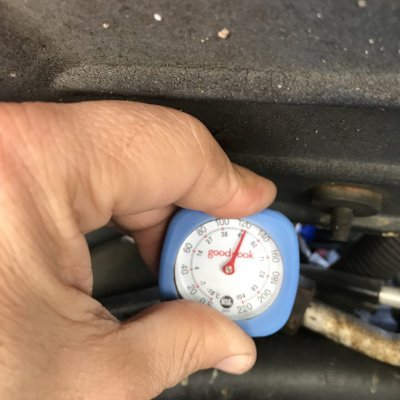
Toss the upper right thermometer since it is off by 11-12 degrees.

At 125 degrees, does the accumulator feel warm/hot?

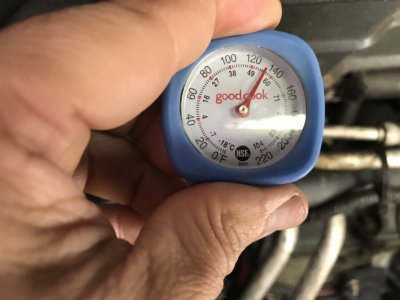
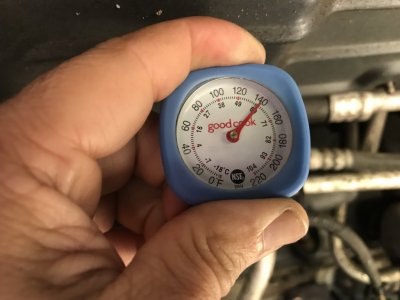
Place either of the two other thermometers on the accumulator and see what they say it is. It needs to be on the metal part of the lines or can.

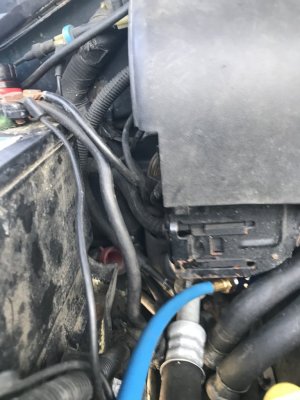
Please post a pic of the accumulator as it is mounted in the engine compartment.

I take it the last pic is of the condensate under the truck? If it is the system is working at some point.

FYI - in auto ac, the larger diameter line is the suction/low pressure side. The smaller line is the high pressure line - which gets hot.

Toss the upper right thermometer since it is off by 11-12 degrees.
  • Funny, the top one is the AC thermometer, The blue one is a meat thermometer. The other is my backup They are always in the center console.
At 125 degrees, does the accumulator feel warm/hot?
  • Warm
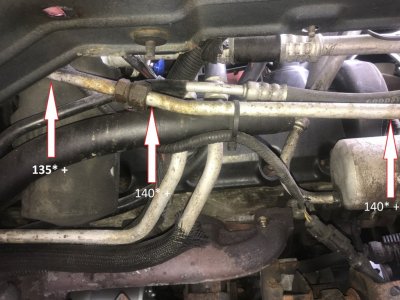
Please post a pic of the accumulator as it is mounted in the engine compartment.
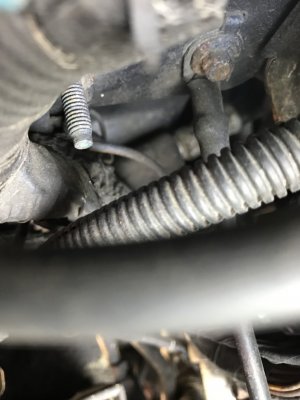
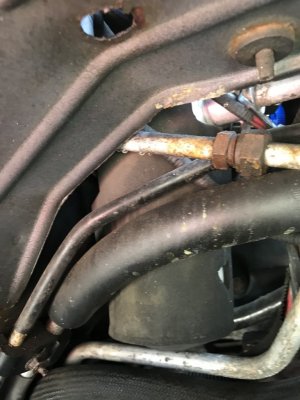
IMG_3899.JPG IMG_3900.JPG IMG_3902.JPG
Place either of the two other thermometers on the accumulator and see what they say it is. It needs to be on the metal part of the lines or can.

Top of Acumulator
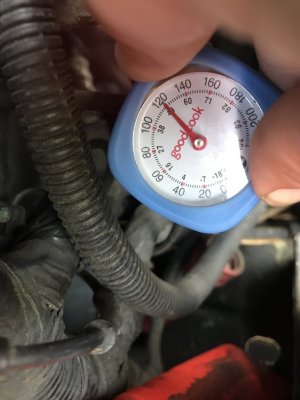
IMG_3901.JPG
Line from compressor at acumulatorIMG_3903.JPG

I take it the last pic is of the condensate under the truck? If it is the system is working at some point.
  • Yes
In the past did your old compressor shoot a bunch of junk into the system? You would see metal shavings on the orifice tube screen.
  • Don't believe it had any metal. Swaped it anyway because a new one came with the kit and did want to have to take it apart again to change it.
 
Last edited:

stamp11127

Full Access Members
Joined
Mar 10, 2012
Posts
6,207
Reaction score
1,246
Location
Temple, Georgia
This is a new one, temps are bass ackwards (ass backwards).

For giggles while I'm thinking this one through, what are the line temps before and after the orifice tube, inlet and outlet of the condenser?

The line from the condenser outlet to the evap inlet should be getting cold as the system runs. Any exposed fitting should also start sweating.

One of the things we need to be careful of is what is going to the compressor. As long as it is gas there is nothing to worry about. However if the evap is really flooded and not performing its function of changing the liquid to gas, you run the chance of trying to compress liquid in the compressor. That usually doesn't end well.
In order for that to happen there would have be no airflow over the evap, so no cooling and no condensate. But you have cooling and condensate....hmmm
 
Last edited:
OP
OP
J

juan214

Full Access Members
Joined
Sep 11, 2013
Posts
506
Reaction score
61
Location
Stoughton, MA.
This is a new one, temps are bass ackwards (ass backwards).

For giggles while I'm thinking this one through, what are the line temps before and after the orifice tube, inlet and outlet of the condenser?

The line from the condenser outlet to the evap inlet should be getting cold as the system runs. Any exposed fitting should also start sweating.

I can grab these lines with my bare hands without issue.

The probe is touching metal but wouldn't the air around it contribute to readings?


Shats
IMG_3905.JPG
&
&.jpg
Goggles
IMG_3907.JPG

The line from the condenser outlet to the evap inlet should be getting cold as the system runs. Any exposed fitting should also start sweating.

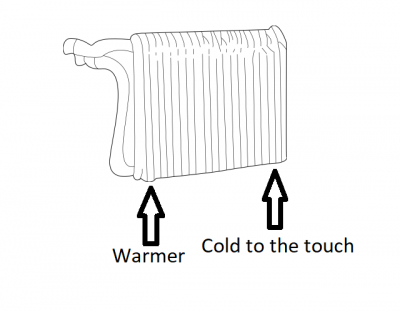
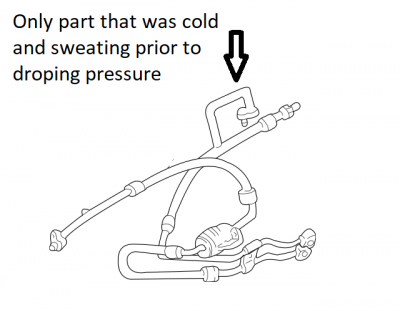
Nothing is sweating. what is aqnd very slight are the bottom of the air plenum (EVAP). Which started draining today.

Only part that is cold now since dropping pressure down.
EVAP.png

AC line.png
 
Last edited:

stamp11127

Full Access Members
Joined
Mar 10, 2012
Posts
6,207
Reaction score
1,246
Location
Temple, Georgia
Lets see how the system reacts by raising the static pressure 5 psi above ambient temp. So if it is 69 degrees out raise the pressure to 74 etc.

Also check the fan clutch. If that isn't moving enough air it will raise pressures.
 
Last edited:

max78

Full Access Members
Joined
Sep 15, 2018
Posts
255
Reaction score
145
Location
AZ
Stupid question. When you put everything back together is there any way you connected the wrong line to the wrong port? Seems like the system is running in reverse. . .
 

stamp11127

Full Access Members
Joined
Mar 10, 2012
Posts
6,207
Reaction score
1,246
Location
Temple, Georgia
That crossed my mind also but the lines were not changed plus the fittings on them make it impossible unless modified.

It is almost as if the orifice tube is absent. Then you would have high pressure liquid flooding the evap instead of low pressure liquid. Any obstruction in the evap would act as an orifice and give limited if any cooling.

The high accumulator temp is throwing everything off.
 
OP
OP
J

juan214

Full Access Members
Joined
Sep 11, 2013
Posts
506
Reaction score
61
Location
Stoughton, MA.
Lets see how the system reacts by raising the static pressure 5 psi above ambient temp. So if it is 69 degrees out raise the pressure to 74 etc.

Also check the fan clutch. If that isn't moving enough air it will raise pressures.

Go to be a100 today, good weather

Raise the static pressure 5 PSI
  • We are introducing R-134a back into the system by 5 PSI what about the oil that came out?
Fan CLuct check:
  • Did the simple test: Truck has not been started today. Spun the fan as hard as I could on the engine. The fan rotated about a quarter turn so resistance is there.
Reassembly:
  • Each conection at replaced parts & o-rings done one at a time and reassemble right then.
  • No lines or condenser changed.
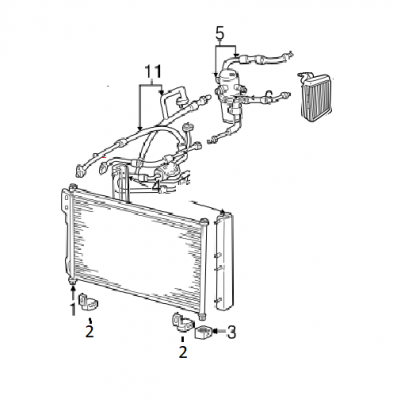
  • Do not believe that at no point in the system that there are four connections in the same area and the lines should different sizes.
AC Line setup.png
 
Last edited:
OP
OP
J

juan214

Full Access Members
Joined
Sep 11, 2013
Posts
506
Reaction score
61
Location
Stoughton, MA.
Don't worry about the oil, you shouldn't have had a large amount come out.

This link is applying refrigeration test procedures to automotive systems. The ir guns aren't accurate for measuring the line temps.

http://ricksfreeautorepairadvice.com/heat-load-test-orifice-tube-system/

About two ounces of oil and dye came out. It was clean pretty clean no sludge, floater, crap or metal. Color is amber as opposed to the clear that went in.

I have to get some welding done late today.
 
Last edited:

stamp11127

Full Access Members
Joined
Mar 10, 2012
Posts
6,207
Reaction score
1,246
Location
Temple, Georgia
Specs call for 14oz of oil on front & rear system and we usually cut that back 25 to 50%. The amount that came out won't hurt.
To be on the safe side if the compressor starts making a racket turn it off quickly.
 
OP
OP
J

juan214

Full Access Members
Joined
Sep 11, 2013
Posts
506
Reaction score
61
Location
Stoughton, MA.
Specs call for 14oz of oil on front & rear system and we usually cut that back 25 to 50%. The amount that came out won't hurt.
To be on the safe side if the compressor starts making a racket turn it off quickly.

My crapsman multimeter has temp setting with wire probe.

Compressor sounds a little bit louder but not making a racket. May be that I still have the inner fender off and never really notice.

Ran out and looked at condenser and it looks fine. No bugs, leaves, pine needles, dirt, mud or degris nothing at all, Tranny and oil coolers also look the same.

Truck is washed at least once a monthand i mean at least once a month on average 2-3 times.

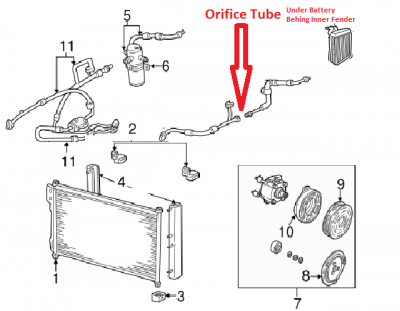
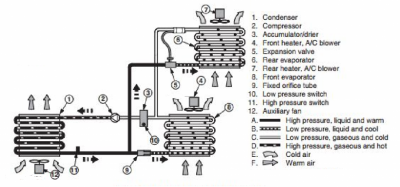
System Diagram:
System Diagram.png
What next?
Add refrigerant?
 
Last edited:

stamp11127

Full Access Members
Joined
Mar 10, 2012
Posts
6,207
Reaction score
1,246
Location
Temple, Georgia
Your meter should give you an idea of the temps but may not be as accurate as the pipe clamp type. Still enough to calculate ballpark superheat & subcooling amounts.

I'm curious about the temps your going to get.
 
Last edited:
OP
OP
J

juan214

Full Access Members
Joined
Sep 11, 2013
Posts
506
Reaction score
61
Location
Stoughton, MA.
Your meter should give you an idea of the temps but may not be as accurate as the pipe clamp type. Still enough to calculate ballpark superheat & subcooling amounts.

I'm curious about the temps your going to get.
Going to warm up the truck haven't ran it today. Let it warm up for ten minutes. Heater lines are blocking the AC lines to EVAP. worse case I will be using one of the vent thermometers.

Took Vent Base line temp reading:
A/C Thermometer - Thrown away
Crapsman Multimeter - Is off don't trust it. (never have used in this setting before)
IR Thermometer - Way out of calibration
Meat Thermometer - Working I assume
AC Thermometer - Working I assume

Temps:
Ambient - 93*
Vent - 78* (both thermometers)
 
Last edited:

stamp11127

Full Access Members
Joined
Mar 10, 2012
Posts
6,207
Reaction score
1,246
Location
Temple, Georgia
Nope, you have to measure the refrigerant temps in and out of the evap and condenser on the line. Air temp doesn't mean anything with this.
 
OP
OP
J

juan214

Full Access Members
Joined
Sep 11, 2013
Posts
506
Reaction score
61
Location
Stoughton, MA.
Nope, you have to measure the refrigerant temps in and out of the evap and condenser on the line. Air temp doesn't mean anything with this.

Took a random base line temp reading on high side line (nothing to do with Heat Load Test):
  • Crapsman Multimeter - 100.6*
  • AC Thermometer - 125*
 
Last edited:
OP
OP
J

juan214

Full Access Members
Joined
Sep 11, 2013
Posts
506
Reaction score
61
Location
Stoughton, MA.
Nope, you have to measure the refrigerant temps in and out of the evap and condenser on the line. Air temp doesn't mean anything with this.

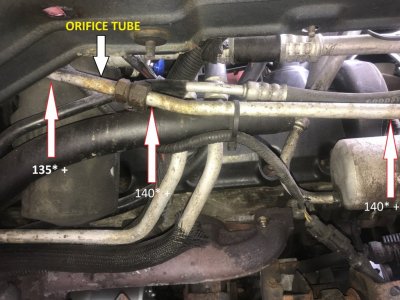
Temps:
  • Vent - 78* (both thermometers)
HEAT LOAD TEST: Taken with thermometer held with long needle nose pliers
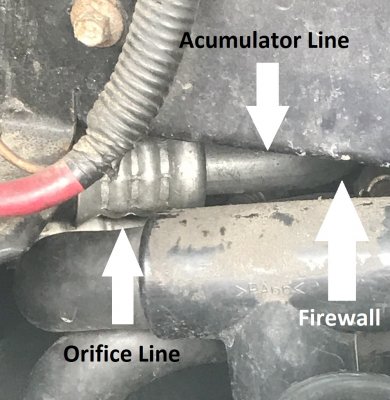
Line Temps at firewal EVAP:
Top: 160* (+/- 2*) Acumulator line to EVAP
Bottom: 160* (-1*) Orifice line to EVAP

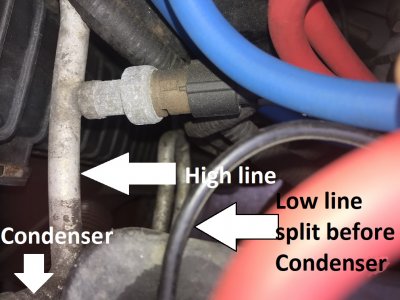
Line Temps at CONDENSER:
Top: 115* (+/- 1*) between condesoor and HP sensor
Bottom: 123* (+/-1*) between condesoor and line split
  • Condensor coils are clean.
  • Shroud is intact and not broken
  • Fan intact no broken blades
  • Fan cluct work (1/4 turn free spin)
  • System no longer overcharged
  • We known air is in the system
  • System is low on charge compressor is running
Possibilities
  • Restriction in condenser coil—sludge
  • Too much oil
  • Mechanical restriction due to pinched tube - Unlikely
OIL SAMPLE
IMG_E3919.JPG

Condensate now dripping at rear now that we are over 90* today.

No refrigerant added yet.
 

stamp11127

Full Access Members
Joined
Mar 10, 2012
Posts
6,207
Reaction score
1,246
Location
Temple, Georgia
The evap superheat test should show no change in temp between inlet and outlet according to the link I posted. Yours does agree but seems high. All the systems I've dealt with so far have had super cold lines to the compressor, even to the point of being uncomfortable.

I'm questioning why it is gaining heat from the condenser to the evaporator though. It may be picking up engine heat since it is still in the gas state.

The condenser should be tested at the line connections on the condenser. Right now those readings are indicating an airflow problem there. Your not getting enough heat removal to change the refrigerant back into a liquid in the condenser. If you can get a shop fan that moves a bunch of air, place it in front of the radiator and measure the temps again and see if they have a wider spread.

Just thinking outside the box now - if the condenser is partially plugged it will not be as efficient as one that isn't and not condense the refrigerant as well or not at all. To see if that is happening you can use your ir temp gun and measure temps across the condenser - left to right and top to bottom. The inlet side should be hotter than the outlet side.
 
Last edited:
OP
OP
J

juan214

Full Access Members
Joined
Sep 11, 2013
Posts
506
Reaction score
61
Location
Stoughton, MA.
The evap superheat test should show no change in temp between inlet and outlet according to the link I posted. Yours does agree but seems high. All the systems I've dealt with so far have had super cold lines to the compressor, even to the point of being uncomfortable.

I'm questioning why it is gaining heat from the condenser to the evaporator though. It may be picking up engine heat since it is still in the gas state.

The condenser should be tested at the line connections on the condenser. Right now those readings are indicating an airflow problem there. Your not getting enough heat removal to change the refrigerant back into a liquid in the condenser. If you can get a shop fan that moves a bunch of air, place it in front of the radiator and measure the temps again and see if they have a wider spread.

Test locations:
Firewall

Fire wall lines.jpg
Condenser:
Lines from condensor.jpg
 
Last edited:
Top