Disclaimer: Links on this page pointing to Amazon, eBay and other sites may include affiliate code. If you click them and make a purchase, we may earn a small commission.
Thanks! I'll be running stock wheels and 275/55/20s until I need new tires but will be looking for either 295/60/20 or 295/65/20 sometime later this yearIt also pushes the front wheels rearward, just the geometry of the suspension. Once you put bigger tires and offset wheels on it, it isn't as noticeable. Every leveling kit on every vehicle with independent suspension does this, BTW.
Ive never seen anything to allow the wheels to move back to center.So I have a question is there a fix for this can you get longer trailing arms
Sent from my SM-G892A using Tapatalk

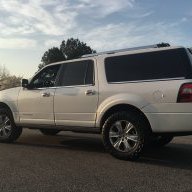
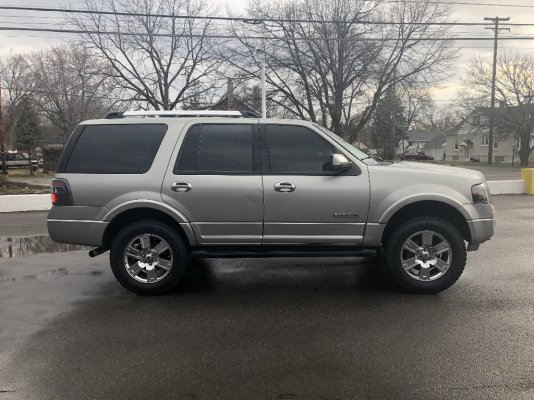
And this is the biggest reason why I don't like the looks of these trucks lifted. This and the fact that I like my wheel well gap to be the same front to rear. Personal opinion, don't flame me.
The way the suspension is designed, the rear wheels move in an arc from a pivot just in front of the wheels. As they move up, they also go forward, and as they compress, they move backward. If you modified the control arms to re-center the wheels in the wheel wells at lifted height, the geometry would be all wrong, therefore causing them to hit the back of the wheel well when the suspension compressed over bumps or when carrying weight.
You’d have to redo the entire suspension and lower the pivot points in order to prevent that from happening.
Yup. There are solutions to everything, but just like the original design, they have compromises. The rear axle has an upper and lower trailing link, and as they swing down (suspension droops), the axle assembly moves forward, and as the swing up (suspension compression) the Axle moves rearward. For this not to happen, and the axle to stay in the same place front to rear would require these links to vary in length throughout the suspension travel, not very practical.
You could compensate for the static position after lift by fitting longer trailing arms, but as AllBoostNoEco mentions, then you run the risk of the tire contacting the rear of the wheel opening or other hard parts on severe compression. Of course, when you use a spacer lift like are most commonly available, your fully compressed position is two inches lower than it was from the factory. Without working numbers its impossible to tell, but I’d venture a guess that you could run longer and/or adjustable length arms to center the wheel at static load, and *probably* not run into interference on compression, since Compression is reduced anyway.
So why don’t longer arms exist? Maybe my ‘back of a napkin’/’in my head’ calculations are wrong, and there become interference issues.. Maybe there is just not deemed enough of a market for it to be profitable? I dunno, you decide..